Sunday, December 19, 2010

Gerd Mink on Commentary MSS

In his article on textual stemmas for the NT - "Problems of a Highly Contaminated Tradition", found in the recent volume, Studies in stemmatology II , By Pieter Th. van Reenen, A. A. den Hollander, Margot van Mulken (2004, p.49) Gerd Mink makes the following concise and accurate statement on "commentary manuscripts", useful for a clear understanding of these special copies:
"Commentary manuscripts contain, apart from the commentaries, the continuous NT text. It is unlikely that these commentary manuscripts served as exemplars for manuscripts containing the continuous text. But it is very plausible that that text form was chosen as the basis for a commentary which was the most highly esteemed at that particular time and place. Accordingly, [that text-type] would also have been used as an exemplar in the scriptoria."

That is, the text chosen for the commentary would be the one popular for regular copies in that scriptorium where the commentary was made, at the time it was made. It would not normally be an "ancient text", but rather an 'approved text'.

This is an important observation regarding the conventions for such commentaries, because the discussion in the commentary itself would often be incongruous with the text presented alongside it. This is because the commentary would often have been composed some 5 or 10 centuries earlier than the commentary manuscript, and the author's text would differ from the one popular many centuries later. The commentaries would not be rewritten to correct this, and in fact it would probably not be noticed, as the two tasks were done separately in sections, even when written by the same scribe.

To take a specific case, 'Codex X' is not an ancient Uncial manuscript, in spite of its conventional letter ('X'). It is actually a late 12th century commentary, with gospel text included. The commentary and text is alternately placed in sections in the manuscript body.

Only parts of text which will be relevant to the commentary will be copied alongside the commentary. Because of this, there is a perfectly obvious explanation as to why this manuscript does not contain the Pericope de Adultera (John 7:53-8:11). The ancient commentary doesn't discuss it, because this passage of John was not read publicly during Pentecost services. The commentary follows the sections of John as they are read in public worship, so the commentary doesn't comment on a passage which is left out of the services.

The scribe who copied the sections from a continuous manuscript into the commentary did not bother to copy Jn. 7:53-8:11, since it was not relevant to the commentary. So even though this commentary manuscript generally gives a faithful copy of the continuous manuscript used to make it, the commentary manuscript itself (Codex X) cannot tell us what the original continuous copy had or did not have in its own text.

It is wrong to call this commentary a "continuous text manuscript". It is not. It is a commentary which contains text from a continuous text manuscript. But it cannot tell us more about that lost exemplar than it has bothered to record. As it is, the passage up to John 7:52 is copied for one section, and the passage beginning at 8:12 is copied a page or two later for the next section of the commentary. We can never know from this what the original continous-text manuscript looked like at the critical junction, 7:52/8:12. It may or may not have contained John 7:53-8:11. If it did, the copyist of Codex X did not record this fact for us, as it was of no concern to him when constructing the commentary with text.

In view of this, it is pointless to cite "Codex X" as if it were a witness for or against the text of the Pericope de Adultera (John 7:53-8:11). It is not a 'continuous-text' manuscript, except in the sense that it contains text from a real 'continuous-text' manuscript. It is not even a NT manuscript at all; it is a commentary, which happens to contain text from all four gospels, but not entirely complete.

Much confusion regarding the 'witness' of Codex X would be eliminated if it were simply dropped from the apparatus, as it has nothing to say about the authenticity or position of the Pericope de Adultera.

peace
Nazaroo


Wednesday, December 15, 2010

Azazel (Lev16): Finally a Plausible Explanation

While you're on Hebrew studies, you may enjoy this as much as I did. It concerns new evidence of a sensible explanation and interpretation of the word "Azazel" in Leviticus 16:6-10:

Its from the July 25 post on Doug's blog, Biblia Hebraica et Graeca:


The Scapegoat Ritual in Leviticus 16

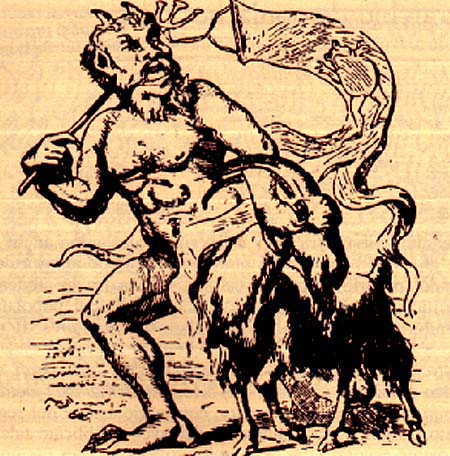
Azazel from Collin de Plancy's Dictionnaire Infernal(Paris,1825).
Leviticus 16 presents the ritual requirements for the Day of Atonement. One of the most enigmatic rituals involves the scapegoat sent off into the wilderness for “Azazel” described in Lev 16:6-10:
6 “Aaron shall offer the bull as a sin offering for himself and shall make atonement for himself and for his house. 7 Then he shall take the two goats and set them before the LORD at the entrance of the tent of meeting. 8 And Aaron shall cast lots over the two goats, one lot for the LORD and the other lot for Azazel. 9 And Aaron shall present the goat on which the lot fell for the LORD and use it as a sin offering, 10 but the goat on which the lot fell for Azazel shall be presented alive before the LORD to make atonement over it, that it may be sent away into the wilderness to Azazel.
There has been much speculation about who or what “Azazel” was: the main interpretations have been a local deity, a wilderness goat-demon, or a desert mountain. Later Jewish literature, notably the Book of Enoch, understood Azazel as a demon, one of the fallen angels and brings him into its complex mythology of supernatural angels and demons.

Rabbinic interpretation understood Azazel to be a cliff off which the goat was driven to its death.
The Rabbis, interpreting "Azazel" as "Azaz" (rugged), and "el" (strong), refer it to the rugged and rough mountain cliff from which the goat was cast down (Yoma 67b; Sifra, Ahare, ii. 2; Targ. Yer. Lev. xiv. 10, and most medieval commentators). Most modern scholars, after having for some time indorsed the old view, have accepted the opinion mysteriously hinted at by Ibn Ezra and expressly stated by Nahmanides to Lev. xvi. 8, that Azazel belongs to the class of "se'irim," goat-like demons, jinn haunting the desert, to which the Israelites were wont to offer sacrifice (Lev. xvii. 7 [A. V. "devils"] (from the Jewish Encyclopedia).
Of course, all of that may be for naught if this Hittite parallel is correct and the term is connected with a type of offering.
“In the Leviticus 16 ritual a crux has always been the term laʿazāʾzēl rendered in the Septuagint and Vulgate by “as a scapegoat” (followed by the English AV), but replaced in more recent English translations by “for Azazel,” sometimes thought to denote a wilderness demon. Appealing to scapegoat rites in the Hurrian language from the Hittite archives, Janowski and Wilhelm would derive the biblical term from a Hurrian offering term, azazḫiya. This is particularly appealing to me. There were two goats used in the Leviticus 16 ritual. One is designated for Yahweh as a “sin offering” (Heb. ḥaṭṭāʾṭ, LXX peri hamartias) (16:9), and the other is “for Azazel,” but is presented alive before Yahweh to make atonement, and is sent away into the wilderness “to/for Azazel.” The contrast is twofold: (1) Yahweh versus Azazel, and (2) sin offering versus Azazel. If one adopts the first, Azazel seems to be a divine being or demon, who must be appeased. But if one adopts the second as primary, the word ʿazāʾzēl represents the goal of the action. In the system of Hurrian offering terms to which Wilhelm’s azazḫiya belongs, the terms represent either a benefit that is sought by the offering (e.g., keldiya “for wellbeing,” cf. Heb. šelāmîm), or the central element offered (e.g., zurgiya “blood”). If Janowski and Wilhelm’s theory is correct, the Hebrew term would not denote a demon as recipient of the goat, but some benefit desired (e.g., removal of the sins and impurities) or the primary method of the offering (e.g. the banishment of the goat).”[1]
Similar rituals are widely attested in the ancient Near East with examples from Ebla and elsewhere. I'm sure much more could be said about the practice and its ancient parallels. Leviticus 16 and the term Azazel provide a fascinating example of how misunderstandings and speculation sometimes spin off into elaborate traditions that fall far from the likely original meaning of the biblical text.

Harry A. Hoffner, Jr., “Hittite-Israelite Cultural Parallels” in Hallo, W. W., & Younger, K. L. (2003). Context of Scripture, vol. 3 (xxxii). Leiden; Boston: Brill.

Tuesday, December 14, 2010

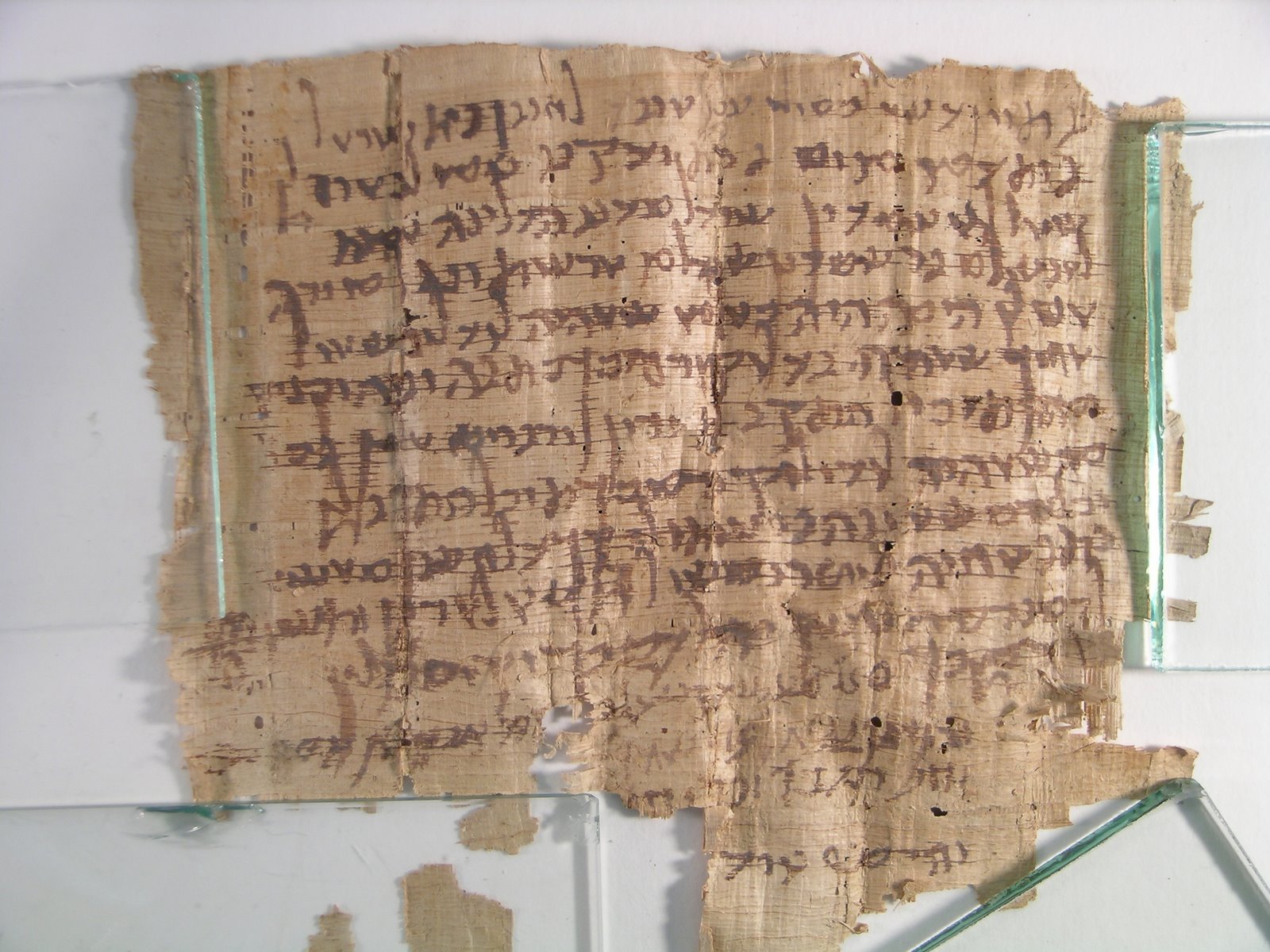
2009 Hebrew Scroll Find:


Possibly dated within four years of Temple's destruction (c. 74 A.D.):

The IAA press release:
Fifteen lines of Hebrew text, written from right to left and one below the other, can be discerned in the document. In the upper line of the text one can clearly read the sentence “Year 4 to the destruction of Israel”. This is likely to be the year 74 CE – in the event the author of the document is referring to the year when the Second Temple was destroyed during the Great Revolt. Another possibility is the year 139 CE – in the event the author is referring to the time when the rural settlement in Judah was devastated at the end of the Bar Kokhba Revolt.

The name of a woman, “Miriam Barat Ya‘aqov”, is also legible in the document followed by a name that is likely to be that of the settlement where she resided: Misalev. This is probably the settlement Salabim. The name Miriam Bat Ya‘aqov is a common name in the Second Temple period. Also mentioned in the document are the names of other people and families, the names of a number of ancient settlements from the Second Temple period and legal wording which deals with the property of a widow and her relinquishment of it."

The Bibliahebraica.blogspot comments:

"Since the find is unprovenanced, the authenticity of the scroll is officially yet to be determined. After viewing the photo, I strongly suspect it will turn out to be genuine. Finds like this of legal or business documents in Hebrew provide important data for exploring the issues of literacy and the use of Hebrew in Palestine in the 1st-2nd centuries CE. Gone are the days of simplistic models of how Hebrew all but died out, supplanted by Aramaic and Greek. Why use a nearly dead classical language to record a legal transaction? It's intended to be read and the terms understood."
peace
Nazaroo

Saturday, December 11, 2010

Emerging Technology for MS Analysis

I reproduce below a recent post on a new technology for detecting the difference between "grassroots" dissemination of information, and "orchestrated campaigns". It should be obvious that if this can be detected on the internet, the same techniques should be able to establish whether for instance the Byzantine text-type is a real "grassroots" type, or an "artificial" (formal) recension.


Truthy: Visualizing the Diffusion of Information on Twitter


"Truthy [indiana.edu] is a recently developed online system to analyze and visualize the diffusion of information on Twitter. It evaluates 1,000s of tweets an hour to identify new bursts of activity around specific topics and memes, to reveal when, where and how they emerged .

For instance, Truthy claims it can distinguish organically emerging grass-roots viral campaigns from those that [are] forged (i.e. 'astroturfing', which denotes political, advertising, or public relations campaigns that are formally planned by an organization, but are disguised as spontaneous, popular 'grassroots' behavior). It therefore uses a combination of text and data mining, social network analysis, and complex networks models, together with a training algorithm based on input from users who are invited to flag dubious injections.

Next to a network diagram that shows the relationships between Twitter members that retweet or mention a specific of meme, the interface also contains a meme activity timeline graph and various numerical statistics and mood-identifying semantic analysis results."

For more information, see also here. See also Tracking the Mood on Twitter.

peace,

Nazaroo


Friday, December 10, 2010

Ben Witherington on TC

Ben Witherington graciously put himself on the record in a video interview with Simon Smart (about 4 months ago) here: Witherington Interview.

Starting on minute 4, Ben begins to give us a sketch of his TC position:
"I agree with professor Metzger, when he says, that 'only about 2 to 5% of the textual variants are of any theological or ethical significance at all;' and, he goes on to say, 'and there are no major doctrines that are in any way compromised by these textual variants', - because, there are other texts where there is no doubt about what was the original text, or a very high degree of certainty about the original text where you find the same theological or ethical idea, - so no."
Dr. Witherington is obviously a Metzgerite, but is he a Hortian? Apparently so. He gives a description of textual criticism, which, however brief, plainly takes the standard Hortian view:
[5:55] "Well there's a whole scientific process of critical sifting that you go through to decide what the original reading is, I mean, we have a whole series of rules that we follow when you do textual criticism;

One of them which would be 'Our earliest witnesses, are likely to be our best witnesses:' the closer to the source, the more likely its going to be accurate.

Another rule would be, 'A multiply attested witness', a witness that we find in an Alexandrian text, and in the B manuscript [Vaticanus], and even in the Western text over here, in other words, geographical spread in where these manuscripts were copied: When we find the same reading in a variety of places, its more likely to be original than a 'one off' reading that came from Syria, okay?

[6:48] Or another good example would be, 'the reading that best explains the other readings' is more likely to be original because what you try to do is, you create a sort of stemma or tree, to get back to the root, and the root is going to be the one from which all these other readings could have come, - these other readings couldn't all be the root, you see, so that's another way of looking at it;

[7:14] And lastly, we have the rule of 'the more difficult reading is likely to be original', I'll give you a good example; In the vast majority of our manuscripts of Mark [Mk. 10:18] at this particular juncture, a young man comes to Jesus and says "Good teacher what must I do to inherit eternal life?" and Jesus just about bites his head off: - in our best text it reads "Why do you call me good? Nobody's good but God alone!" Wow! he he, you know now thats a difficult text, thats a hard reading; is Jesus denying that he's good? Is Jesus denying that he's God? The more difficult reading is likely to be original. Why? Because we know that devout pious Christian scribes were likely to wittle off the hard edges of the text.
[8:00] Some texts read: "Why do you ask me about the 'good'?" - not 'why do you call me good?', - 'why do you ask me the philosophical question about 'the good'?' Well that is definitely an ameliorating reading. Its this like "whew, we're glad Jesus wasn't denying He was good." So the scribe is sort of wiping his brow and saying 'okay I saved Jesus that faux paus.' Well yes, you do have some of that, its true that scribes were very concerned about a clear picture, uh, an orthodox picture of Jesus, and so there is some editing, ameliorating tendencies.

[8:40] That's why, um, to me one of the most exciting things I can tell you about NT studies in the past 150 years, is that we are closer now today to the original text of the Greek NT than at any time in human history since about the 2nd or 3rd century A.D.
[8:56] We now have over 5,000 whole or partial MSS of the GNT, we even have some bits of MSS from the 2nd century papyri, we are getting closer and closer to the original text. And the value textual study, textual criticism, is we are reconstructing the original text and we are becoming more and more certain about what it actually said so more and more of the variant textual readings are falling by the wayside, and uh, you know and probably not in my lifetime, but perhaps in the 21st century, we may well have a condition where we've got 99% of the original text of the Greek NT established with a high degree of certainty. Well that's exciting, you know, we're getting there but its a work in progress. "
Well, Witherington is wise enough to carefully skirt quoting the infamous canon: "prefer the shorter reading". He is well aware that this 'Canon' has been all but abandoned quietly by contemporary textual critics. See for instance Royse, here: Royse on Shorter Readings

But he has no qualms riffling off another four dubious 'canons' of NT Textual criticism, and claiming "scientific" status for the current state of the art.

- It is as if these four 'canons' simply and easily solved the majority of Variation Units, and there was no doubt or challenge to the textual emendations of the last 150 years by Unitarian and Rationalist critics.

But his handling of his four 'Canons' is itself suspect:

(1) Oldest reading: Of course the logic seems undeniable: purity increases as we get "closer to the source". But first, Witherington knows that the age of a manuscript does not coincide with the age of the text it contains, and these are often quite different. Manuscript Age is not a reliable indicator of the text. Second, there is a difference between physical distance in time and copy-generational difference. A manuscript could be 5th or 6th century (as with many Old Latin copies) but might only be a few copies away from their 2nd century source. Third,even the oldest manuscripts may be many generations away from the original text, while later copies might in fact be much closer. Codex Bezae (5th cent.) is an example, where many critics have assessed it to contain a very early (2nd cent. Western) text.

(2) Multiple Attestation: Witherington equates this to geographical spread. But the justification is weak. Copies traveled throughout the Roman Empire via traveling preachers like St. Paul and Luke. In his example, he only uses it to dismiss Syrian readings, even though the Old Syriac reaches into the 2nd century, and its a whole Version with multiple MS and Patristic support, not just a single manuscript. Why not use the same principle and argument to dismiss the peculiar readings of Aleph/B, and embrace the widely supported Traditional (Byzantine) text?

(3) The Reading that explains the others: This is in reality little more than a pipe-dream, part of the wish-list of textual critics. Most Variation Units simply don't cooperate by presenting features that account for variant readings. This would only work for accidental readings anyway, but many edits, as Witherington concedes, are deliberate. His quote of Metzger's "2-5%" is ridiculously unrealistic, and the real percentage is probably more in the 40-50% range for accidental/deliberate.

(4) The more 'difficult' reading: When originally proposed, Bengel, Griesbach etc. intended this to apply to theologically difficult, in the context of later controversies and scribal concerns. It cannot apply to accidental errors, which according to Witherington amount to some 95-97% of variants!!! What a useless rule, that can only deal with 2-5% of variants...

The rosey picture Witherington paints of "readings falling by the wayside" is in fact just a falsification of the true deplorable state of affairs.

In fact, what has been happening, is that publishers of modern critical Greek texts have been dumbing down the apparatus, and omitting hundreds of important variations, while secretly embracing the Westcott/Hort text. Its now a game of 'hide and seek', with textual critics pretending to have established the text, while covering their Hortian tracks. Textual critics have taken a cue from ethically immoral corporations, building layers of disinformation and isolation to push the consumer further and further away from discovery of the true quality of the product and their unethical standards.

His position is clear from his statement about being,
"closer...to the original text...than at any time...since about the 2nd or 3rd century"
-
that is, Dr. Witherington is 90%+ Hortian, and believes the current crop of critical texts, all standing in about 90% agreement with Hort's text (against the Traditional, Byzantine, and/or TR) and based on the Aleph/B and Alexandrian papyri, are closest to the original text.

Wednesday, December 8, 2010

Signal to Noise Ratio: Part II

Someone might object, "Your previous picture is of a loud, clean signal, with little noise. Its not relevant here."

Actually, its very relevant, because it models the textual stream far more accurately than a 'dirty signal'.

In a dirty signal, with plenty of error and noise, you get a picture that looks like the following:


Here you can see that as noise increases, two other things simultaneously happen:

1. The Signal looks more like the noise and vise-versa.

2. No loud, clean, focused and coherent signal is possible.

This idea of 'coherence' is important, for it is what characterizes and describes the transmission process. If the signal is 'coherent', we know that the transmission process is relatively error-free. If the signal is not coherent, we know that the process is error -prone and 'dirty'.

The problem with the Hort-position, is that it postulates a very unreliable transmission medium, and a very 'dirty' transmission. But if that were true, we could not have a 'coherent' signal at the end of it.

The very existance of the tight, coherent Byzantine text-type points to a clean, relatively error-free transmission process. It is the loose Alexandrian cluster of manuscripts and readings that suggests a 'dirty transmission'.

- the Engineer

The Physicist's View: Symmetry Breaking...

Well, Joe gave us the engineer's eye view, and I think I can guess where that is going. His post has spurred me on to write this slightly different take on things.

To me the key issue rests in accounting for the peculiar structure of the textual evidence, the data concerning the textual streams. The process can't be 'normal' in some sense of the word, because we have an essential dichotomy, a bifurcation if you will as per Chaos Theory.

On the one hand you have a well-defined, crisp and relatively non-variant text, which is stable over a period of nearly 800-1000 years (the Byzantine). On the other you have a text that is a little wilder, a significantly less stable, less clearly defined, and having its 'text' appear more as a vague cloud of shared readings among a woolly, loosely grouped cluster of manuscripts (the Alexandrian). They come from different time-periods, and are completely different in nature and quality.

Physicists have to confront such asymmetrical situations so frequently, they have developed a whole group of theories and concepts falling under the category of "Symmetry Breaking".

The idea is simple. Some situations and processes are by nature "stable", robust and predictable, whether steady-state (unchanging), oscillating (cyclic), or progressive (evolving).

A good example of a simple, predictable process might be the slow melting of ice, or a marble rolling around the rim of a shallow bowl toward the center. The process is smooth, and progress can be timed and predicted with reasonable certainty.

A "symmetry Breaking" process is different: Its inherently unstable, and worse, its unpredictable in its particulars. Consider for example, a marble, balanced on the tip of a cone. However long it stays there, we know that at some point in time, a relatively instantaneous change will take place: the balance will fail, and the marble will come rolling down the side of the cone. The problem is, while the geometry of the cone and marble are symmetrical, we have no way of knowing or predicting which way the marble will tip and roll, be it North South, East or West. Some outside force, some jostle, or quake, or bump, will bring the marble tumbling down. But who knows where it will roll.

If the textual transmission were a purely 'normal' process in the sense that Wilbur N. Pickering and friends pose in their book, The Identity of the New Testament Text, (online here), there would be no Alexandrian or other text-types at all; no bifurcation, no abberant manuscripts, no odd clusters of readings or groups of manuscripts.

The text would be copied and evolve randomly and gradually in small steps, through a very long and diffuse process, with errors fairly evenly spread among all the manuscripts. Even local catastrophes (slaughter of a local church, destruction of a scriptorium) would get dissipated by diffusion and mixture, through creeping and cumulative errors.

Pickering himself poses two simultaneous processes acting in parallel, one 'normal' transmission, and one abberant or unusual one. In his model, you have a sedate and stable evolution of the text in the 'normal' stream (Byzantine), with wild, jumpy branching of various isolated local texts accounting for the early diverse witnesses, - an 'abnormal' stream (Alexandrian/Caesarian/Western).

His opponents, supporters of the Alexandrian text-type, would also suggest two separate main streams, only they would pose the Byzantine as the 'abnormal' (corrupt) stream, notwithstanding its uniformity and stability, and the Alexandrian as the 'normal' (purer) stream, in spite of the lack of uniformity of its witnesses.

In either case, some kind of catastrophic "symmetry breaking" event must have taken place to account for the separation and disparity between the two text-types.

Pickering poses a wild, uncontrolled side-process to account for the Alexandrian, while the Hortians propose a 'recension' artificially imposed upon the stream to create the Byzantine.

Both parties seem to agree however, that an 'abnormal', symmetry breaking, bifurcating process has affected at least part of the transmission stream. Each has taken opposite horns of the dilemma, but they both account effectively for the division and difference in nature of the two basic texts, within their own models of textual transmission.

The demonstration of who is right, and who more accurately describes the textual stream is open, without careful deduction. The earliest evidence from the time these processes began is for the most part missing, with only tantalizing but tiny fragments surviving from the early critical period.

peace
Nazaroo