

Showing posts with label Nazaroo. Show all posts
Showing posts with label Nazaroo. Show all posts
Tuesday, January 10, 2012

Monday, January 9, 2012

Sunday, January 8, 2012


Monday, October 31, 2011
Real Christianity is not mere Anti-Judaism

I hold the following to be a self-evident truth:
ANY religion which, for its own fundamental self-identity,
depends upon the villainizing of another prior religion,
is an utterly artificial and false religion.
I give the following three obvious, artificial, and ultimately harmful examples as proof of this statement:
(1) The Recent 'Witchcraft'/Wicca Pagan Revival. (1800-2000 A.D.)
Here, (a) there was another early Persecution by Christians of Pagan religions during the Byzantine Empire (330-1200 A.D.). (b) This was followed by a Crusade against the East, and (c) finally a large-scale Inquisition against heresy and 'witchcraft', including pogroms, and culminating in torture and execution.
This was finally quite clearly seen as a fundamental failure and injustice, brought on by ignorance, superstition, deep-rooted corruption, and abuse of power. As a result, we had a necessary religious Reformation, and the birth of modern democracy and science, with a corrective separation of Church and State.
Unfortunately, as a backlash and reaction to such extreme injustices and moral failure, we also had a resurgence of alternative superstitions. What had been mostly fictional nonsense about 'witches' and 'secret pagan rites', concocted by authorities from absurd 'confessions' in order to secure convictions and confiscate property, was given undeserved credibility and authenticity, and was believed by the gullible to have religious value.
As a result, a "Revival' of Witchcraft and 'Wicca' lore and superstition was born, which however was for the most part entirely unauthentic, and based on fiction and imagination, in part driven by profiteering from the ignorance of the gullible. A whole 'religion' was formed based on a kind of "Anti-Christianity", in which Christianity was villainized and whereby a 'Wicca culture' was created which defined itself more by being 'anti-Christian' than by being authentically Pagan.
(2) The Islamic 'Religion' (620-2000 A.D.)
Again, a 'religion' based largely upon plagarism of Judaism and other Middle-Eastern beliefs and tribal practices, was created in order to secure a power-base for a military-style ideological dictatorship with an entrenched hereditary "theocracy" whose rule was based upon a fixed set of legal practices and judicial guidelines.
The fact that the political motivation for "Islam" comes largely from the persecution and violence against another neighboring religion (Judaism) is a sure sign of a basic artificiality and an unsustainable approach to religion.
If Islam were authentic it would not need a perpetual caricature of an 'evil villain-race' or tribe to battle against, especially when that group is an obvious religious minority and of little significance to most of the world.
(3) European "Christianity" (1200-2000 A.D.)
Again we have a supposed 'religion' defining itself by the imagined or perceived necessity of a 'common enemy', "the Jews", a supposed conspiracy of 'anti-Christs' perpetually at war with the 'Church', the "true Israel" of faith.
All of this posturing is specifically framed in order to appropriate the supposed 'promises' to Israel given by the God of the Bible. The new Church substitutes itself for the "Israel" of old, indiscriminately and ahistorically applying all statements, claims, prophecies, promises, and covenants to itself, regardless of historical truth or circumstances behind the original documents.
Such an artificial version of 'Christianity' perpetuates a caste-system in which groups of ethnic and religious people (i.e., historical descendants and/or converts to another religion, Judaism) are assigned a second-class status based on a Spiritual and moral ranking, under the rubric "the Jews".
This status is maintained in order to define a form of 'Christianity' which can claim a superior religious and Spiritual status over and against its own Spiritual heritage and roots.
Unfortunately, this ideology works out in practical terms as very real and unjust persecution of an ethnic group, with economic and judicial hardships imposed, even to the point of a historical genocidal Holocaust.
In fact however, this artifical version of 'Christianity' is fundamentally flawed on two blatant points, both involving historical fact:
(a) The bulk of O.T. description, prophecy, promise and covenant was historically given to Israelites (i.e., "the Jews"), not the modern 'Church'. This is a simple historical fact, beyond dispute, if the O.T. documents are properly recognized as accurate, authoritative historical documents.
(b) The bulk of modern "Jews" do not at all conform to the simplistic, false caricature projected upon them by this artificial and historically false version of 'Christianity'.
Most modern "Jews" are not religious, and those who practice their religion do not base it upon an active persecution of those styling themselves "Christians". Although Judaism itself is a religion which has changed and evolved, and is now based on practices developed in a post-Christian world, it is still an older religion, and does not define itself in terms of another religion, especially as a religion which is "against Christianity". This is nonsense.
Most modern "Jews" intermarry with other religious and ethnic groups, and although they maintain a strong sense of identity and community, they are not a xenophobic or racist organization. As a result of obvioius historical persecution, the Jewish community does not actively proselytize or seek converts, but neither does it turn them away. Nor do most Jews single out Christianity as an 'enemy', or seek to divert or corrupt Christians and turn them into Jews.
What we see in all three historical examples above, is an artificial and even pathetic attempt by religious groups to make themselves distinct from others, largely at the expense of some minority of a usually already historically marginalized class.
What all three examples also have in common, is not just the targeting of "others" generally, but the active and conscious selection of a specific group to put down and persecute in order to build up themselves.
ANY religion which, for its own fundamental self-identity,
depends upon the villainizing of another prior religion,
is an utterly artificial and false religion.
I give the following three obvious, artificial, and ultimately harmful examples as proof of this statement:
(1) The Recent 'Witchcraft'/Wicca Pagan Revival. (1800-2000 A.D.)
Here, (a) there was another early Persecution by Christians of Pagan religions during the Byzantine Empire (330-1200 A.D.). (b) This was followed by a Crusade against the East, and (c) finally a large-scale Inquisition against heresy and 'witchcraft', including pogroms, and culminating in torture and execution.
This was finally quite clearly seen as a fundamental failure and injustice, brought on by ignorance, superstition, deep-rooted corruption, and abuse of power. As a result, we had a necessary religious Reformation, and the birth of modern democracy and science, with a corrective separation of Church and State.
Unfortunately, as a backlash and reaction to such extreme injustices and moral failure, we also had a resurgence of alternative superstitions. What had been mostly fictional nonsense about 'witches' and 'secret pagan rites', concocted by authorities from absurd 'confessions' in order to secure convictions and confiscate property, was given undeserved credibility and authenticity, and was believed by the gullible to have religious value.
As a result, a "Revival' of Witchcraft and 'Wicca' lore and superstition was born, which however was for the most part entirely unauthentic, and based on fiction and imagination, in part driven by profiteering from the ignorance of the gullible. A whole 'religion' was formed based on a kind of "Anti-Christianity", in which Christianity was villainized and whereby a 'Wicca culture' was created which defined itself more by being 'anti-Christian' than by being authentically Pagan.
(2) The Islamic 'Religion' (620-2000 A.D.)
Again, a 'religion' based largely upon plagarism of Judaism and other Middle-Eastern beliefs and tribal practices, was created in order to secure a power-base for a military-style ideological dictatorship with an entrenched hereditary "theocracy" whose rule was based upon a fixed set of legal practices and judicial guidelines.
The fact that the political motivation for "Islam" comes largely from the persecution and violence against another neighboring religion (Judaism) is a sure sign of a basic artificiality and an unsustainable approach to religion.
If Islam were authentic it would not need a perpetual caricature of an 'evil villain-race' or tribe to battle against, especially when that group is an obvious religious minority and of little significance to most of the world.
(3) European "Christianity" (1200-2000 A.D.)
Again we have a supposed 'religion' defining itself by the imagined or perceived necessity of a 'common enemy', "the Jews", a supposed conspiracy of 'anti-Christs' perpetually at war with the 'Church', the "true Israel" of faith.
All of this posturing is specifically framed in order to appropriate the supposed 'promises' to Israel given by the God of the Bible. The new Church substitutes itself for the "Israel" of old, indiscriminately and ahistorically applying all statements, claims, prophecies, promises, and covenants to itself, regardless of historical truth or circumstances behind the original documents.
Such an artificial version of 'Christianity' perpetuates a caste-system in which groups of ethnic and religious people (i.e., historical descendants and/or converts to another religion, Judaism) are assigned a second-class status based on a Spiritual and moral ranking, under the rubric "the Jews".
This status is maintained in order to define a form of 'Christianity' which can claim a superior religious and Spiritual status over and against its own Spiritual heritage and roots.
Unfortunately, this ideology works out in practical terms as very real and unjust persecution of an ethnic group, with economic and judicial hardships imposed, even to the point of a historical genocidal Holocaust.
In fact however, this artifical version of 'Christianity' is fundamentally flawed on two blatant points, both involving historical fact:
(a) The bulk of O.T. description, prophecy, promise and covenant was historically given to Israelites (i.e., "the Jews"), not the modern 'Church'. This is a simple historical fact, beyond dispute, if the O.T. documents are properly recognized as accurate, authoritative historical documents.
(b) The bulk of modern "Jews" do not at all conform to the simplistic, false caricature projected upon them by this artificial and historically false version of 'Christianity'.
Most modern "Jews" are not religious, and those who practice their religion do not base it upon an active persecution of those styling themselves "Christians". Although Judaism itself is a religion which has changed and evolved, and is now based on practices developed in a post-Christian world, it is still an older religion, and does not define itself in terms of another religion, especially as a religion which is "against Christianity". This is nonsense.
Most modern "Jews" intermarry with other religious and ethnic groups, and although they maintain a strong sense of identity and community, they are not a xenophobic or racist organization. As a result of obvioius historical persecution, the Jewish community does not actively proselytize or seek converts, but neither does it turn them away. Nor do most Jews single out Christianity as an 'enemy', or seek to divert or corrupt Christians and turn them into Jews.
What we see in all three historical examples above, is an artificial and even pathetic attempt by religious groups to make themselves distinct from others, largely at the expense of some minority of a usually already historically marginalized class.
What all three examples also have in common, is not just the targeting of "others" generally, but the active and conscious selection of a specific group to put down and persecute in order to build up themselves.
Friday, October 28, 2011
How young girls are lured into prostitution (3)

How Old are Prostitution Rings that infiltrate the Christian Churches,
and disguise themselves as "Christian" groups?
Incredibly, this technique was used by a powerful group in the early 300's!
I quote here from the introduction to The Text of the Apostolos in Epiphanius of Salamis. (c.330 A.D.) , by Carroll D. Osburn, p. 3 (SBL, 2004):
"During these years in Egypt, Epiphanius' Nicene orientation was challenged by ideas that he viewed later as "poisonous snakes". One important threat came from a sexually oriented group that he later termed "Gnostics" [13]. In his response to this threat, Epiphanius demonstrated the zeal for unmasking error that became characteristic of his later life [14].
______________________________
13. See Pourkier, L'heresiologie chez Epiphane de Salamine, 30-32; and Bentley Layton, "The Riddle of th Thunder", in Nag Hammadi, Gnosticism, and Early Christianity (ed. C. Hedrick and R. Hodgson; Peabody, Mass.: Hendricson, 1986), 52.
14. Epihanius, Panarion Haereses 26.17.4-9.
(- Osburn, The Text...p. 3 fwd)
and disguise themselves as "Christian" groups?
Incredibly, this technique was used by a powerful group in the early 300's!
I quote here from the introduction to The Text of the Apostolos in Epiphanius of Salamis. (c.330 A.D.) , by Carroll D. Osburn, p. 3 (SBL, 2004):
"During these years in Egypt, Epiphanius' Nicene orientation was challenged by ideas that he viewed later as "poisonous snakes". One important threat came from a sexually oriented group that he later termed "Gnostics" [13]. In his response to this threat, Epiphanius demonstrated the zeal for unmasking error that became characteristic of his later life [14].
'With impudent boldness moreover, they tried to seduce me themselves...I was pitied and rescued by my groaning to God.... Now the women who taught this trivial myth were very lovely to look at, but in their wicked minds they had all the devil's ugliness. ... I lost no time reporting them to the bishops there, and finding out which ones were hidden in the Church. They were expelled from the city, about 80 of them.'Athanasius returned to Egypt after the Council of Nicea and had a good reception in pro-Nicene monastic circles that were loyal to himself and Alexander, his anti-Arian predecessor. In this pro-Nicene monastic environment, Epiphanius' anti-Arian views were strengthened."
______________________________
13. See Pourkier, L'heresiologie chez Epiphane de Salamine, 30-32; and Bentley Layton, "The Riddle of th Thunder", in Nag Hammadi, Gnosticism, and Early Christianity (ed. C. Hedrick and R. Hodgson; Peabody, Mass.: Hendricson, 1986), 52.
14. Epihanius, Panarion Haereses 26.17.4-9.
(- Osburn, The Text...p. 3 fwd)
Saturday, October 22, 2011
How young girls are lured into prostitution (2)
In this second post, I'm examining the mechanics of how cult leaders and brainwashing experts program and control their naive victims.
 In particular, I'd like to focus on the technique the predator has used in the first (previous) Example. Just look at some of the power-techniques: There are so many, and together they are almost overwhelming to a young mind. Every objection and question has already been answered and removed: (1) The use of flattery, through identification of the whoring acts with Jesus, 'Godly action' and therefore the whole enterprise being justified: "you're like the Lord..." (p. 2) "If they fall in love with you first before they find out its the Lord...", the girl is "irresistable", (p. 3) Well, its not "the Lord", but rather a naive teen being used to lure suckers into a prostitution/exploitation ring. She is only 'irresistable' to a fool who can't keep his sexual organ in his pants. (2) Substitution of Meaning: "in love with you" (p. 3) (as opposed to what is really going on, i.e., sexual stimulation, infatuation, lust, and enticement to sex.) (3) Use of 'religious' language ("thy", "thee", "thou", vocative address to "God") (p.3 etc.) "these three become one" (p. 5) to give bogus authority and religiosity to the lies. (4) Encouragement of magical thinking and fantasizing to help remove natural fear of wrongdoing and to help rationalize away sin: "In the early morning hours came the following prophecy: ..." (p. 2) What is described is however, not prophecy at all, but fantasizing. The kind of 'hearing voices' etc. that Pentecostals regularly engage in, which again grants false legitimacy to the speech. (5) Affirmation of 'Empowerment' fantasy, in which it is pretended that the exploited teen girl is really "in control" and has secret knowledge of the situation, making her believe she is superior to the other exploited victim. "but they don't know it!" (p.2) (6) Suggestion of alternate interpretations of emotional experience. Romanticizing, portraying the girl as a 'hero'... "unashamed", "brazen" (p. 4) (7) Inclusive language, suggesting participation in 'will of God' etc. "we don't want to lose - not one, Lord!" Obvious attempted grouping with God and His will. (8) Appeal to Ego, and self-image, esteem-building speech: "you've got something they've been searching for all their lives" (p 2) "each of them seek after her, dream of her, drink of her!" (p 4) (9) Description of act as heroic, charitable, self-less, honorable: "unselfish love" (p.2) , "thy love and mercy" (p. 3) "through thy death to thyself" (p.4) (10) Description of misgivings as a sin: "You must not let self and pride enter in" (p 2) (11) Encouragement to abandon misgivings or inhibitions, and especially to ignore good advice from the men being lured: "so interested in them that you don't care what they think about you." (p. 2) she is "to use anything she has..." (p.4) "yield thyself!" (p. 6) (12) Comparison to and Equated with Apostles - "I will make you fishers of men" (p. 8). (13) Promise of Divine Protection: "but he cannot consume thee" (p. 5) "they shall not hurt thee", "I shall save thy soul from destruction" (p.6) "Thou shalt escape, I promise thee!" (p. 7) (14) Demand for Complete Devotion: "Would you do anything for Jesus?" (p. 8) (15) Claim of Complete Power: "Only I, the fisherman can remove the hook", "Neither shall he remove it forever!" (p. 5) "I shall catch them all!" (p.7) (16) Equating trickery and prostitution with the Cross of Christ: "to suffer the crucifixion of the hook" (17) Making trickery and whoring a universally acceptable action: "May God help us all to be flirty little fishes for Jesus", "be sure you use the right bait for the right fish!" (p. 8) (18) Assigning God's Authority to Leader: "David is My Master Fisherman" (p. 7) "David your father" (p. 2) (19) Speaking in the Name of God: "the words that I have given to David your father", (p. 2) "I shall open his jaws" (p. 5) (20) Switching in and out of God's voice and the Leader's voice: "not one, Lord!", (p.3) "anything she has, O God..." "My kiss of life" (p.4) "My love" "the hook of My Spirit" (p. 5) (21) Switching grammatical 'person' of leader's voice: "David will never leave thee" [David speaking!] (p. 7) This adds to the blurring and confusion of God with Leader. (22) Application of 'guilt' to possible shortcomings: "Are you skillfully, patiently fishing for men?" (p.8) (23) Repeated request to carry out task: "are you willing?" (p. 8 etc. repeatedly) (24) Granting Superpowers to Requested Action: "a lost soul that we don't want to lose" (p. 3) "to catch men for God", "to kiss many with My kiss of Life", "Thou shalt bring life to many" (p.4) "he is safely within My net" (p.5) "catch many for My kingdom" (p. 6) (25) Divine Promises: "I shall give thee light" (p. 6) (26) Heartbreak as a Consequence Disallowed: "Why shedest thou these tears before Me?" (p.7) (27) Absurd Promises: "The bait and the fish become one flesh, both on the hook of My Spirit" (p. 5) Here the whoring is given Divine sanction, marriage status, and an eternal value by the leader encouraging the whoring. Its surprising just how many different techniques and angles have been worked into this short but powerfully contrived brainwashing pamphlet. One of the main reasons that so many pastors are uncomfortable with a careful examination of the methods of cults, is that many Christian churches, organizations, and groups also use the same fraudulent methods. |
Thursday, October 20, 2011
How young girls are lured into prostitution
Young people today are brainwashed and exploited to such a degree that their programmed core values are so distant from those of their own parents as to make them complete strangers. It is a dangerous development has created a toxic environment for both children and parents.
One of the ways this is achieved is through a constant substitution of meaning for common words. It results in statements and sentences that sound the same, but have entirely different meanings between generations.
A powerful case of word-meaning substitution is the word "love". From the early Reformation until the 1930's, the word "love" had a predominantly Christian meaning, elevating it spiritually, and encompassing in it Christian concepts of charity, generosity, compassion, and self-sacrifice.
These built-in ideals contributed to everyone's world-view in powerful ways that influenced how people connected to community, how they held themselves responsible for the poor, the misfortunate, the sick and elderly, and how they understood their roles in marriage and parenting. The Christian ethos and values permeated society so deeply that children easily assimilated commitment to honoring parents, and even basic manners.
Now such ideas are all but eroded, and even unknown to those growing up in a culture saturated by sex and consumption, selfishness and greed, glamour and fashion. "love" is virtually equated to sexual gratification. and Christian "love" appears to young people as a strange and irrelevant philosophy.
The methods of those who exploit children and profit from them have become so powerful and sophisticated, that parents are virtually unarmed and helpless to protect their children from the onslaught.
In such an emergency-situation, it is important to examine how the methods were developed, by studying simpler and earlier cases.
One such case is the "children of God" cult in the USA. In this cult, which posed falsely as a "Christian" group, young girls were lured away from parents, taught to exploit their own sexuality to bring in more cult-members (males) who would be in turn exploited in other ways, such as being tricked or blackmailed out of money.
Why were young girls so easy to exploit? How did this group use Christian symbols and words, and subtly alter their meanings to overwhelm those young minds?
A careful examination of the type of teaching and propaganda that the "Children of God" used, and how it has been improved and polished by later groups is very instructive, both as to how they did it and how it can be combated.
The following images and text have been taken from a Swiss group which further exploited the original work of the "Children of God" cult.


One of the ways this is achieved is through a constant substitution of meaning for common words. It results in statements and sentences that sound the same, but have entirely different meanings between generations.
A powerful case of word-meaning substitution is the word "love". From the early Reformation until the 1930's, the word "love" had a predominantly Christian meaning, elevating it spiritually, and encompassing in it Christian concepts of charity, generosity, compassion, and self-sacrifice.
These built-in ideals contributed to everyone's world-view in powerful ways that influenced how people connected to community, how they held themselves responsible for the poor, the misfortunate, the sick and elderly, and how they understood their roles in marriage and parenting. The Christian ethos and values permeated society so deeply that children easily assimilated commitment to honoring parents, and even basic manners.
Now such ideas are all but eroded, and even unknown to those growing up in a culture saturated by sex and consumption, selfishness and greed, glamour and fashion. "love" is virtually equated to sexual gratification. and Christian "love" appears to young people as a strange and irrelevant philosophy.
The methods of those who exploit children and profit from them have become so powerful and sophisticated, that parents are virtually unarmed and helpless to protect their children from the onslaught.
In such an emergency-situation, it is important to examine how the methods were developed, by studying simpler and earlier cases.
One such case is the "children of God" cult in the USA. In this cult, which posed falsely as a "Christian" group, young girls were lured away from parents, taught to exploit their own sexuality to bring in more cult-members (males) who would be in turn exploited in other ways, such as being tricked or blackmailed out of money.
Why were young girls so easy to exploit? How did this group use Christian symbols and words, and subtly alter their meanings to overwhelm those young minds?
A careful examination of the type of teaching and propaganda that the "Children of God" used, and how it has been improved and polished by later groups is very instructive, both as to how they did it and how it can be combated.
The following images and text have been taken from a Swiss group which further exploited the original work of the "Children of God" cult.


Thursday, October 6, 2011
Hard look at Acts (5) Chronology of Paul

While conservative Christian scholars have relied heavily on the book of Acts in the reconstruction of Paul's journeys, other academics have rejected the historicity/reliability of Acts, and preferred to rely upon Paul's letters alone. The problem with the second approach is that there is very little in Paul's letters to establish dates with, or even to put them in order.
A Chronology based on Acts
A basic modern approach using Acts is given by Gerd Luedemann in "A Chronology of Paul", Colloquy on NT Studies, Ed. Bruce Corley, SBTS (Mercer U., 1983) p. 289 fwd.
'The Conventional View:
'The conventional view...may be broadly described as ...ingenious combination of ...Acts with info in [Paul's] letters. ...One proceeds on the basis of the sole absolute datum ...the Gallio inscription. Since Gallio held office in A.D. 51-52, Acts 18:12 is taken as a sure indication that Paul stood trial before Gallio in this year. Further confirmation is then derived from 18:2, which mentions the arrival of Priscilla and Aquilla from Rome after the expulsion of the Jews (the year is assumed, on the basis of Orosius, to be A.D. 49). Since these two dates confirm one another, it is held that Luke's report of Paul's 1st Cor. Mission in Acts 18 is historically accurate. With the date of the mission on European soil relatively set, other dates are reckoned both before and after this period.After the stay in Corinth Paul traveled to Ephesus, then on to Palestine, and then back to Ephesus (Acts 18:18ff.). There Paul wrote the Corinthian letters and later traveled back to Jerusalem (by way of Macedonia) to deliver the [money] collection. In Jerusalem, Paul was arrested and was eventually taken to rome to meet his death as a martyr.Before the stay in Corinth, Paul had worked as a missionary in Philippi, Thessalonica, and Athens (and agreement of 1st Thess. with Acts 17ff.). Prior to this mission, Paul had traveled as a delegate of the Antioch congregation, to Jerusalem for the conference (Acts 15:2ff.). One determines this date of the conference, 14 - 17 years after Paul's conversion, on the basis of Gal 1ff. Confirmation of this view is then found in the reference to the ensuing conflict between Paul and Barnabas in both Acts and Gal. 2:13.For 11 - 14 years prior to the Jerusalem conference, Paul had worked, as a missionary of the Antioch congregation, in Syria and Cilicia (a combin. of Gal 1:21 and Acts 13ff.).
I wish to emphasize at this point that if this veiw were correct, then all of Paul's letters would have been composed within about 5 years of one another. They would all have been written by a man who had already been a Christian for about 19 years and who was a veteran missionary. Accordingly, one should expect the letters to be quite homogeneous; little room would be left for any theory regarding a development in Paul's thought reflected in the letters. The historian's exposition could rather proceed from the old theological principle, "scriptura ipsius interpres". (i.e., "Scripture is [self]-explanatory")Luedemann goes on in his article to develop a "non-conventional view" (i.e., a chronology that rejects the historicity and usefulness of Acts. But that does not concern us here. We remain grateful for Luedemann's concise description of the 'conventional view'.
Nazaroo
Saturday, September 17, 2011
The Juggling of Certainty vs. Science
 |
| Click to Enlarge |
The conflict is this:
Fundamentally, the Scientific Method is tentative and agnostic. In order to remain truly scientific, it must deal in probabilities, and ever hold the door open to new discoveries which can not only modify current ideas, but completely overthrow them. Diagrammed as above, one can see that it forms an Endless Loop, without ever establishing any permanent, universal truth.
Those engaged in Textual Criticism on the other hand, while desperately desiring to garner the support and also credibility of scientific method, nonetheless cling to ideas which at base are in fundamental opposition to science. First, is the idea of a fundamental Objective Reality, a non-changing universal truth applicable to every situation, and second is the idea that science 'progresses' inevitably toward greater and greater accuracy and surety in regard to believed facts.
Neither of these ideas is really a part of Scientific Method, or a necessary ingredient of Scientific philosophy, even though both ideas have been around as long as science, and have been more often than not inextricably bound up with scientific investigation.
The growth of science in the 19th century, also saw advancing alongside it the field of mathematics. In this field, especially the concepts of Convergence, developing from Calculus, led men to believe that almost any problem could be solved by honing and improving the appropriate method of approximation, which would naturally and result in more and more accurate statements about the world.
The New Testament Text was regarded no differently: It was believed to be only a matter of time before textual-critical methods would tighten up and produce a more and more accurate 'original text', finally as sharp and accurate as a photograph, or a scientific measurement of light-speed to 8 decimal places.
Eureka! - Hort's Innovation
Surprisingly, F.J.A. Hort was instrumental in forwarding this ideology. Contrary to current historians and various opponents, Hort's real innovation in Textual Criticism was not "the genealogical method", or the advancement in the evaluation of various sources. It was the innovation of what is now called in modern mathematics and computing as "iteration".
Iteration is the application of a set of instructions, a 'program' or algorithm,
repeatedly, usually to refine or home in on a result. Imagine for instance, a lathe that shapes table-legs. It shapes the wood by repeated cutting away of waste, leaving the desired pattern behind.
An Algorithm is usually fixed, but sometimes having optional paths or choices built in. The flexibility comes through a testing, measurement or decision process (as in the flowchart above, where the 'diamond' shapes mark points in the flow where choices will be made).
Some objects in mathematics are better and more efficiently expressed as algorithms - a group of ordered steps or instructions, meant to be applied like a recipe or prescription, and often actually acting as a description of a process or phenomenon. Other objects can ONLY be described by algorithms. Unfortunately, some objects cannot be expressed by algorithms at all.
When mathematicians began to notice algorithms, they discovered other sometimes disturbing properties of said 'objects', such as the fact that some mathematical objects and ideas have no algorithm at all. (the calculation of PI or the search for Prime Numbers are examples of things that must be calculated by 'brute force' and crude testing rather than elegant formulas).
When mathematicians noticed that some problems and ideas cannot be expressed by algorithms, it became clear that some problems were by their very nature "unsolvable".
On a simpler level, it was clear that some 'formulas' simply did not and could not 'converge'; that is could not settle down and spit out one single numerical answer. Likewise, algorithms simply did not always produce a useful or reliable result, nor could they even come to an end. They were like run-away processes, and if left to themselves would get stuck in endless loops, or randomly wander the universe of numbers.
Hort's assumption was that by using the novel idea of "iteration", meaning the repeated application of textual-critical principles and techniques, to further and further refine the content and certainty of the text, one could arrive as close as possible to the original text as the extant data and the scientific process allowed.
Unfortunately, Hort was wrong on this entire idea:
(1) There was nothing in the realm of science that indicated that discovering the 'original text' was even possible let alone probable.
(2) There was nothing that suggested that text-critical methods could or should converge toward any fixed text, let alone the true original text.
(3) Iteration itself had no magical power to force the textual variants to converge into a 'near certain' text, in spite of its allure and mathematical usefulness in certain situations. If the applied method was flawed, or ill-defined, the opposite result was inevitable.
(4) The success of iterative methods in other areas of science had no bearing on iteration as an intelligent or useful technique in textual criticism. In order for iteratiion to work, the techniques to be iterated must first be sound.
Later, when men of religion attempted to apply mathematical and scientific concepts and techniques to the problem, they were inevitably biased and their work tainted by their own conviction that these methods would converge to an absolutely certain 'original text', and that this was the way God intended us to acquire this certainly established, authoritative, original text.
Nobody thought to inquire and investigate thoroughly what methods that God Himself chose to preserve and deliver the text, and what this meant for the credibility of textual criticism of the NT as a historical science.
As it turned out, God did not use the historical-critical techniques of NT Textual Criticism to preserve and supply the NT text. God chose simpler, and quite apparently, more reliable methods than those proposed and used by modern Textual Critics to 'reconstruct' the NT text.
These facts strongly suggest that those who wish to establish, secure, or restore the NT text ought to imitate the methods used historically by God Himself for the last 2000 years.
Nazaroo
Monday, September 12, 2011
Lachmann (3) - The "Illiad Theory" and Acts

F.N. Peloubet, in The Teacher's commentary on the Acts (1903, Oxford) deals with Lachmann's multiple author theory in passing, in the context of the composition of Acts.
Peloubet (Introduction, xxxv fwd) states:
"VI. THE SOURCES OF ACTS. As Luke expressly says in the preface to his Gospel that he derived his information from the records of eye-witnesses, with which he was perfectly familiar, the same is doubtless true of his treatise on the Acts of the Apostles. ...
...there is no reason for thinking, a priori, that the speeches cannot be historical. . . . The speeches of the leading apostles would impress themselves on the growing community, and would be remembered as the words of the Lord were remembered.
...
There are some interesting comparisons of the discussion of the composite nature of the Acts with other literature in A. H. Strong's The Great Poets and their Theology."The German Lachmann resolved the Iliad into sixteen distinct and clearly defined layers. Paley has compared the Iliad and the Odyssey to pictures of stained glass made up by an artistic combination of handsome bits of older windows which fortune and time had shivered."The combatants [textual critics] are more and more arraying themselves on the side of the traditional view that both poems are by the same author, and that this author is Homer. But Homer himself may have taken many years for the elaboration of his poems, revising and improving them as he repeated them again and again, so that during those years versions of various degrees of perfection may have been set in circulation.
Goethe in one of his letters to Schiller cites different versions of his own poems, in connection with the theory we have been considering. He had at various times amended and enlarged them; but he did not on that account prove that there was a second Goethe, or many Goethes. "What all this tells us is that subsequent critics and investigators cioming after Lachmann have found that all such naive theories of 'many detectable layers' and 'multiple authors' are at best precarious conjectures and near-worthless. Even, and perhaps especially, reconstructed 'genealogies', based on the alleged identification of various 'interpolations' and layers are simply academic fantasies, their proliferation and variations providing the best evidence of their spuriousness.
Nazaroo
Lachmann - exaggerater of the "Genealogical Method"
(1973-1851) German philologist.
Educational Background and Training
Lachmann studied at Leipzig and Gottingen, mainly philological studies.
1816 - assistant master in the Friedrichswerder gymnasium (Berlin)
- privatdozent at the University (of Berlin?)
- principal master in Friedrichs-Gymnasium of Konigsberg
1818 - assisted Germanist Friedrich Karl Kopke
- professor extraordinarius of classical philosophy (U. of Konigsberg)
1818 - 1825 - devoted to studying Old German Grammar & Middle High German poetry
1825 - leave of absence to search libraries for German materials
- nom. Extraordinary Professor of German philology (Humboldt U., Berlin)
1827 - professor (Humbolt U., Berlin)
1830 - member of academy of sciences
Up until about 1827, Lachmann had hardly spent any time on New Testament studies or NT Greek, but had devoted all his effort toward German languages and literature, although he also translated the first volume of PE Müller's Sagabibliothek des skandinavischen Altertums (1816). A look at his publications shows his interest and focus of study:
Published Works and Area of Study
Early Work before engaging in Greek NT:
Lachmann edited Propertius (1816); Catullus (1829); Tibullus (1829);
He also translated Shakespeare's sonnets (1820) and Macbeth (1829).
Work published while working on Greek NT:
Genesius (1834); Terentianus Maurus (1836); Homer's Illiad (1837-41)
Babrius (1845); Avianus (1845); Gaius (1841-1842); the Agrimensores Romani (1848-1852); Lucretius (1850).
Lachmann also apparently edited Lucilius (re--edited after his death by Vahlen, 1876).
Although this is a substantial body of work, very little of it bears upon the task of NT Textual Criticism. Lachmann's own textual-critical skills were all based on classical works, which pose a much different and far simpler problem: Most classical works were not the target of religious or political attack, and the NT was written and copied under unique and exceptional circumstances.
Lachmann's Greek New Testament
Between 1831 and 1850 Lachmann now turned to the Greek NT.
The plan of Lachmann's edition, which he explained in his Studia Krit. of 1830, is a modification of the unaccomplished project of Richard Bentley. Lachmann was the first major editor to break from the Textus Receptus, seeking to restore the most ancient reading current in manuscripts of the Alexandrian text-type, using the agreement of the Western authorities (Old Latin and Greek Western Uncials) as the main proof of antiquity of a reading where the oldest Alexandrian authorities differ.
1831 - published his smaller edition of the New Testament
1842 - the larger second edition, in two volumes (1842-1850).
1846 - the 3rd edition
Lachmann's 'Crowning Achievement'
Lachmann then immediately went back to other classical interests. According to Wikipedia,
"Lachmann's edition of Lucretius (1850), was the principal occupation of his life from 1845, and perhaps his greatest achievement of scholarship.
He demonstrated how the three main manuscripts all derived from one archetype, containing 302 pages of 26 lines to a page. Further, he was able to show that this archetype was a copy of a manuscript written in a minuscule hand, which in itself was a copy of a manuscript of the 4th or 5th centuries written in rustic capitals. To say his recreation of the text was accepted is anticlimactic..."
"in it he sought to show that the Illiad consists of eighteen independent layers, variously enlarged and interpolated, had considerable influence on 19th century Homeric scholarship, although his views are no longer accepted."
Tuesday, September 6, 2011
Later dates for MSS: Codex W = 700 CE, P52 = II-III cent
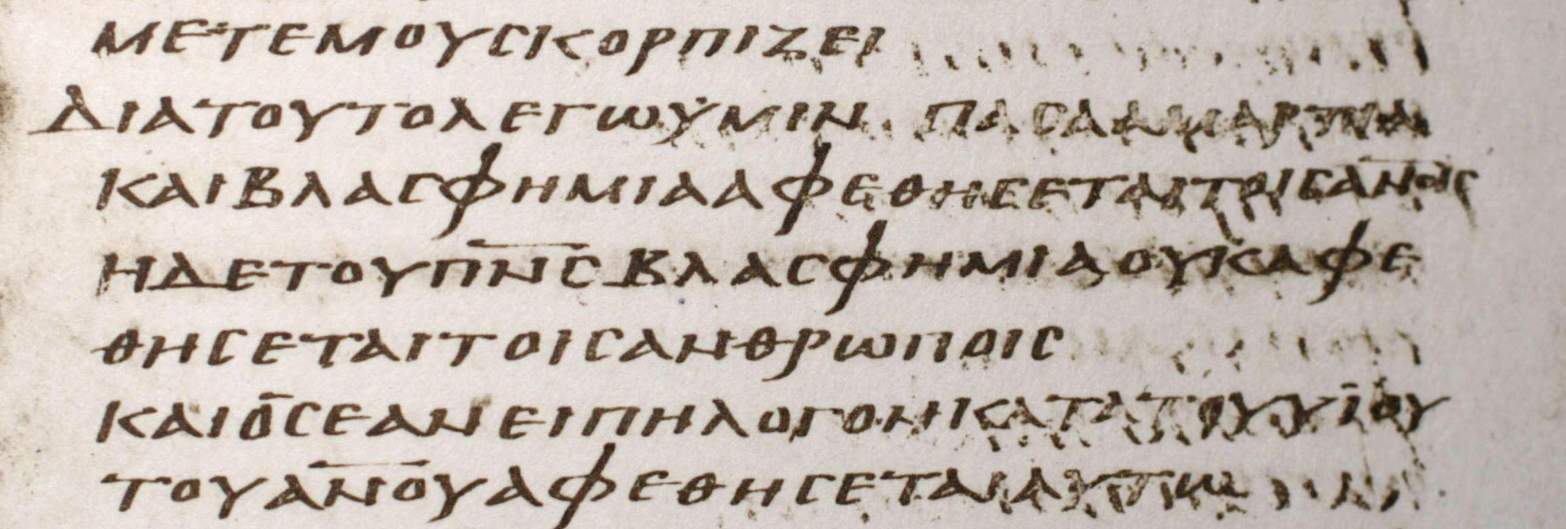
H. Houghton has reported in "Recent Developments in NT TC (2011, Early Christianity 2.2, p. 245-268:
"...There have also been developments in the dating of certain manuscripts. The Freer Gospels (032, W), famous for their unique text in the Longer Ending of Mark, were initially assigned to the fourth or fifth century. However, following the redating of the manuscripts used for the original comparison and the subsequent discovery of similar material, including the Cologne Mani Codex, Schmid has suggested that it may have been copied at least a century later. [29] Parker and Birdsall's consideration of the palaeography and catena of Codex Zacynthius (040, Ξ) prompt them to propose a date of around 700 for the majuscule underwriting, rather than Hatch's suggestion of the sixth century. [30] The date of the earliest surviving fragment of the New Testament, P52, has also been the subject of a recent review by Nongbri. [31] This cautions against the uncritical adoption of the earliest suggested date of 125 CE and demonstrates that a date in the late second or early third centuries remains palaeographically possible. As more and more comparative material becomes available online, it will not be surprising if the dating of other manuscripts is reassessed. ...
29. Ulrich Schmid, "Reassessing the Palaeography and Codicology of the Freer Gospel Manuscript," in The Freer Biblical Manuscripts: Fresh Studies of an American Treasure Trove ed. Larry W. Hurtado (SBLTCS 6. Atlanta GA: SBL, 2006), 227–49.
30. D.C. Parker and J. Neville Birdsall, "The Date of Codex Zacynthius (Ξ): A New Proposal," JTS 55.1 (2004): 117–31 (reprinted in Parker, Manuscripts, Texts, Theology, 113–20).
31. Brent Nongbri, "The Use and Abuse of P52: Papyrological Pitfalls in the Dating of the Fourth Gospel," HTR 98.1 (2005): 23–48.
It seems what has long been suspected by outsiders is turning out to have some substance and basis, namely that manuscripts generally have been dated too early, and more revisions are in the works, either by their over-enthusiastic discoverers, or else apologists.
Nazaroo
Sunday, September 4, 2011
The 'Schools' of Alexandria and Antioch (4th-5th c. A.D.)
Here is a short discussion of the so-called 'schools' of Antioch and Alexandria, culled from the Orthodox site Monachos

"...
With regard to the Christological discussions of our period (the later fourth and early fifth centuries), reference made in modern scholarship to the 'Alexandrian' and 'Antiochene' schools attempts to homogenise under two relatively coherent umbrellas two general approaches to Christological reflection centred round these great cities and sees. The Alexandrine 'school' is seen most often as the older, dating back at least to Arius, and including such notable figures as the sainted bishop Athanasius of that city, as well as the anathematised Apollinarius. The insistence of all three writers, as well as others of their converging tradition, upon the divinity of the Logos in the 'becoming' of the incarnation, and a tendency in each to see that incarnation as a 'taking on of flesh' by the Logos, has earned their 'school' the reputation of fostering another scholarly category: a 'Logos/sarx Christology'.
Those referred to as 'Antiochene'-for example Diodore of Tarsus, Theodore of Mopsuestia, Nestorius of Constantinople, John of Antioch-are often referred to as preferring a 'Logos/anthropos Christology'; namely, one in which the Logos is united to man, or even 'a man'. A dominant insistence upon the full humanity of the incarnate Christ characterises all those shuffled under this umbrella.
The classification of these 'schools' is rather rough-and-ready. While some cases are clear-cut (e.g. Nestorius, who is evidently a theological descendent of Theodore), others are more difficult. St Cyril is a notable example. As bishop of Alexandria and strongly influenced by the theology of his predecessor, Athanasius, the temptation is certainly to call him a member of the Alexandrian 'school'. Yet one is hard-pressed to consider Cyril's Christology of hypostatic union conformable to any definition of the Logos/sarx 'model' by which that 'school' is so often characterised. And while such a figure as John of Antioch is almost universally considered a member of the Antiochene 'school', his later Christological dialogues with Cyril, most pointedly their joint 'formula of reunion', addresses the incarnational becoming in a manner that hardly fits within the broad categories of Theodore's reflection, taken by most as the standard for Antiochene Christology.
So we must take care not to read these 'schools' not schools in any strict sense. Rather, they represent loci of converging approaches to Christological reflection centred around two great strongholds of theological activity in the fourth and fifth centuries. And despite the dangers of generalisation, which in historical analysis leads too often to a false-homogenisation, certain common characteristics of these converging traditions can be ascertained, and prove helpful in our reading of doctrinal reflection in its historical progression. In a general sense, these trends and tendencies are as follows:
Nazaroo

"...
With regard to the Christological discussions of our period (the later fourth and early fifth centuries), reference made in modern scholarship to the 'Alexandrian' and 'Antiochene' schools attempts to homogenise under two relatively coherent umbrellas two general approaches to Christological reflection centred round these great cities and sees. The Alexandrine 'school' is seen most often as the older, dating back at least to Arius, and including such notable figures as the sainted bishop Athanasius of that city, as well as the anathematised Apollinarius. The insistence of all three writers, as well as others of their converging tradition, upon the divinity of the Logos in the 'becoming' of the incarnation, and a tendency in each to see that incarnation as a 'taking on of flesh' by the Logos, has earned their 'school' the reputation of fostering another scholarly category: a 'Logos/sarx Christology'.
Those referred to as 'Antiochene'-for example Diodore of Tarsus, Theodore of Mopsuestia, Nestorius of Constantinople, John of Antioch-are often referred to as preferring a 'Logos/anthropos Christology'; namely, one in which the Logos is united to man, or even 'a man'. A dominant insistence upon the full humanity of the incarnate Christ characterises all those shuffled under this umbrella.
The classification of these 'schools' is rather rough-and-ready. While some cases are clear-cut (e.g. Nestorius, who is evidently a theological descendent of Theodore), others are more difficult. St Cyril is a notable example. As bishop of Alexandria and strongly influenced by the theology of his predecessor, Athanasius, the temptation is certainly to call him a member of the Alexandrian 'school'. Yet one is hard-pressed to consider Cyril's Christology of hypostatic union conformable to any definition of the Logos/sarx 'model' by which that 'school' is so often characterised. And while such a figure as John of Antioch is almost universally considered a member of the Antiochene 'school', his later Christological dialogues with Cyril, most pointedly their joint 'formula of reunion', addresses the incarnational becoming in a manner that hardly fits within the broad categories of Theodore's reflection, taken by most as the standard for Antiochene Christology.
So we must take care not to read these 'schools' not schools in any strict sense. Rather, they represent loci of converging approaches to Christological reflection centred around two great strongholds of theological activity in the fourth and fifth centuries. And despite the dangers of generalisation, which in historical analysis leads too often to a false-homogenisation, certain common characteristics of these converging traditions can be ascertained, and prove helpful in our reading of doctrinal reflection in its historical progression. In a general sense, these trends and tendencies are as follows:
| Alexandrian 'school' | Antiochene 'school' | |
| Tendency toward Platonic metaphysical approach; a desire to move beyond appearances to the 'truly real'. | Tendency toward Aristotelian stress on concrete realities, factual historicity and its analysis, and the discernable characteristics of concrete reality. | |
| Favours an allegorical reading of scripture, first proffered in a notable way by Origen; driven here by a desire to 'get to the real meaning' of given biblical passages. | Favours an historical/factual, 'literal', reading of scripture. | |
| With regard to Christ, a tendency to focus on inner, metaphysical composition and activity. | A tendency to focus upon the factual/historical aspects of the human life of Christ-what he did, said, accomplished, etc. Cf. Theodore's exegetical interest in the 'historical Jesus'. | |
| Soteriological convictions driven most often by notions of sanctification/divinisation, mystical relation, etc. | Soteriological convictions driven by corrective agency of divinity on humanity. | |
| Generally: stress laid upon the ontological oneness of Christ-the divinity and humanity form one being-wrought most often by reference to the Logos/sarx framework (though not always; cf. Cyril of Alexandria). | Generally: stress laid upon the distinction between God and man in Christ-these not only distinct in discernable attributes, but in substantive reality. Preservation of full reality and integrity of both natures. Logos/anthropos model predominates. | |
| Key weakness lies in the routine jeopardy into which the persistent distinction of natures is cast in the maintenance of the single ontological reality of the incarnate Christ. | Key weakness lies in the difficulty in expressing the genuine union of the two natures, and indeed the true oneness or singular subjectivity of the incarnate Christ. |
Our thanks to the anonymous author of that useful overview.
Nazaroo
Thursday, August 18, 2011
The Question of the Theft of Codex Aleph

“Codex Sinaiticus, most of it taken by Dr von Tischendorf in 1859 from St. Catherine’s monastery beside Mt Sinai in Egypt– the monks say stolen –”
http://www.theologicaleditions.com/Features/religioustexts.htm
“J. Rendel Harris (who had visited St. Catherine’s) had no illusions: in his review of Gregory’s “Text and Canon” in the February 1908 issue of The Expositor, Harris expressed extreme skepticism (bordering on outright ridicule) of Tischendorf’s version of events pertaining to the “rescue” of Codex Sinaiticus.” – James Snapp Jr.
http://evangelicaltextualcriticism.blogspot.com/2009/07/codex-sinaiticus-highlights-ii.html
“While staying at St. Catherine’s monastery on Mount Sinai, he made the momentous discovery of the Codex Sinaiticus–a text dated to be from the fourth century C.E. He brought back the text with him. (According to the Mt Sinai monks, though there were bad feelings, and claims that Tischendorf had “stolen” the manuscript.)”
http://www.entheology.org/library/winters/NEWTEST2.TXT
“See for example D.A. Waite, Defending the King James Bible (The Bible For Today: 1993), p. 61, “They just about worship that manuscript.” This was just after alleging, inaccurately, that a was about to be burned (one will note that the steward at St. Catherine’s kept the manuscript in his cell, wrapped in a red cloth, hardly the way in which one treats trash). ”
http://www.aomin.org/aoblog/index.php?itemid=1290
“Under a complicated arrangement, Tischendorf was allowed to transcribe the manuscript, but did not have the time to examine it in full detail. Tischendorf wanted to take the manuscript to the west, where it could be examined more carefully.
It is at this point that the record becomes unclear. The monks, understandably, had no great desire to give up the greatest treasure of their monastery. Tischendorf, understandably, wanted to make the manuscript more accessible (though not necessarily safer; unlike Saint Petersburg and London, Mount Sinai has not suffered a revolution or been bombed since the discovery of Aleph). In hindsight, it seems quite clear that the monks were promised better terms than they actually received (though this may be the fault of the Tsarist government rather than Tischendorf). Still, by whatever means, the manuscript wound up in Saint Petersburg, and later was sold to the British Museum. ”
http://www.skypoint.com/members/waltzmn/ManuscriptsUncials.html
“A story of high adventure swirls around the Codex Sinaiticus. Tischendorf was granted an audience with the pope. The czar of Russia showered him with money and financed his final mission. Despite his fame, though, a shadow hangs over the man, who some insist was a thief.
Scattered Book, Checkered Reputation
…
However, opinion on Tischendorf is as diffuse and puzzling as the ancient pages themselves. Christfried Böttrich, an expert on the New Testament at Germany’s University of Greifswald, claims that “Tischendorf was a man without blemish and above reproach.”
But the monks at St. Catherine’s have a less flattering view. They think he stole the manuscript. “The Codex Sinaiticus Was Stolen,” was the headline of a 2000 article in the Sunday Times about a conference a British parliamentary committee held on stolen artifacts. Prince Charles, who is chairman of the St. Catherine’s Foundation, has reportedly demanded the return of the manuscripts to Egypt.”
http://www.spiegel.de/international/world/0,1518,479791,00.html
peace
Nazaroo
Wednesday, August 17, 2011
Revelation for Dummies (6) - The Great Period of Martyrdom
In Revelation 7:9-34 we are given a special vision,
of a vast number of Christian martyrs.
Those who try to apply this vision to the very early times (c. 60-130 A.D.)
or even the last 'great persecution' (c. 280-300 A.D.)
must interpret the vision as an exaggeration of sorts,
a poetical hyperbole.
But if we actually look at the history of Christianity for the last 2000 years,
we will be startled when we find just such a period in history,
and it was quite recent: The first and second World Wars.
The following chart diagrams both the expansion of Christianity,
and the significant periods and places of Christian Martyrdom:
The Second World War in particular is remembered for the Holocaust,
the slaughter of some 6 million people of the Jewish faith,
but the actual numbers for this war show that a a vastly larger number
of Christians, mostly civilians, women and children, were also slaughtered,
in a systemic pattern of genocidal acts, mostly simply butchering,
such as in the Croatian Holocaust, and other East-European events from
the beginning of the 20th century until the end of the Cold War.

It is remarkable that although this great slaughter of Christians temporarily slowed the expansion
of Christianity, it also gave it the greatest boost since the fall of Constantinople.
If we want to interpret Revelation historically, we are again faced with a prophecy
which has a clear and plain literal fulfillment without exaggeration, and with a specific time marked out.
Again, the overall effect is to place us in the Last Times, with few prophecies left to fulfill,
before the Return of the King.
of a vast number of Christian martyrs.
Those who try to apply this vision to the very early times (c. 60-130 A.D.)
or even the last 'great persecution' (c. 280-300 A.D.)
must interpret the vision as an exaggeration of sorts,
a poetical hyperbole.
But if we actually look at the history of Christianity for the last 2000 years,
we will be startled when we find just such a period in history,
and it was quite recent: The first and second World Wars.
The following chart diagrams both the expansion of Christianity,
and the significant periods and places of Christian Martyrdom:
The Second World War in particular is remembered for the Holocaust,
the slaughter of some 6 million people of the Jewish faith,
but the actual numbers for this war show that a a vastly larger number
of Christians, mostly civilians, women and children, were also slaughtered,
in a systemic pattern of genocidal acts, mostly simply butchering,
such as in the Croatian Holocaust, and other East-European events from
the beginning of the 20th century until the end of the Cold War.
It is remarkable that although this great slaughter of Christians temporarily slowed the expansion
of Christianity, it also gave it the greatest boost since the fall of Constantinople.
If we want to interpret Revelation historically, we are again faced with a prophecy
which has a clear and plain literal fulfillment without exaggeration, and with a specific time marked out.
Again, the overall effect is to place us in the Last Times, with few prophecies left to fulfill,
before the Return of the King.
Friday, July 29, 2011
Esther, Star of the OT: Part 11: The Invisible God...

Last post, we outlined steps to secure Esther in its place in the Jewish and Christian canon. Lets now move to step 2:
(2) "We must demonstrate that the kind of theology presented in Esther is not foreign to Jewish literature as found in the rest of the Bible, but wholly compatible and consistent with it."The first part of such a step will be in establishing how God is presented in the rest of the OT.
The OT view of God is unique in literature. Not any 'God', but a specific God, objectively known by His modus operandi and His personal traits.
The Invisible God...
The first striking thing about the Biblical God is that He is invisible. From His first interaction with Adam in the book of Genesis, He makes Himself known, not by appearance, but by His voice: 'And they heard the voice of the LORD God walking in the garden ...'
In every interaction between God and man, we find God introduced by His voice; He speaks His way into the scene, and his presence and nature is known by His communication.
Abraham also hears God's voice (Gen 12:1), but he does business through the Priest Melchizedek (Gen 14:18), or must 'see God' and communicate only via God's angels (Gen. 18:1-2, esp. Gen. 22:11).
Isaac also must discover God's by indirect sign (Gen. 24:66), in fact a fortunate coincidence! (Gen.24:43-44).
Jacob too must spend the first half of his life as an ignorant agnostic, then encounter God indirectly, by a dream (Gen. 28:16-21). In passing, Jacob seems to have learned that God is not detectably omnipresent (contra Pantheism), but only choses to reveal Himself via signs and supernatural effects.
Joseph also discovers God via dreams (Gen 37:5), and most importantly, God's actions are revealed to him through Providence, the hidden hand of God, directing fate for a miraculous (i.e., an improbable) outcome (Gen. 45:5-8).
Even Moses is not introduced to God by a direct view: He sees instead a sign; the burning tree, and hears God's voice only. (Exod. 3:2-6). Even when Moses seems to 'see God', again, the view and staging is severely limited, and is most strange (Exod. 33:20-23), certainly an exception to any rule one could draw from the O.T. generally. The people of Israel and indeed the world must experience God indirectly through frightening signs alone (Exod. 13:15, 19:16), and must hear His voice through appointed prophets only (Exod. 7:1, 19:21).
Appearances by Angels are tantalizing but brief and puzzling. As God's agents, they are treated to all intents and purposes as if one were dealing directly with God (cf. Gen. 32:25-32, Gen. 18:1-16 etc.) Abraham and Jacob don't quibble about their obvious authority.
But the prevailing doctrine is not affected by any apparent 'exceptions':
Nor has the doctrine changed in any way, long after the coming of the Messiah, in spite of all the miracles and signs surrounding that event:"You cannot see my face:For no man shall see me and survive." (Exod. 33:20, cf. Judges 6:22)
"No man has seen God at any time." (John 1:18)Thus there is complete harmony between OT and NT on these crucial points.
The God of Improbability and Impossibility...
Perhaps because of these limitations of human access to the Most High and Living God, we find God compensating by showing His action in history through the improbable and the impossible:
Moses witnesses a tree burning that never actually burns up, remaining unharmed (Exod 3:2). No explanation is given, and the reader is expected to recognize indeed the impossibility of it, marking the event as God-caused.
Abraham likewise is given a sign with a message, in the birth of Isaac:
"Is anything too hard for the LORD?" (Gen 18:14)Gideon requests the impossible twice from God for certainty (cf. Gen. 41:32) and he gets a highly improbable (miraculous) answer for his test both times (Judges 6:36-40).
The same teaching is repeated in the NT:
"For with God nothing shall be impossible!" (Luke 1:37)
The examples could be multiplied from both Testaments, but the point is clear:
The Biblical God is a God who reveals Himself through highly improbable and even impossible (miraculous) events. His hand is the invisible Hand of Providence. This is precisely the same God who is quietly revealed in the book of Esther (on both counts; invisibility, and improbability).
(to be continued).
Tuesday, July 26, 2011
Esther, Star of the OT: Part 10: The Providential Aspect

At this point, the task before us can be outlined:
(1) We must show that Esther is not merely secular or non-religious literature (in the best inclusive sense of religious), but is actually profoundly religious in character.
(2) We must demonstrate that the kind of theology presented in Esther is not foreign to Jewish literature as found in the rest of the Bible, but wholly compatible and consistent with it.
(3) We must show that the book is authentic Jewish historical literature, and not merely an imitation or forgery of the same.
Lets look at number 1. The very subtlety of Esther makes revealing its religious character a challenge. But thankfully, many have labored in this area, and made quite a clear case that Esther as story utterly depends upon what we call God's Providence, His unseen hand working invisibly in the turn of events.
"The whole book could be taken as nothing more than chance and luck. It can be seen as a literary tale of how a young Jewish orphan just happened to become queen and be in the right place at the right time to save her people. Or is there more to it than that?" - S. Atteberry, "God Uses Harem Girls: Esther"
A Series of Coincidences
What is a coincidence? An unlikely coordination of circumstance. The key word, the essence, is "unlikely". The improbable, the unusual, the strikingly odd, and out of the ordinary, is what is meant, and what will be recognizable in a legitimate and significant 'coincidence'.
Those who understand the science of Probability Theory know that probabilities can be estimated, and calculated from other probabilities by strict rules of combination: Probabilities are expressed as fractions between 0 and 1, and the probability of two different events happening is calculated by simply multiplying the probability of each event together. The probability of a string of events happening is calculated by multiplying the fractional probability of each event together.
It becomes apparent that the chances of ALL the events in a long sequence happening becomes very small, even if the chances of each individual event are reasonably probable. For instance, the chances of "heads" in a fair coin toss is 50% or as a fraction, 1/2. The chances of flipping "heads" twice in a row however, is (1/2 x 1/2) or 1/4 (25%). The chances of 3 in a row are (1/2 x 1/2 x 1/2) = 1/8 (12.5%), that is the overall chance is halved again. Consequently, you have only about a 1 in 1000 chance of throwing 10 "heads" in a row!
Now look at the story of Esther:
"The book begins on a whim of a king. King Ahasuerus had given a great banquet for all the leading officials and dignitaries of his kingdom. After much revelry, the king ordered for his queen, Vashti, to be brought before everyone, so he could show her off. Vashti refused. In a fit of drunken rage Ahasuerus for all intents and purposes divorced her to set an example that wives are to obey their husbands. After he sobered up and cooled down, he realized that he had no queen. The decree could not be changed so the search began for a new queen. All the beautiful young virgins were brought in, and one of the virgins was Esther." (ibid.)
The probability of the first event happening is unknown. We might even posit that it was inevitable, bound to happen sooner or later, given the propensities of the characters. Technically, the probability of the event could be set to 100% (i.e., certain). This means the first factor in our probability equation is simply 1. This would not really yet be a 'coincidence'. Nothing particularly unlikely here.
But Atteberry goes on to list the sequence of following events:
(1) Out of "a harem that likely numbered in the 1000s", in the first coincidence of the book she won the contest! She found favour and was crowned queen. It would be fair to say, since such choices are fickle, that even if beautiful or intelligent, Esther had less than a 1/100 shot in such a contest, and that may be too generous.
(2) "Mordecai found out about an assassination plot and warned Esther who told the king." Another fortunate, but honestly unlikely occurance. Even supposing the discovery was probable, give it less than 50-50 that it would be Mordecai who chanced to do it: 49/100. Again we 'err' on the conservative side.
(4) Esther risks appearing to the King unsummoned. Anyone who goes to the king without being called risks being killed, and the king had not sent for her for thirty days.
Beautiful or not, Esther is dealing with a psycho, she's going against his second in command, and the subject matter is hardly pleasing. We have to assess the risk negatively, even if close to 50-50, so set it again at 49/100."This was the king who commanded the engineers of a bridge he was building be thrown off the end of the bridge when they fell behind due to a horrible storm. When a father requested this king not to send his last son off to war (he had lost his 3 other sons to this king’s war), the king commanded the last son be killed in front of the father, then had the father blinded so that was the last thing he saw. This was the king to which Esther was going, without an invitation." (ibid)
(5) "Now another coincidence happens: the king had insomnia. He commanded the book of the annals be brought to him and heard the re-telling of how Mordecai saved his life." The reader will pardon me if I again set the probability for this event below 50-50. The insomnia is an independent event; the narrow window for the nick of time, the luck of the reading selection, all conspire to call for a significantly negative probability for this set of events: Call it a one in three chance, again too generous, at 1/3.
What now is our estimated probability for this series of events?
1/100 x 49/100 x 99/100 x 49/100 x 49/100 x 1/3 = .0004 or 4 in 10,000!
That is, by the most generous estimate, a 0.004 % chance of occurring.
Many have claimed that the content of Esther is 'unlikely'. There is no point in denying this. Because that actually is the point of the book. With God nothing is impossible. This is a theme that runs throughout all Holy Scripture, especially the O.T. Esther goes out of its way to show the hidden hand of God in the Providential and unlikely events surrounding the Jewish people."...It is truly a book of coincidences. That is why we need Esther. Too often we think that just because there is no obvious working of God in the world that God is not working. Esther’s discreet witness says otherwise.And we need these reminders. We need reminders that God working in our world is not always obvious—even to those in the church. We also need reminders that God uses harem girls to accomplish His purposes. Sometimes God uses the small things, the little things, the things that could be easily overlooked to accomplish His purposes.Paul reflects this truth in 1 Cor. 1:25-29:'For God's foolishness is wiser than human wisdom, and God's weakness is stronger than human strength. Consider your own call, brothers and sisters: not many of you were wise by human standards, not many were powerful, not many were of noble birth. But God chose what is foolish in the world to shame the wise; God chose what is weak in the world to shame the strong; God chose what is low and despised in the world, things that are not, to reduce to nothing things that are, so that no one might boast in the presence of God.'There are always those times in life when we wonder where God is. Esther reminds us that there are times that God is firmly behind the scenes, and we may not see how He has been working till well after what is taking place now. Part of our walk with God is realizing that God is with us regardless of circumstances or how we feel. The Jews had to have felt abandoned as they saw the decree that would take all of their lives. But seven years before they even realized they were going to need a deliverer, a Jewish queen came to the palace. ... God used those events to deliver his people. Even in the worst the world can throw at us, God continues to walk with us and provide ways of deliverance for His people. He walks with us through the messes as well as the celebrations.
The book of Esther seems to be driven by whims, accidents, and coincidence. But is it? The underlying, almost invisible, current running through Esther is that God is working in the world to accomplish his purposes. He can even use a harem girl and an arrogant, pagan king to do this. The book of coincidences is really a book of grace. In one of the most pagan places possible—the palace of a pagan king who does not even know that he has married a Jew, nor does he know that a decree has went out in his name to destroy his wife and her people, God is working."
This is not a flaw of the book, but rather its central theme.
(to be continued)
Sunday, July 24, 2011
Esther, Star of the OT: Part 9: Luther's Contradictory Platform

Before passing to other issues, we need to re-examine Martin Luther's radical position on Esther.
The observation of Peter J. Leithart (2005) nails the problem squarely:
"Luther was famously hostile to the book of Esther. Luther was also famously enamoured of the idea of the Deus absconditus, the hidden God. These positions are inconsistent: No book of the Bible better narrates the power and providence of the hidden God than Esther, which refrains even from naming Him."Leithart notes that Luther's strong advocacy of Providence, the idea of God acting behind the scenes in history with a hidden hand, ought to have caused Luther to embrace the book as the center-piece of his platform! In fact, the idea of God's Providence was a fundamental part of the Reformation.
The question of the authenticity and/or historicity of the book is not relevant to the point before us, because Luther didn't question the fundamental point that it was indeed a Jewish book, originally written in Hebrew. He did not deny that it was part of the Jewish canon, accepted by Jews everywhere and included in the Tanach (Holy Scripture). Luther did not doubt that the book had been adopted by the entire Jewish nation since the 200 B.C., and was the basis of the annual celebration of the Festival of Purim, or that Esther was publicly celebrated as a historical document, and had been since time immemorial.
Luther instead attacked the book on the two points already discussed:
(1) That the book (Hebrew version at least) didn't openly use God's name [YHWH], and that no specific prayers are recorded in the book;
(2) And infamously, because the book was too Jewish.
The whole basis of the attack is that somehow Esther is different than all the other accepted Holy books, because it presents a different God, or has a different way of presenting God. i.e., the claim is that either :
(1) After the captivity of Babylon, Jews had now become non-religious and had abandoned worship of the God of Israel for Babylonian paganism, and so their writings from this period are simply not inspired, or,This is not a natural Christian or Jewish position on the OT canon, and Luther's attitude seems rather based on criticisms by various opponents of both religions, ancient and modern. There is indeed some substance in these claims regarding the book's superficial appearance. The problem was noticeable enough that some early Christians felt moved to rectify the alleged lack by adding sections to give the book a more overtly 'Godly' look. The Jewish scribes however, lthough aware of the claims, felt no such need, and continued to copy the book verbatum.
(2) God ceased to inspire Hebrew writers during and/or after the Babylonian Captivity.
The point is not that the claim had no superficial reality, but that the two conflicting ideas in Luther's position are in fact ultimately incompatible: The book can't be too Jewish, and at the same time not Jewish enough. But recognizing this contradiction is not enough to solve the problem. We have to decide which side of the fence to come down on.
The essential issue is this:
I. Is Esther qualitatively different from, and thus incompatible with, recognized Holy Scripture?
For this is the core challenge thrown down by Luther and others who would reject the book from the canon of Holy Scripture.
(to be continued...)
Subscribe to:
Posts (Atom)
