Friday, March 11, 2011

Sinaiticus & Mark's Ending (Pt 13): Burgon's Vindication on Dating

We may appropriately close this series of articles on Sinaiticus and Mark's Ending with the original Appendix by Dean John Burgon (1871) in his classic defense of the ME,

On the Relative Antiquity of B & Aleph

א Lacks Ancient Features

I. Vix differt aetate a Codice Sinaitico,, says Tischendorf, (ed. 8va, 1869, p. ix,) speaking of the Codex Vaticanus (B). Yet does he perpetually designate his own Sinaitic Codex (א) as “omnium antiquissimus.” Now,
(1) The (all but unique) sectional division of the Text of Codex B, — confessedly the oldest scheme of chapters extant, is in itself a striking note of primitiveness. The author of the Codex knew nothing, apparently, of the Eusebian method. But I venture further to suggest that the following peculiarities in Codex unmistakably indicate for it a later date than Codex B.
(2) Cod. א , (like C, and other later MSS.,) is broken up into short paragraphs throughout. The Vatican Codex, on the contrary, has very few breaks indeed: e.g. it is without break of any sort from S. Matth. xvii. 24 to xx. 17: whereas, within the same limits, there are in Cod. א as many as thirty interruptions of the context. From S. Mark xiii. 1 to the end of the Gospel the text is absolutely continuous in Codex B, except in one place: but in Cod. א it is interrupted upwards of fifty times. Again: from S. Luke xvii. 11, to the end of the Gospel there is but one break in Codex B. But it is broken into well nigh an hundred and fifty short paragraphs in Cod. א .   There can be no doubt that the unbroken text of Codex B, (resembling the style of the papyrus of Hyperides published by Mr. Babington,) is the more ancient. The only places where it approximates to the method of Cod. א , is where the Command- ments are briefly recited (S. Matth. xix. 18, &c.), and where our LORD proclaims the eight Beatitudes (S. Matth. v.)
(3) Again; Cod. א is prone to exhibit, on extraordinary occasions, a single word in a line, as at —

S. MATTH. XV. 30.
ΧΩΛΟΥΣ
ΤΥΦΛΟΥΣ
ΚΥΛΛΟΥΣ
ΚΩΦΟΥΣ

S. MARK X. 29.
Η ΑΔΕΛΦΑΣ
Η ΠΑΤΕΡΑ
Η ΜΗΤΕΡΑ
Η ΤΕΚΝΑ
Η ΑΓΡΟΥΣ

S. LUKE XIV. 13
ΠΤΩΧΟΥΣ
ΑΝΑ ΗΡΟΥΣ
ΧΩΛΟΥΣ
ΤΥΦΛΟΥΣ

This became a prevailing fashion in the 6th century; e.g. when the Cod. Laudianus of the Acts (E) was written. The only trace of anything of the kind in Cod. B is at the Genealogy of our LORD.
(4) At the commencement of every fresh paragraph, the initial letter in Cod. slightly projects into the margin, — beyond the left hand edge of the column; as usual in all later MSS. This characteristic is only not undiscoverable in Cod. B. Instances of it there are in the earlier Codex; but they are of exceedingly rare occurrence.
(5) Further; Cod. א abounds in such contractions as ΑΝΟΣ, ΟΥΝΟΣ (with all their cases), for ΑΝΘΡΩΠΟΣ, ΟΥΡΑΝΟΣ, &c. Not only ΠΝΑ, ΠΗΡ, ΠΕΡ, ΠΡΑ, ΜΡΑ (for πνευμα, πατηρ-τερ,-τερα, μητερα ), but also ΣΤΡΘΗ, ΙΗΛ, ΙΗΛΗΜ, for Σταυρωθη, Ισραηλ, Ιερουσαλεμ.
But Cod. B, though familiar with ΙΣ (Ιησους), and a few other of the most ordinary abbreviations, knows nothing of these compendia: which certainly cannot have existed in the earliest copies of all. Once more, it seems reasonable to suppose that their constant occurrence in Cod א indicates for that Codex a date subsequent to Cod. B.
(6) The very discrepancy observable between these two Codices in their method of dealing with “the last twelve verses of S. Mark's Gospel,” (already adverted to at p. 88,) is a further indication, and as it seems to the present writer a very striking one, that Cod. B is the older of the two. Cod. א is evidently familiar with the phenomenon which astonishes Cod. B by its novelty and strangeness.
(7) But the most striking feature of difference, after all, is only to be recognised by one who surveys the Codices themselves with attention. It is that general air of primitiveness in Cod. B which makes itself at once felt. The even symmetry of the unbroken columns; — the work of the prima manus everywhere vanishing through sheer antiquity; — the small, even, square writing, which partly recalls the style of the Herculanean rolls; partly, the papyrus fragments of the Oration against Demosthenes (published by Harris in 1848): — all these notes of superior antiquity infallibly set Cod. B before Cod.א; though it may be impossible to determine whether by 50, by 75, or by 100 years."

 The special feature we discussed in the previous article, Dean Burgon had not noted, but in point (4) he fully notices the general frequency of "outdenting" the first letter of every paragraph so prevalent in Sinaiticus but almost nonexistent in Vaticanus, itself suggesting a significant difference in style and age.

Peace
Nazaroo


Thursday, March 10, 2011

Undocumented Edits to the NT in modern versions

Fact or Fiction: You decide:
 
Here are some examples of completely undocumented mutilations of the NT text, which find their way readily into modern versions, also without so much as a footnote indicating text has been ripped out or drastically altered. In the following list "MV" means Modern Versions collectively, although one or two might have a note where the majority have nothing at all:

Matt. 15:8 UBS2 undocumented ΤΩ ΣΤΟΜΑΤΙ αυτων και
Matt. 20:7 UBS2 undocumented και ο εαν η δικαιον ληψεσθε
Matt. 20:16 UBS2 undocumented πολλοι γαρ εισιν κλητοι ολιγοι δε εκλεκτοι
Matt. 20:22 UBS2 undocumented το βαπτισμα ο εγω βαπτιζομαι βαπτισθηναι...
και το βαπτισμα ο εγω βαπτιζομαι βαπτισθησεσθε
Mark 11:8 UBS2 undocumented KΑI ΕΣTΡΩNNΥON ΕIΣ THN OΔON
Mark 12:33 UBS2 undocumented KΑI ΕΞ OΛHΣ THΣ ΨΥXH
Luke 4:5 UBS2 undocumented O ΔIΑΒOΛOΣ ΕIΣ OΡOΣ ΥΨHΛON
Luke 17:9 UBS2 undocumented (αυτω)
Luke 19:45 UBS2 undocumented εν αυτω και αγοραζοντας
Luke 22:68 MV undocumented μοι η απολυσητε
John 5:16 UBS2 undocumented και  εζητουν αυτον αποκτειναι
John 6:11 UBS2 undocumented τοις μαθηταις οι δε μαθηται
John 8:59-9:2 MV undocumented και διελθων δια μεσου αυτων [επορευετο] και παρηγεν ουτως
John 11:41 UBS2 undocumented ου ην  ο τεθνηκως  κειμενος
John 17:12 UBS2 undocumented εν τω κοσμω
BY THE WAY, ALL OF THE ABOVE EXAMPLES ARE KNOWN PROBABLE HOMOEOTELEUTON ERRORS.
Instead of guessing how 'unlikely' it might be for scholars to be wrong, dishonest, or have a hidden agenda, open a copy of the UBS text, and see if they deleted the half-verses or not.
Check the apparatus, and see if they documented the alterations or not.
Check for yourself, and answer the question for yourself.

These aren't just Majority Text and Byzantine text-type readings.
They are readings that have been in the NT text in both Greek and Latin for 1000 years. ( - that is, the texts used by the vast majority of Christians everywhere in the Roman Empire).

Its not that critics altered the verses: its that they altered the verses without telling the reader.
What is your definition of honest?

Saturday, March 5, 2011

Middleton (1892) on Vellum Production & Cost

Some interesting background on vellum for manuscripts is given in Middleton's volume: 
Here is an exerpt:

Illuminated Manuscripts in Classical
and Mediaeval Times: And Their Art and ...
By J. Henry Middleton
Originally published in 1892 (reprinted. Cambridge 2010)

Chapter XIV. (p. 224-225)
The Materials and Technical Processes of the Illuminator.

Vellum for scribes 1 The most remarkable skill is shown by the perfection to which the art of preparing vellum 2 for the scribe was brought. The exquisitely thin uterine vellum, which was specially used for the minutely written Anglo-Norman Vulgates of the 13th century, has been already described (see p. 113). For ivory-likebeauty of colour and texture nothing could surpass the best Italian vellum of the 15th century.
One occasional use of the very thin uterine vellum should be noted.
For example in a German 12th century copy of the Vulgate, now in the corpus library in Cambridge, some fo the miniature pictures have been painted on separate pieces of uterine vellum, and then pasted into their place on the thicker vellum pages of the manuscript. This, however, is an exceptional thing.
The vellum used for illuminated manuscripts appears to have been costly, partly on account of the skill and labour that were required for its production, and, in the case of uterine vellum on account of the great number of animals' skins that were required to provide enough material for the writing of a single manuscript such as a copy of the Vulgate.
Even the commoner kind of parchment used for official documents was a rather costly thing. The roll with the Visitation expenses of Bishop Swinfield, Bishop of Hereford from 1282 to 1317, shows that 150 sheets of parchment cost 3s. 4d., about 4 lb in modern value 3.
The vellum used for manuscripts has a different texture on its two sides. One side, that on which the hair grew, has a matt, unglossy surface; the other (interior) side of the skin is perfectly smooth and, in the case of the finest vellum, has a beautifully glossy texture like that of polished ivory.
In writing a manuscript the scribe was careful to arrange his pages so that two glossy and two dull pages came opposite each other. 4
The are of preparing vellum of the finest kind is now lost; the vellum made in England is usually spoilt first by rubbing down the surface to make it unnaturally even, and then by loading it with a sort of priming of plaster and white lead, very much like the paper of a cheap memorandum book.
The best vellum is still made in Italy, especially in Rome. Good, stout, undoctored vellum of a fine, pure colour can be procured in Rome, though in limited quantities, and at a high price, 5 but nothing is now made which resembles either the finest ivory-textured vellum of 15th century Italian manuscripts, or the exquisitely thin uterine vellum of the Anglo-Norman Bibles.


1. See Peignot, Essai sur l'histoire du parchemin et du vellin, Paris, 1812.
2. Strictly speaking, the word vellum should denote parchment made from calf-skin,
but the word is commonly used for any of the finer qualities of parchment which were
used for manuscripts.
3. Quoted by Hook, Lives of Archbishops of Canterbury, Vol. III, p.353; the Rev. Canon G.F.  Browne kindly called my attention to this passage. Other examples of the cost of vellum are given in the preceeding chapter.
4. The same arrangement is to be seen in books printed on vellum.
5. For example, the mere vellum required to print a small thick folio, such as Caxton's Golden Legend, would now cost about 40 lbs.


On note 3, the cost of vellum:

  One Pound Sterling (GBP) in 1892 had the purchasing power of about £72.41  today.  'Times four' that would give about £290, or  $472.41 American for 150 sheets of ordinary parchment, = $3.00 per sheet in 1892, with quantities limited.  

This seems quite low, and the real value should be measured instead against what an ordinary laborer could afford, or against the available resources for other community projects:

£4 (150 sheets of ordinary parchment) in 1892 converts to the following in modern money:


   £322.00 using the retail price index   A Commodity. If your are asking about the "present worth" of buying a loaf of bread, or the amount of money spent today on such things? If so, use the price index
   £430.00 using the GDP deflator
If the question is how much it cost compared to the present cost of materials or labor, you would use the the GDP deflator value.
£1,930.00 using the average earnings
how "affordable" this would be to the average person, the compensation of a production worker is given by the average earnings figure,
£2,450.00 using the per capita GDP
another estimate of how "affordable" this would be to the average person, is the GDP per capita. 
£3,970.00 using the share of GDP
In the past there were less materials and labor available for all projects. So to measure how important this project was to the community (vs. other projects) use the share of GDP indicator.


These numbers now give a more realistic range of values based on real conditions 100 years ago, such as expected earnings and availability of resources.

You can get estimates for purchasing power 100 years ago and today here:
Measuring Worth

You can convert to American dollars here:
Currency Conversion

peace
Nazaroo

Friday, February 25, 2011

Sinaiticus & Mark's Ending (Pt 12): The Dating Bombshell

Earlier we posted a chart showing the Quire structure of Sinaiticus, but left some portions of the chart unexplained.  Now we turn to this problem, specifically the following blip on the radar screen:
Two and a Half Pages of Bizarre!

Now these pages are certainly also written by Scribe A, and identified as such by the British Museum Official Website.   In fact, the second half of page 76-7 verso could hardly have been written by anyone else, given that the first half was clearly done the previous day by him:

First 2 columns normal: Last two in style of Alexandrinus!
76-7 verso: Click to Enlarge, backbutton to return


Just as Mr. Scrivener has described Alexandrinus on his blog, we see the first letters of paragraphs fully 'outdented' into the margin, and enlarged!  What is Scribe A doing?   He finishes this page and also the whole last folio of the Quire (76) in the same format (this shows by the way that the text was written Quire by Quire: the next Quire begins again with the expected 'regular' style).

The answer is obvious, but not welcome.  Scribe A has slipped into his own habitual way of copying MSS.   He's forgotten what he's doing.  He completes the Quire without even noticing this major gaffe.

But this is the most important and stunning piece of information we have yet gathered about Scribe A, the scriptorium, and specifically, the date of the manuscript's manufacture.

As Mr. Scrivener has noted for us, Alexandrinus was made no earlier than about 380 A.D. (Dating Alexandrinus) This was the time that this style of calligraphy was popular and even standard, and not before.   Scribe A has tipped his hand, and perhaps not accidentally at that, but even slyly.   And Scribe D has not noticed this boner, but it is such a disfigurement of the style of the codex that surely Scribe D would have yanked out the bottom sheet of the Quire and replaced the 1st and 8th folios to fix it.

Why then were the Scribes trying carefully to copy the style of a manuscript written about 100 years earlier?   The answer is obvious here too.  They wanted to give it the look and feel, the prestige, perhaps even the authority of an earlier manuscript.  Why?  Because this is what the rich patron who was paying for this expensive copy wanted.   Like an early Roman copy of Greek 'gods', this manuscript is actually a reproduction, not a real early 4th century manuscript.   

Is it a forgery?  No.  Not exactly.  In fact, as a comparison to Codex B shows, the scribes were indeed copying from a much older master-copy, presenting a very early text.   Thus it is in some sense just what it purporting to be: the text of an early 4th century manuscript.  This was probably a stylistic choice dictated by the artistic vogue of the later period.    But the point is, its just an early reproduction.


Hort Knew Sinaiticus was Late:

This fact did not pass unnoticed, even by Hort himself.  He did not dare openly suggest a date 80 years later than the one supposed by Tischendorf and accepted by most other critics on his authority.   But Hort carefully and quite clearly indicated that he knew this codex was much later than Codex Vaticanus. As Mr. Scrivener noted in another context on his blog ( copy generations ) :

[Hort] does say a few things [re: Aleph/B]:

a) B and Aleph are entirely different in regard to their subsequent history,   i.e., 'post-nearest common ancestor'. For Vaticanus he makes incredible claims of purity and FEWNESS of generations:
"The ancestry of B posterior to the common archetype was probably a chain of very few links indeed;..." (Hort, Introduction, ¶ 328. pg 248-9, ).

Again, speaking primarily of B's unique/subsingular readings, he says,
"the sources of corruption in B are for the most part of a sporadic and indeterminate character (cf. 204)." (Hort, Intro, ¶ 328, p.250)
Hort here clearly indicates that the subsequent history (post common-ancestor) of Codex Vaticanus is relatively short and direct.   This is in contradistinction to Codex Sinaiticus, for which he posits a longer and more complex history for the text it contains.  But this would make little sense if they are really closely contemporary and from the same scriptorium.

It makes perfect sense however, if Sinaiticus is actually a reproduction, made in the same or a similar scriptorium, but 80-100 years later.  The original master used by Vaticanus was probably now long gone, but a copy several generations later was still available, reflecting essentially the same archetype as Vaticanus, but with subsequent layers of copying errors.   

Thus Hort knew that Sinaiticus betrayed itself as a later text with a subsequent accumulation of further corruption, explaining well its differences from Vaticanus, and Hort's own preference for Vaticanus.


Other Examples:

What other manuscripts also exhibit this similar and quite unique style of "outdenting"?

Codex Φ (Beratinus, GA-043) from the 6th century also displays the same style, with marginal notes placed around the Outdented Letters in the very same way:


Although this manuscript Codex Φ (GA-043) is in very bad shape, you can see that it was once a beautiful piece of caligraphy in the same style as Alexandrinus (5th cent.) and these unusual pages of Sinaiticus  from Quire 76. 


peace
Nazaroo

Saturday, February 19, 2011

Sinaiticus & Mark's Ending (Pt 11): Quire Structure - Synoptics

It has taken some time, but now we are approaching the more interesting aspects of the making of Sinaiticus:

An examination of the Quires by others has revealed the basic quire structure, and groupings of the folios.  This is important, for it gives us important clues as to how the task of writing and compiling the NT was carried off.

The text was written quire by quire (in folded 8 folio sections).  However, the planning was carried out on a larger scale, to calculate and provide just enough vellum (a very expensive material) for the task.

John was done separately, on two quires, beginning at the top of a new quire, and the second quire consisted of only three sheets (quire 81 has only 6 folios).   The Collection of Paul's letters was begun also on a new quire (82-1), so we know that quire 81 probably never had 8 folios.  (Paul follows John in Aleph.  1st Cor. begins immediately after Romans on folio 82-7verso, column 3, showing that the letters were treated as a group and copied continuously in quires of 8).

This information, combined with the layout of the Synoptics shows that the Synoptics were done together, and laid out on six quires, with the scribe periodically checking the page-by-page progress, and compressing or expanding the material by columns as required to keep pace and arrive at the correct place at various points in each quire.  

This process makes it important to note that although Quire 79 only has 7 folios, it must have started with 8, because the quires would be assembled in a standard way before the text was planned and written.  The reason for this step is to prevent the mixing up of pages, while breaking the job down into reasonably sized tasks.  When the quire was complete, the 8th blank folio would have been trimmed off.


We can now consider the replacement-sheets.

We already know that the reason for replacement-sheet 1 (folios 75-2, 75-7) was a severe and problematic omission of large size (see previous post).   This was done long after the entire Synoptics section at least was complete, because the Eusebian marks are missing.

But this is not so for replacement-sheet 2 (folios 77-4, 77-5):  This on the contrary, appears to indeed have been done certainly before the manuscript ever left the scriptorium, and even before the Eusebian marks were added, since they are present on this sheet.

Why was this sheet replaced?  (77-4/5)

Since there has not been any real addition of unusual material here (not even the Short Ending of Mark was inserted), some have conjectured that there must have been an unknown omission in the first six columns of Luke, for this would leave the format of the critical page the same, but also explain the extra letters here squeezed in by Scribe D on the last two columns of 77-5 recto and also 77-5 verso (about 315 extra letters in Luke 1:1-56.).

This is an attractive explanation, even though we have only indirect evidence in the compressed text on the replacement sheet (there seems to be no surviving omission this size).   If this is ultimately plausible here, then it is equally plausible in regard to replacement-sheet 1 (folio 75-2), where there is also a discrepancy in the quantity of text and that suggested by the surrounding pages, of between 120 - 300 letters.


Mark's Ending Revisited (& 77-4/5)


The only drawback with this, is that it doesn't explain the behavior of Scribe D in regard to the last nine columns of Mark.


There (Part 7) we saw that again we have extra material on the first page of the cancel-sheet (101 letters on 77-4 recto, 78 of them crammed into the last column).   Why did Scribe D do this?  He should have easily estimated that he had plenty of space, including the now nearly blank 2nd column on 77-5 recto.

In fact, after having stuffed 77-4 recto, he had room for 853 more letters at normal pacing.  But when its obvious that you are starting with room for at least 750 letters in page 2, why cram 100 of them onto page 1?  It makes no sense, especially when the scribe has the old page he is replacing in his hand, and he's still in the scriptorium. 

But the long ending of Mark (LE) is only 982 letters.  It does make sense to squeeze 100 letters into the 4 columns of page 1, leaving space for 850, if you're going to insert the LE.  You now only need to squeeze an extra 132 letters into page 2 and 3 (over 6 more columns).   The real question then is why did he change his mind, and leave it out?


Questions of Authority and Cost:

The answer must be in the real background circumstances of the Codex's manufacture.   As we replied to James Snapp Jr.  in the comments for Part 6 of this series, it is a mistake to think that the Corrector/Overseer was the "order-giver", in the sense that he could make autonomous and independent decisions to leave out or put in something like the Ending of Mark.   He may have had authority over the scribes under his watch, but not over the New Testament text!

If we are to look anywhere for this kind of authority, it must be either much higher, such as the Abbot of the monastery, or even higher than that, such as the regional bishop.   But we could also look to the wealthy and powerful patron who was paying for the manuscript.  This person might be a bishop or even a king or emperor, or their representative.  Mr. Scrivener has given an excellent quotation of an expert estimate of the cost of making such a precious item ( Scrivener's Blog ):
"Bagnall insists that the prices of books were expensive enough that copies of the Scriptures would have been possessed, in most cases, only by churches and monasteries. Churches were concerned with charity and financial support for their clergy—thus making clergymen the most likely owners of Christian books. Listen to this quote from Bagnall:
"At the lower end, let us imagine a reader who received 10 solidi per year. A complete Bible would cost him half a year’s income. Such a purchase would have been entirely out of reach. Even an unbound short book, a single gospel on papyrus of the sort that cost a third of a solidus in the ostraka cited by Anne Boud’hors, would amount to one-thirtieth of a year’s income—in proportionate terms (although not in purchasing power) the equivalent of $1,000 today, let us say, for someone earning $35,000. People at that sort of income level do not buy books at that price. Even the best-paid of academics do not buy books at that price (62)."
Further, it is most likely that we must look to the high clergy (e.g., the office of bishop) for those who may have been able to purchase books in ancient Egypt."           
- Rex Howe, Review: Bagnall’s  Early Christian Books In Egypt (2009) blogged on  Level Paths

In this scenario then, we would expect that someone else may have been consulted, and the word was given to leave the ending of Mark out, as perhaps it was originally penned by Scribe A.


The Full Explanation

But if Scribe A had left out Mark's Ending in the first place, what prompted Scribe D (the corrector) to replace this folio?   Part of the story is hinted at in the fact that this is a very early repair, probably done even before the quires were assembled.

Suppose now, that Scribe A had correctly laid out his quires, as the quantity of material had indicated in his master-copy, which was a special older manuscript, highly prized for its antiquity in the 4th century.   In these circumstances (the careful duplication of a venerable ancient copy for a wealthy patron), the Scribe would modify his procedure and carefully measure according to the actual text to be copied, not necessarily the standard layout for a well-known and fuller text.

But it was probably not until Scribe A got reasonably close to the ending of Mark that he noticed the ending was actually missing in his master-copy.  His natural instinct was to begin compressing his text to make room for the ending.   For proof of this, we can examine the pages of Scribe A just prior to the cancel-sheet. (see folios 77-3 recto and verso, particularly the extra material in 77-3 recto column 2 ).  He was probably quite pleased with himself, having been able to squeeze in Mark's Ending.

Unfortunately, Scribe D must have become aware of the situation after some discussion, and saw that Scribe A's action violated the directive to copy the ancient exemplar's text accurately without variation.  To make matters worse, Scribe A seems also to have omitted a significant portion of Luke's chapter 1.  The double-jeopardy of flawed ending and beginning called for the drastic measure of a cancel-sheet.  Scribe D took over the job himself, as this would require his special skill in laying out the material so that it did not alter the look and style of the book-borders and yet stayed true to the master-text.  A scenario like this would account for all the unusual features found.

Alternately, Scribe A may have indeed finished Mark without the ending, but nonetheless brought it to the attention of the Corrector (Scribe D).  In this scenario, Scribe D at first attempted to make room for Mark's Ending, but after some other consultation with a superior or the patron reversed his decision and now stretched the rest of Mark to fill the space.  However, in this case, Scribe D, while allowing the Ending to be dropped, could not pass over the extensive omission in Luke he now noticed, which had no precedent or approval as a 'reading'.  So he replaced the lost text in Luke, but had probably already planned that repair before struggling with Mark's ending.

Each alternate scenario faces the problem of accounting for the second omission of material in Luke, which will require a separate investigation.   Yet both alternatives also suggest that the scribes were well aware of the Long Ending of Mark. 

In the meantime, we have accounted for all the basic features of the cancel-sheet, surrounding text, and the probable circumstances, much more thoroughly and adequately than previous proposals.

peace
Nazaroo

Thursday, February 17, 2011

Sinaiticus & Mark's Ending (Pt 10): replacement sheet 1

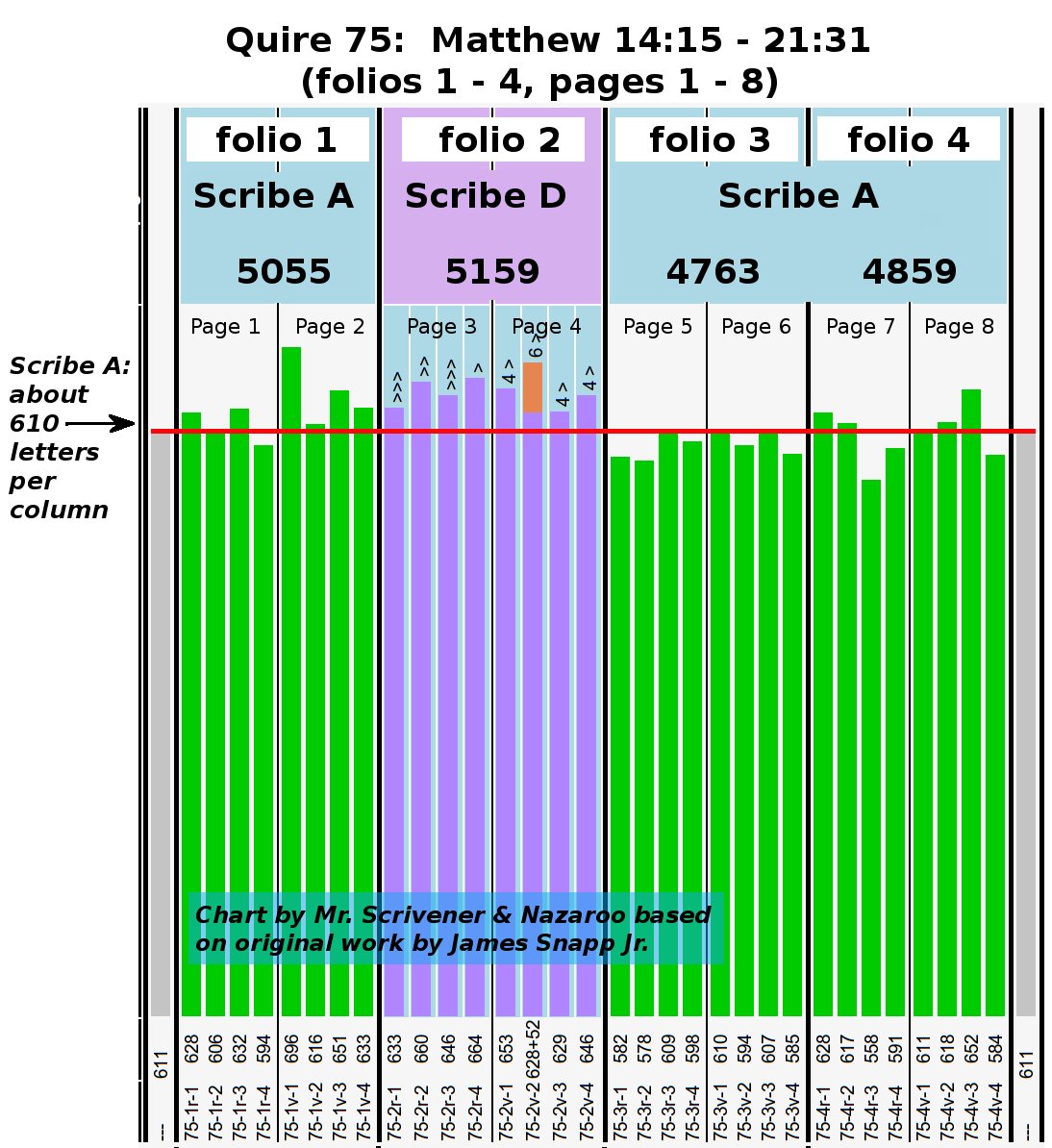
We will be better equipped to discern the borders and purpose of the "cancel sheets" in Aleph if we examine first the more obvious of the two.   I refer here to the sheet making up folios 2 and 7 in Quire 75, replaced by Scribe D and covering pages 3 & 4 (Matthew 16:9-18:12) and pages 13 & 14 (Matt. 24:35-26:6) of the Quire.  Recall again the layout of a quire below:
In our case for Quire 75, the replacement sheet replaces folios #2 and #7 (second sheet from bottom: these were misnumbered by Myshrall as 74-2, 74-7, but are in fact 75-2 and 75-7).

Since the replacement sheet was apparently done in the scriptorium by the original scribes, there is nothing obvious about the vellum itself to distinguish it from the vellum used elsewhere.   However, the borders between scribes are well-defined in this case, by several signs:

Click to Enlarge: backbutton to return


(1) The red Eusebian marginal numberings are missing completely from all four pages.  This indicates the sheet was replaced after they had already been added to the manuscript, and after this quire was completed by Scribe A.  

This does not necessarily prove either they or the replacement sheet were done before the MS left the scriptorium.  On the contrary, all it shows is that the Eusebian numberings are contemporary with and prior to the replacement sheet.  Although it is near-certain that Scribe D (who wrote other sections) wrote the sheet, this doesn't mean the MS never left the scriptorium.  It is quite possible that it went out, a complaint was made, and it was sent back for repair, at which time the sheet was replaced.   But it seems clear that both the Eusebian marks and the replacement sheet were done very close to the time of manufacture.

(2) The replacement pages have Scribe D's trademark 'fill-characters' (">") at the ends of lines in every column of the replacement pages.  And with only one exception (a single ">" on page 9, column 4), these appear only on the replacement pages.

This flourish is not merely decorative (giving the right-margin sharper definition), but also appears to make the replacement pages easy to find and indicate the completion of the the repair beyond any doubt.  As this was a very expensive and time-consuming operation, this was probably done for billing purposes, or to provide proof the repair-work was done as ordered.

There was no attempt to hide the replacement job in any sinister sense.  Instead, it appears that the repair was done essentially to restore the text, but also carefully preserve the look and style of the manuscript throughout.  This is why the Scribes are careful to write so similarly.

(3) The problem-area was on Folio 2.  This becomes obvious when we compare the material originally done by Scribe A on the surrounding pages.  Scribe D crams an extra 120 - 350 letters on his replacement pages 3 and 4.  This is a large discrepancy, amounting to from 2 - 12 verses!   The material on the other end of the sheet, pages 13-14, although slightly higher than average, is about the same as that on the surrounding pages in the last half of the Quire.

Click to Enlarge

(4) Scribe A had omitted a large portion of text, requiring the extreme solution of replacing the pages.  In other places Scribe D (the overseer/corrector) is content to insert up to 72 characters in the margin of the manuscript, without replacing pages.

More to follow...

Nazaroo

Saturday, February 12, 2011

Sinaiticus & Mark's Ending (Pt 9): Myshrall on Scribe D

Well, we may never get much help from the Official Sinaiticus Site (they will be too busy no doubt to respond).  But we need a definitive answer on exactly what Scribe D was responsible for (last week we noted that they listed the rest of the entire Quire 77 as the work of Scribe D!).

Before we set off, we will give the up-to-date discussion of Scribe D by Myshrall, an excellent and thorough piece by the way.  Here we will find more useful keys for sorting which scribe is which:

"Scribe D was an excellent speller, A was poor, and B was appalling! One must be aware of the circularity of some of this reasoning though. If one assumes that a scribe is a poor speller, then one will try to assign all the texts with spelling mistakes to that scribe, which many not be so. Not every scribe was entirely consistent, so ther must be more concrete palaeographical reasons for identifying a hand.
Several individual characteristics distinguish the three scribes of Sinaiticus, although the general appearance of the hands is very similar... The superline of the final nu (i.e., a nu found at the end of a line) by Scribe A partly covers the preceding vowel, whereas with Scribe B it is placed more to the right and goes further into the margin (M & S, Figure 6). The line endings themselves also help to identify the hands (M & S, Figure 7).
For Scribe A, compression begins a long way back into the line at the 6th or 7th letter(11th in poetical texts). The upright slopes become elongated and the rounded letters diminished to allow the writing to be compressed into a smaller space.
For Scribe B compression rarely affects more than three letters, and those evenly.
Click to Enlarge: Backbutton to return

Scribe D resembles Scribe A in the final letters but there is no elongation of the vertical strokes. IN addition, he seldom diminishes more than three letters at a time.


KAI Forms & Diples (">")


The KAI compendium by Scribe A is in the form of an oblique stroke at an acute angle from the bottom of the K. With Scribe B, the angle of the stroke is flatter, and the stroke often shorter (M&S, Figure 6).
Scribe D has a curved stroke on his KAI compendium which is very distinctive.
Scribe A never uses the diple (">") to fill in the ends of empty lines. Scribe B uses it very rarely; no more than once every three pages in the prophetic books and less in Hermas (with the exception of one page in Jeremiah where he uses it 12 times). However, Scribe D uses it in abundance, sometimes doubled (">>") to cover erasures, which makes his NT cancel leaves stand out. The hand of Scribe D is smaller, with an undulating effect as the rounded letters are smaller. This has led M&S to say that Scribe D is a far superior scribe, due to his spelling and style. (M&S, p. 23).


The Cancel Leaves of Matthew
Within the Gospel of Matthew in Aleph, Scribe D has replaced one sheet of parchment (2 folios). This stands out because the rest of the text is by Scribe A. The sheet replaced is Quire 74-2 and 74-7 [@ 4 sheets or 8 folios /quire], this being folio pages 10/10b, and 15/15b [i.e., recto/verso of folios 10 & 15 = 4 page faces]. The text is Matt. 16:9-18:12 [f10] and Matt. 24:36- 26:6.[f15]

Although the letter shapes of Scribes A and D are very similar (so similar in fact that I could not tell a difference between the two scribes, apart from through the following features), there are certain signs that can be seen showing these pages are by a different hand:
(1) Scribe D uses diples ("<", ">") to fill in the ends of his lines. these number 8 on page 10, 17 on page 10b, 17 on page 15, and 31 on 15b. Scribe A rarely uses diples, so this sudden abundance indicates a different scribe. An example of Scribe A's diples is on 3b/4/24.
(2) Scribe D's KAI compendium is more curved than Scribe A's within the text. This can be seen on 10/3/1, 10/4/26, 10b/1/28, 15/1/16, 15/2/30, 15b/2/20, 15b/2/46, 15b/3/40. For an example of Scribe A's compendium see 3.5 (1b/4/30) and throughout the rest of Matthew.
(3) Scribe D's spelling is generally more precise. There are fewer itacisms on his pages, as well as basic spelling mistakes. Itacisms found, number 8 on pg 10, 7 on 10b, 7 on 15, 4 on 15b. This compares to Scribe A's 41 on p.11, 40 on 11b, 38 on 16, 34 on 16b. (pages chosen follow on from Scribe D. The same is true for any of Scribe A's leaves.)
(4) Scribe D tends to use fewer abbreviations in his text, these including Nomina Sacra and numerals. (I haven't counted these because the number of abbreviations varies depending on the number of Nomina sacra.)


The Cancel Leaves of Mark and Luke
There is only one cancel leaf in Mark/Luke, which contains the end of Mark (14:54-16:8), and Luke 1:1-56. As this cancel sheet (two folios) was in the center of the quire, both leaves are consecutive, 76-4 and 76-5, called folios 29 and 29b by Lake.
These pages were replaced by Scribe D, possibly because Scribe A made an unusually serious mistake. The same features of the change of hands can be seen as in the cancel leaves of Matthew. The number of diples used in Mark are 20 on folio 38, 20 on 28b, and 16 on 29. The number in Luke are 5 on the rest of 29, and 11 on 29b. This suggests that Scribe D was trying to stretch Mark out onto another column, but does not necessarily imply that the original problem was with the end of Mark, although this is always an option. Also indicative of Scribe D here is the spelling of Ιωανην for Ιωαννην in Luke 1:13.
However, on this cancel leaf we do have Eusebian notation unlike in Matthew, and we do have a fair few nomina sacra, 10 examples on folio 29, and 23 on folio 29b. THis includes the first occurrence of CPI for σωτηρι. There are also some itacisms here but they mainly involve propoer nouns such as Elizabeth Ελεισαβετ Ελισαβετ. There was a lot of variation in the spelling of proper names, so Scribe D can still be seen as an accurate speller.
The importance of the indentification of cancel leaves is that it shows how thoroughly the MS was revised in the scriptorium. It suggests that it was destined for somewhere quite important because of the care taken in producing it, with appearance being as important as text. Only when it reached the "C Correctors" did the text become of fundamental importance, hence the numerous corrections carried out at that time. This can be seen because the corrections were carried out in a more careless way than the earlier ones.
The other major complication of the cancel leaves is that they indicate the number of people working on one text at one time. This implies a scriptorium background for Aleph, as privately copied MSS would probably have been done by one person. Scribe D could be viewed as the senior scribe, who probably skim read the text looking for obvious errors before it went out. This would explain why his corrections would tend to be bunched, because if he noticed one error he would probably concentrate more in that area on finding problems, and then relax again when the text seemed to be going alright. It is even possible to hypothesize that in areas where many mistakes were made the scribe was tiring, and ready for a break, and then when the text suddenly rights itself he had stopped and had a rest.
The identification of Scribe D for these pages has repercussions for the running titles. Within these pages Scribe D spells Ιωανην for Scribe A and B's Ιωαννην. Byu demonstrating D's spelling of this proper noun, he can be ruled out for the running titles, superscription and subscription of the Gospel of John. The other major importance of this identification is that it proves that cancel leaves were written for Sinaiticus, showing that accuracy was of great importance for this MS. It also shows that it was not necessarily the original hand that completed the cancel leaf."
A.C. Myshrall,
Cod.Sinaiticus,
Its Correctors & the Caesarean text of the Gospels,
Dissertation, (Birmingham U., 2005)

We are now I think ready to try an analysis of the surrounding pages, to determine the actual extent of the work of Scribe D involving Mark's Ending and the modified Quire 77.

peace
Nazaroo