Friday, February 25, 2011

Sinaiticus & Mark's Ending (Pt 12): The Dating Bombshell

Earlier we posted a chart showing the Quire structure of Sinaiticus, but left some portions of the chart unexplained.  Now we turn to this problem, specifically the following blip on the radar screen:
Two and a Half Pages of Bizarre!

Now these pages are certainly also written by Scribe A, and identified as such by the British Museum Official Website.   In fact, the second half of page 76-7 verso could hardly have been written by anyone else, given that the first half was clearly done the previous day by him:

First 2 columns normal: Last two in style of Alexandrinus!
76-7 verso: Click to Enlarge, backbutton to return


Just as Mr. Scrivener has described Alexandrinus on his blog, we see the first letters of paragraphs fully 'outdented' into the margin, and enlarged!  What is Scribe A doing?   He finishes this page and also the whole last folio of the Quire (76) in the same format (this shows by the way that the text was written Quire by Quire: the next Quire begins again with the expected 'regular' style).

The answer is obvious, but not welcome.  Scribe A has slipped into his own habitual way of copying MSS.   He's forgotten what he's doing.  He completes the Quire without even noticing this major gaffe.

But this is the most important and stunning piece of information we have yet gathered about Scribe A, the scriptorium, and specifically, the date of the manuscript's manufacture.

As Mr. Scrivener has noted for us, Alexandrinus was made no earlier than about 380 A.D. (Dating Alexandrinus) This was the time that this style of calligraphy was popular and even standard, and not before.   Scribe A has tipped his hand, and perhaps not accidentally at that, but even slyly.   And Scribe D has not noticed this boner, but it is such a disfigurement of the style of the codex that surely Scribe D would have yanked out the bottom sheet of the Quire and replaced the 1st and 8th folios to fix it.

Why then were the Scribes trying carefully to copy the style of a manuscript written about 100 years earlier?   The answer is obvious here too.  They wanted to give it the look and feel, the prestige, perhaps even the authority of an earlier manuscript.  Why?  Because this is what the rich patron who was paying for this expensive copy wanted.   Like an early Roman copy of Greek 'gods', this manuscript is actually a reproduction, not a real early 4th century manuscript.   

Is it a forgery?  No.  Not exactly.  In fact, as a comparison to Codex B shows, the scribes were indeed copying from a much older master-copy, presenting a very early text.   Thus it is in some sense just what it purporting to be: the text of an early 4th century manuscript.  This was probably a stylistic choice dictated by the artistic vogue of the later period.    But the point is, its just an early reproduction.


Hort Knew Sinaiticus was Late:

This fact did not pass unnoticed, even by Hort himself.  He did not dare openly suggest a date 80 years later than the one supposed by Tischendorf and accepted by most other critics on his authority.   But Hort carefully and quite clearly indicated that he knew this codex was much later than Codex Vaticanus. As Mr. Scrivener noted in another context on his blog ( copy generations ) :

[Hort] does say a few things [re: Aleph/B]:

a) B and Aleph are entirely different in regard to their subsequent history,   i.e., 'post-nearest common ancestor'. For Vaticanus he makes incredible claims of purity and FEWNESS of generations:
"The ancestry of B posterior to the common archetype was probably a chain of very few links indeed;..." (Hort, Introduction, ¶ 328. pg 248-9, ).

Again, speaking primarily of B's unique/subsingular readings, he says,
"the sources of corruption in B are for the most part of a sporadic and indeterminate character (cf. 204)." (Hort, Intro, ¶ 328, p.250)
Hort here clearly indicates that the subsequent history (post common-ancestor) of Codex Vaticanus is relatively short and direct.   This is in contradistinction to Codex Sinaiticus, for which he posits a longer and more complex history for the text it contains.  But this would make little sense if they are really closely contemporary and from the same scriptorium.

It makes perfect sense however, if Sinaiticus is actually a reproduction, made in the same or a similar scriptorium, but 80-100 years later.  The original master used by Vaticanus was probably now long gone, but a copy several generations later was still available, reflecting essentially the same archetype as Vaticanus, but with subsequent layers of copying errors.   

Thus Hort knew that Sinaiticus betrayed itself as a later text with a subsequent accumulation of further corruption, explaining well its differences from Vaticanus, and Hort's own preference for Vaticanus.


Other Examples:

What other manuscripts also exhibit this similar and quite unique style of "outdenting"?

Codex Φ (Beratinus, GA-043) from the 6th century also displays the same style, with marginal notes placed around the Outdented Letters in the very same way:


Although this manuscript Codex Φ (GA-043) is in very bad shape, you can see that it was once a beautiful piece of caligraphy in the same style as Alexandrinus (5th cent.) and these unusual pages of Sinaiticus  from Quire 76. 


peace
Nazaroo

Saturday, February 19, 2011

Sinaiticus & Mark's Ending (Pt 11): Quire Structure - Synoptics

It has taken some time, but now we are approaching the more interesting aspects of the making of Sinaiticus:

An examination of the Quires by others has revealed the basic quire structure, and groupings of the folios.  This is important, for it gives us important clues as to how the task of writing and compiling the NT was carried off.

The text was written quire by quire (in folded 8 folio sections).  However, the planning was carried out on a larger scale, to calculate and provide just enough vellum (a very expensive material) for the task.

John was done separately, on two quires, beginning at the top of a new quire, and the second quire consisted of only three sheets (quire 81 has only 6 folios).   The Collection of Paul's letters was begun also on a new quire (82-1), so we know that quire 81 probably never had 8 folios.  (Paul follows John in Aleph.  1st Cor. begins immediately after Romans on folio 82-7verso, column 3, showing that the letters were treated as a group and copied continuously in quires of 8).

This information, combined with the layout of the Synoptics shows that the Synoptics were done together, and laid out on six quires, with the scribe periodically checking the page-by-page progress, and compressing or expanding the material by columns as required to keep pace and arrive at the correct place at various points in each quire.  

This process makes it important to note that although Quire 79 only has 7 folios, it must have started with 8, because the quires would be assembled in a standard way before the text was planned and written.  The reason for this step is to prevent the mixing up of pages, while breaking the job down into reasonably sized tasks.  When the quire was complete, the 8th blank folio would have been trimmed off.


We can now consider the replacement-sheets.

We already know that the reason for replacement-sheet 1 (folios 75-2, 75-7) was a severe and problematic omission of large size (see previous post).   This was done long after the entire Synoptics section at least was complete, because the Eusebian marks are missing.

But this is not so for replacement-sheet 2 (folios 77-4, 77-5):  This on the contrary, appears to indeed have been done certainly before the manuscript ever left the scriptorium, and even before the Eusebian marks were added, since they are present on this sheet.

Why was this sheet replaced?  (77-4/5)

Since there has not been any real addition of unusual material here (not even the Short Ending of Mark was inserted), some have conjectured that there must have been an unknown omission in the first six columns of Luke, for this would leave the format of the critical page the same, but also explain the extra letters here squeezed in by Scribe D on the last two columns of 77-5 recto and also 77-5 verso (about 315 extra letters in Luke 1:1-56.).

This is an attractive explanation, even though we have only indirect evidence in the compressed text on the replacement sheet (there seems to be no surviving omission this size).   If this is ultimately plausible here, then it is equally plausible in regard to replacement-sheet 1 (folio 75-2), where there is also a discrepancy in the quantity of text and that suggested by the surrounding pages, of between 120 - 300 letters.


Mark's Ending Revisited (& 77-4/5)


The only drawback with this, is that it doesn't explain the behavior of Scribe D in regard to the last nine columns of Mark.


There (Part 7) we saw that again we have extra material on the first page of the cancel-sheet (101 letters on 77-4 recto, 78 of them crammed into the last column).   Why did Scribe D do this?  He should have easily estimated that he had plenty of space, including the now nearly blank 2nd column on 77-5 recto.

In fact, after having stuffed 77-4 recto, he had room for 853 more letters at normal pacing.  But when its obvious that you are starting with room for at least 750 letters in page 2, why cram 100 of them onto page 1?  It makes no sense, especially when the scribe has the old page he is replacing in his hand, and he's still in the scriptorium. 

But the long ending of Mark (LE) is only 982 letters.  It does make sense to squeeze 100 letters into the 4 columns of page 1, leaving space for 850, if you're going to insert the LE.  You now only need to squeeze an extra 132 letters into page 2 and 3 (over 6 more columns).   The real question then is why did he change his mind, and leave it out?


Questions of Authority and Cost:

The answer must be in the real background circumstances of the Codex's manufacture.   As we replied to James Snapp Jr.  in the comments for Part 6 of this series, it is a mistake to think that the Corrector/Overseer was the "order-giver", in the sense that he could make autonomous and independent decisions to leave out or put in something like the Ending of Mark.   He may have had authority over the scribes under his watch, but not over the New Testament text!

If we are to look anywhere for this kind of authority, it must be either much higher, such as the Abbot of the monastery, or even higher than that, such as the regional bishop.   But we could also look to the wealthy and powerful patron who was paying for the manuscript.  This person might be a bishop or even a king or emperor, or their representative.  Mr. Scrivener has given an excellent quotation of an expert estimate of the cost of making such a precious item ( Scrivener's Blog ):
"Bagnall insists that the prices of books were expensive enough that copies of the Scriptures would have been possessed, in most cases, only by churches and monasteries. Churches were concerned with charity and financial support for their clergy—thus making clergymen the most likely owners of Christian books. Listen to this quote from Bagnall:
"At the lower end, let us imagine a reader who received 10 solidi per year. A complete Bible would cost him half a year’s income. Such a purchase would have been entirely out of reach. Even an unbound short book, a single gospel on papyrus of the sort that cost a third of a solidus in the ostraka cited by Anne Boud’hors, would amount to one-thirtieth of a year’s income—in proportionate terms (although not in purchasing power) the equivalent of $1,000 today, let us say, for someone earning $35,000. People at that sort of income level do not buy books at that price. Even the best-paid of academics do not buy books at that price (62)."
Further, it is most likely that we must look to the high clergy (e.g., the office of bishop) for those who may have been able to purchase books in ancient Egypt."           
- Rex Howe, Review: Bagnall’s  Early Christian Books In Egypt (2009) blogged on  Level Paths. 

In this scenario then, we would expect that someone else may have been consulted, and the word was given to leave the ending of Mark out, as perhaps it was originally penned by Scribe A.


The Full Explanation: 

But if Scribe A had left out Mark's Ending in the first place, what prompted Scribe D (the corrector) to replace this folio?   Part of the story is hinted at in the fact that this is a very early repair, probably done even before the quires were assembled.

Suppose now, that Scribe A had correctly laid out his quires, as the quantity of material had indicated in his master-copy, which was a special older manuscript, highly prized for its antiquity in the 4th century.   In these circumstances (the careful duplication of a venerable ancient copy for a wealthy patron), the Scribe would modify his procedure and carefully measure according to the actual text to be copied, not necessarily the standard layout for a well-known and fuller text.

But it was probably not until Scribe A got reasonably close to the ending of Mark that he noticed the ending was actually missing in his master-copy.  His natural instinct was to begin compressing his text to make room for the ending.   For proof of this, we can examine the pages of Scribe A just prior to the cancel-sheet. (see folios 77-3 recto and verso, particularly the extra material in 77-3 recto column 2 ).  He was probably quite pleased with himself, having been able to squeeze in Mark's Ending.

Unfortunately, Scribe D must have become aware of the situation after some discussion, and saw that Scribe A's action violated the directive to copy the ancient exemplar's text accurately without variation.  To make matters worse, Scribe A seems also to have omitted a significant portion of Luke's chapter 1.  The double-jeopardy of flawed ending and beginning called for the drastic measure of a cancel-sheet.  Scribe D took over the job himself, as this would require his special skill in laying out the material so that it did not alter the look and style of the book-borders and yet stayed true to the master-text.  A scenario like this would account for all the unusual features found.

Alternately, Scribe A may have indeed finished Mark without the ending, but nonetheless brought it to the attention of the Corrector (Scribe D).  In this scenario, Scribe D at first attempted to make room for Mark's Ending, but after some other consultation with a superior or the patron reversed his decision and now stretched the rest of Mark to fill the space.  However, in this case, Scribe D, while allowing the Ending to be dropped, could not pass over the extensive omission in Luke he now noticed, which had no precedent or approval as a 'reading'.  So he replaced the lost text in Luke, but had probably already planned that repair before struggling with Mark's ending.

Each alternate scenario faces the problem of accounting for the second omission of material in Luke, which will require a separate investigation.   Yet both alternatives also suggest that the scribes were well aware of the Long Ending of Mark. 

In the meantime, we have accounted for all the basic features of the cancel-sheet, surrounding text, and the probable circumstances, much more thoroughly and adequately than previous proposals.

peace
Nazaroo

Thursday, February 17, 2011

Sinaiticus & Mark's Ending (Pt 10): replacement sheet 1

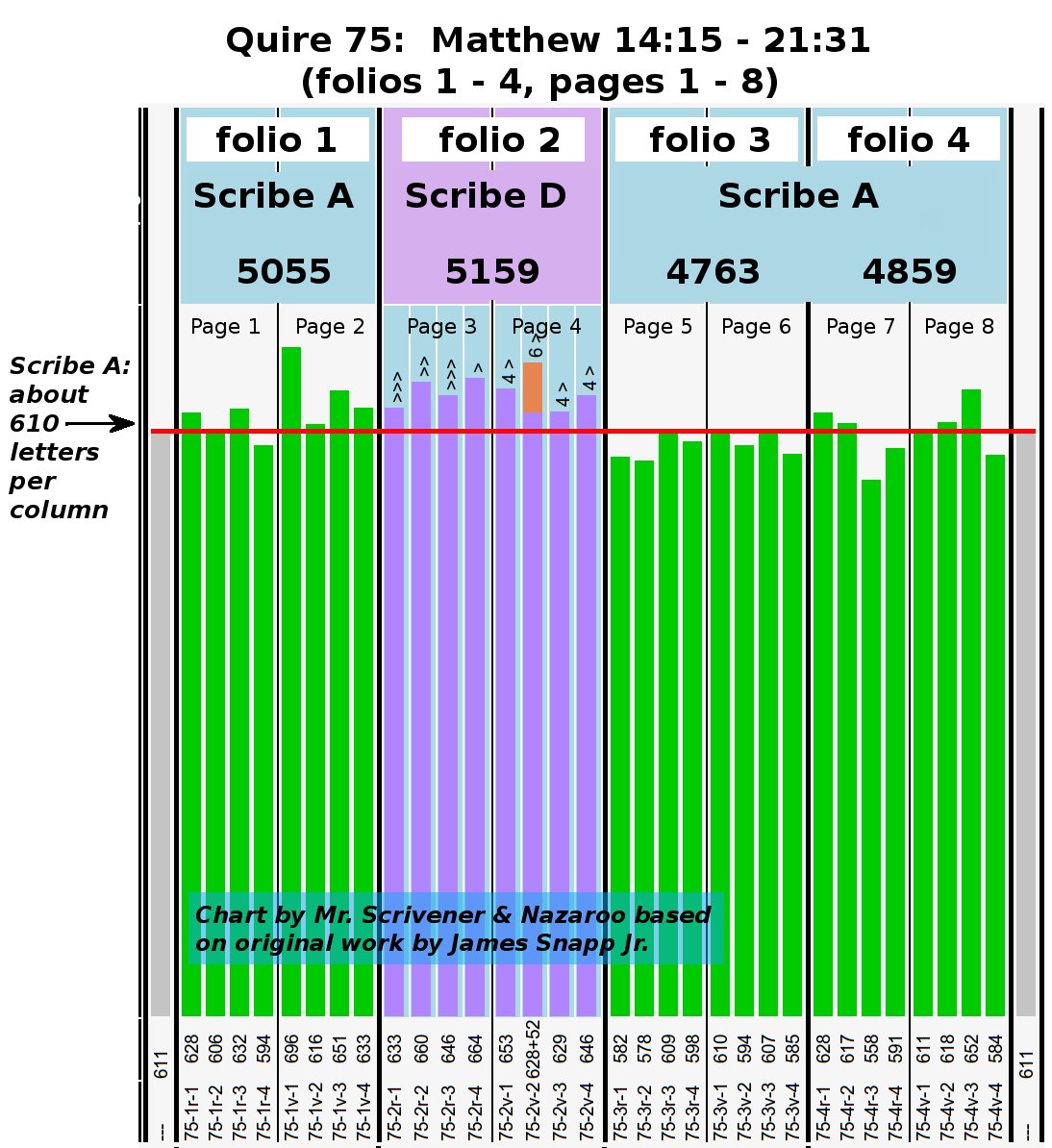
We will be better equipped to discern the borders and purpose of the "cancel sheets" in Aleph if we examine first the more obvious of the two.   I refer here to the sheet making up folios 2 and 7 in Quire 75, replaced by Scribe D and covering pages 3 & 4 (Matthew 16:9-18:12) and pages 13 & 14 (Matt. 24:35-26:6) of the Quire.  Recall again the layout of a quire below:
In our case for Quire 75, the replacement sheet replaces folios #2 and #7 (second sheet from bottom: these were misnumbered by Myshrall as 74-2, 74-7, but are in fact 75-2 and 75-7).

Since the replacement sheet was apparently done in the scriptorium by the original scribes, there is nothing obvious about the vellum itself to distinguish it from the vellum used elsewhere.   However, the borders between scribes are well-defined in this case, by several signs:

Click to Enlarge: backbutton to return


(1) The red Eusebian marginal numberings are missing completely from all four pages.  This indicates the sheet was replaced after they had already been added to the manuscript, and after this quire was completed by Scribe A.  

This does not necessarily prove either they or the replacement sheet were done before the MS left the scriptorium.  On the contrary, all it shows is that the Eusebian numberings are contemporary with and prior to the replacement sheet.  Although it is near-certain that Scribe D (who wrote other sections) wrote the sheet, this doesn't mean the MS never left the scriptorium.  It is quite possible that it went out, a complaint was made, and it was sent back for repair, at which time the sheet was replaced.   But it seems clear that both the Eusebian marks and the replacement sheet were done very close to the time of manufacture.

(2) The replacement pages have Scribe D's trademark 'fill-characters' (">") at the ends of lines in every column of the replacement pages.  And with only one exception (a single ">" on page 9, column 4), these appear only on the replacement pages.

This flourish is not merely decorative (giving the right-margin sharper definition), but also appears to make the replacement pages easy to find and indicate the completion of the the repair beyond any doubt.  As this was a very expensive and time-consuming operation, this was probably done for billing purposes, or to provide proof the repair-work was done as ordered.

There was no attempt to hide the replacement job in any sinister sense.  Instead, it appears that the repair was done essentially to restore the text, but also carefully preserve the look and style of the manuscript throughout.  This is why the Scribes are careful to write so similarly.

(3) The problem-area was on Folio 2.  This becomes obvious when we compare the material originally done by Scribe A on the surrounding pages.  Scribe D crams an extra 120 - 350 letters on his replacement pages 3 and 4.  This is a large discrepancy, amounting to from 2 - 12 verses!   The material on the other end of the sheet, pages 13-14, although slightly higher than average, is about the same as that on the surrounding pages in the last half of the Quire.

Click to Enlarge

(4) Scribe A had omitted a large portion of text, requiring the extreme solution of replacing the pages.  In other places Scribe D (the overseer/corrector) is content to insert up to 72 characters in the margin of the manuscript, without replacing pages.

More to follow...

Nazaroo

Saturday, February 12, 2011

Sinaiticus & Mark's Ending (Pt 9): Myshrall on Scribe D

Well, we may never get much help from the Official Sinaiticus Site (they will be too busy no doubt to respond).  But we need a definitive answer on exactly what Scribe D was responsible for (last week we noted that they listed the rest of the entire Quire 77 as the work of Scribe D!).

Before we set off, we will give the up-to-date discussion of Scribe D by Myshrall, an excellent and thorough piece by the way.  Here we will find more useful keys for sorting which scribe is which:

"Scribe D was an excellent speller, A was poor, and B was appalling! One must be aware of the circularity of some of this reasoning though. If one assumes that a scribe is a poor speller, then one will try to assign all the texts with spelling mistakes to that scribe, which many not be so. Not every scribe was entirely consistent, so ther must be more concrete palaeographical reasons for identifying a hand.
Several individual characteristics distinguish the three scribes of Sinaiticus, although the general appearance of the hands is very similar... The superline of the final nu (i.e., a nu found at the end of a line) by Scribe A partly covers the preceding vowel, whereas with Scribe B it is placed more to the right and goes further into the margin (M & S, Figure 6). The line endings themselves also help to identify the hands (M & S, Figure 7).
For Scribe A, compression begins a long way back into the line at the 6th or 7th letter(11th in poetical texts). The upright slopes become elongated and the rounded letters diminished to allow the writing to be compressed into a smaller space.
For Scribe B compression rarely affects more than three letters, and those evenly.
Click to Enlarge: Backbutton to return

Scribe D resembles Scribe A in the final letters but there is no elongation of the vertical strokes. IN addition, he seldom diminishes more than three letters at a time.


KAI Forms & Diples (">")


The KAI compendium by Scribe A is in the form of an oblique stroke at an acute angle from the bottom of the K. With Scribe B, the angle of the stroke is flatter, and the stroke often shorter (M&S, Figure 6).
Scribe D has a curved stroke on his KAI compendium which is very distinctive.
Scribe A never uses the diple (">") to fill in the ends of empty lines. Scribe B uses it very rarely; no more than once every three pages in the prophetic books and less in Hermas (with the exception of one page in Jeremiah where he uses it 12 times). However, Scribe D uses it in abundance, sometimes doubled (">>") to cover erasures, which makes his NT cancel leaves stand out. The hand of Scribe D is smaller, with an undulating effect as the rounded letters are smaller. This has led M&S to say that Scribe D is a far superior scribe, due to his spelling and style. (M&S, p. 23).


The Cancel Leaves of Matthew
Within the Gospel of Matthew in Aleph, Scribe D has replaced one sheet of parchment (2 folios). This stands out because the rest of the text is by Scribe A. The sheet replaced is Quire 74-2 and 74-7 [@ 4 sheets or 8 folios /quire], this being folio pages 10/10b, and 15/15b [i.e., recto/verso of folios 10 & 15 = 4 page faces]. The text is Matt. 16:9-18:12 [f10] and Matt. 24:36- 26:6.[f15]

Although the letter shapes of Scribes A and D are very similar (so similar in fact that I could not tell a difference between the two scribes, apart from through the following features), there are certain signs that can be seen showing these pages are by a different hand:
(1) Scribe D uses diples ("<", ">") to fill in the ends of his lines. these number 8 on page 10, 17 on page 10b, 17 on page 15, and 31 on 15b. Scribe A rarely uses diples, so this sudden abundance indicates a different scribe. An example of Scribe A's diples is on 3b/4/24.
(2) Scribe D's KAI compendium is more curved than Scribe A's within the text. This can be seen on 10/3/1, 10/4/26, 10b/1/28, 15/1/16, 15/2/30, 15b/2/20, 15b/2/46, 15b/3/40. For an example of Scribe A's compendium see 3.5 (1b/4/30) and throughout the rest of Matthew.
(3) Scribe D's spelling is generally more precise. There are fewer itacisms on his pages, as well as basic spelling mistakes. Itacisms found, number 8 on pg 10, 7 on 10b, 7 on 15, 4 on 15b. This compares to Scribe A's 41 on p.11, 40 on 11b, 38 on 16, 34 on 16b. (pages chosen follow on from Scribe D. The same is true for any of Scribe A's leaves.)
(4) Scribe D tends to use fewer abbreviations in his text, these including Nomina Sacra and numerals. (I haven't counted these because the number of abbreviations varies depending on the number of Nomina sacra.)


The Cancel Leaves of Mark and Luke
There is only one cancel leaf in Mark/Luke, which contains the end of Mark (14:54-16:8), and Luke 1:1-56. As this cancel sheet (two folios) was in the center of the quire, both leaves are consecutive, 76-4 and 76-5, called folios 29 and 29b by Lake.
These pages were replaced by Scribe D, possibly because Scribe A made an unusually serious mistake. The same features of the change of hands can be seen as in the cancel leaves of Matthew. The number of diples used in Mark are 20 on folio 38, 20 on 28b, and 16 on 29. The number in Luke are 5 on the rest of 29, and 11 on 29b. This suggests that Scribe D was trying to stretch Mark out onto another column, but does not necessarily imply that the original problem was with the end of Mark, although this is always an option. Also indicative of Scribe D here is the spelling of Ιωανην for Ιωαννην in Luke 1:13.
However, on this cancel leaf we do have Eusebian notation unlike in Matthew, and we do have a fair few nomina sacra, 10 examples on folio 29, and 23 on folio 29b. THis includes the first occurrence of CPI for σωτηρι. There are also some itacisms here but they mainly involve propoer nouns such as Elizabeth Ελεισαβετ Ελισαβετ. There was a lot of variation in the spelling of proper names, so Scribe D can still be seen as an accurate speller.
The importance of the indentification of cancel leaves is that it shows how thoroughly the MS was revised in the scriptorium. It suggests that it was destined for somewhere quite important because of the care taken in producing it, with appearance being as important as text. Only when it reached the "C Correctors" did the text become of fundamental importance, hence the numerous corrections carried out at that time. This can be seen because the corrections were carried out in a more careless way than the earlier ones.
The other major complication of the cancel leaves is that they indicate the number of people working on one text at one time. This implies a scriptorium background for Aleph, as privately copied MSS would probably have been done by one person. Scribe D could be viewed as the senior scribe, who probably skim read the text looking for obvious errors before it went out. This would explain why his corrections would tend to be bunched, because if he noticed one error he would probably concentrate more in that area on finding problems, and then relax again when the text seemed to be going alright. It is even possible to hypothesize that in areas where many mistakes were made the scribe was tiring, and ready for a break, and then when the text suddenly rights itself he had stopped and had a rest.
The identification of Scribe D for these pages has repercussions for the running titles. Within these pages Scribe D spells Ιωανην for Scribe A and B's Ιωαννην. Byu demonstrating D's spelling of this proper noun, he can be ruled out for the running titles, superscription and subscription of the Gospel of John. The other major importance of this identification is that it proves that cancel leaves were written for Sinaiticus, showing that accuracy was of great importance for this MS. It also shows that it was not necessarily the original hand that completed the cancel leaf."
A.C. Myshrall,
Cod.Sinaiticus,
Its Correctors & the Caesarean text of the Gospels,
Dissertation, (Birmingham U., 2005)

We are now I think ready to try an analysis of the surrounding pages, to determine the actual extent of the work of Scribe D involving Mark's Ending and the modified Quire 77.

peace
Nazaroo

Sunday, January 30, 2011

Sinaiticus & Mark's Ending (Pt 8): Scribe Identification & Confusion

That multiple scribes were at work on Codex Sinaiticus seems to be completely certain.  We have already noted some of the observations of Tischendorf and  Scrivener in particular on the features that distinguish Scribe D. We repeat F.H.A. Scrivener in full here:
"It is quite worthy of notice, that although ">" is sometimes placed in the margin of the NT to point out quotations from the OT, and that too by the first hand, e.g. Acts 26:23; though more frequently by later scribes, as in Matt. 1:23; 2:6, etc. : this mark is never met with in the NT at the end of a line for the mere purpose of filling up a blank space (which is its usual purpose in the OT portion of Sinaiticus and some other MSS), except repeatedly in the leaves assigned to Scribe D, viz. 219 times in the other six leaves, four times in Rev.1:1—5 (see p. xvi). Elsewhere ">" is found in only four places which have suffered correction (Matt. 6:28 ; 22:9 ; Luke 11:36 ; 12:58), being used, like — in 1st Cor. 15:22, merely to cover erasures.

We must add too, that the few leaves of the NT ascribed by Tischendorf to Scribe D are much freer from itacisms, or instances of false spelling, than those on either side of them : the transition is quite remarkable from leaf 9 of A to leaf 10 (Matt. 16:9-18:12) of Scribe D, and then back again to leaf 11 of A, as the reader may see for himself by consulting our collation. These remarks, so far as they extend, would seem to suggest two scribes, A being identical with B, and possibly С with D ; the members of which pairs Tischendorf declares to be much alike; but whether the actual penmen be one, or two, or four, is of the less importance, as (in the N. T. certainly, and most probably in the Old) the whole work was clearly executed at the same time, and transcribed from the same older copy.

Moreover, the apostrophe ('), though frequently employed in the OT to divide syllables in the middle of a word, is never so used throughout the NT itself; while in the Shepherd of Hermas, at the end, assigned by Tischendorf to scribe B, we read: αγ'γελια, αγ'γελον, αλ'λα (3x), μελ'λοντες, πολ'λους, ελατ'τονι, εχ'μαλωτισμον  , etc, and ">" several times at the end of lines. These minute points, insignificant as they may seem, go far to support Tischendorf's notion that the MS is the work of several distinct hands. (See also p. xxxii, note 7.)" (Scrivener, Sinaiticus Intro.)

 Kirsopp Lake is also informative:
"The discrimination of Scribe D from Scribes A/B is easier and admits of no reasonable doubt. There is a distinct difference in the script, though it is more easily perceived than described; possibly the letters are somewhat squarer in Scribe D than in A - the height being less in proportion to the breadth - and Scribe D is altogether prettier than A. But the decisive point is that Scribe D constantly fills out the end of a line with the sign >, which is rarely or never used by Scribes A/B."
 From all this, it would seem that the work of Scribe D was hardly in dispute, and well understood.   It is naturally with some alarm then, that upon visiting the official Codex Sinaiticus Website, we find all the pages from 77-4 recto to 77-8 verso identified as "Scribe D" in the apparatus and titling above the photos.  
Has there been a mistake by earlier critics with less access to good photos, or has the British Museum, custodian of the actual MS, made some remarkable blunder, based on a confusion between the end of the Quire and the 'cancel-sheet' (77-4 recto to 77-5 verso)??

The only sure guide would seem to be the quality of the text on the disputed pages.

Saturday, January 29, 2011

Sinaiticus & Mark's Ending (Pt 7): James Snapp (cont.)

Continuing our discussion of Codex Sinaiticus, we turn our attention again to the numbers of letters in each column of the 'cancel sheet(s)' (Scribe D),  and the counts in the surrounding area by the original Scribe A.

Here is a wonderful chart composed by Mr. Scrivener diagramming the details of the current picture.   The letter-counts are based on the text as transcribed on the Codex Sinaiticus Homepage (British Museum), but we have subtracted all marginal notes (which were added independently later), and also the peculiar symbols of Scribe D (the ">" arrow used to fill rows to make the page look fuller.).   Still counted as a character was the "dots" indicating verse and paragraph divisions, because these are assumed to have been copied from the original master-copy, and are not the invention of either scribe.

Now lets turn to the chart:
Click to Enlarge: Backbutton to return
The behavior of Scribe D (the person who substituted the pages) is fairly straightforward.    For the first three columns, he simply copies the pages he has removed, rightly noting that the previous Scribe A (author of the rest of the NT minus a couple of pages) has already done some of the work of compressing the text for the purpose of creating nearly a whole blank column of space.


He has already carefully calculated that the best course for handling Luke's verses will be to squeeze them into SIX of the last columns on the 'cancel-sheet' (folio 77-5 recto last 2 columns, and the 4 columns of the other side, 77-5 verso).  This will gain him about a half a column.


Now he calculates the remaining approximately SIX columns of Mark, and to leave the last column nearly empty (but avoiding leaving a whole column), he crams about 60 letters into the last column of folio 77-4 recto.  He has actually been too extreme here, and now must write the final FIVE columns of Mark rather sparsely to make sure he spills over a little into the last blank column before Luke.


A glance at the column heights explains why he chose this route.  He did not have enough material to stretch Luke to fill an entire SEVENTH column, and even if he had done this by some real spreading,  He would have only had just enough space for Mark, filling all the previous columns, without the Long Ending (Mark 16:9-20).   This may indeed have been exactly what Scribe A had originally done.


However, Scribe D, likely the Overseer and Corrector of the scriptorium, knew this would be highly unsatisfactory, and wished to at least leave a nearly blank column to tip off future users and enable them to copy in the Ending if they chose to.   Scribe D then, was aware of the Long Ending.  Even though he did not allow sufficient space for it, due to his desire to keep the look of the manuscript professional and standardize the book-seams, he did feel compelled to make sure that at least the option was available and the problem highlighted.


In this strategy, Scribe D mimicks almost exactly the behavior of the scribe of Codex Vaticanus, who also leaves just enough space to allow for Mark's Ending, but in that case he also left a rather awkward completely blank column between Mark and Luke.  It seems clear that our Scribe D had seen that solution before and wanted to improve it by extending Mark into the blank column, and give the appearance of a normal manuscript.

We only need try to reconstruct what the original Scribe A had done on the pages now lost, which ought to explain how the 'need' for a substitution arose.

Friday, January 28, 2011

Matthew's Ending (28:19): The textual evidence

There's been a bit of a discussion over the past semester on the Ending of Matthew. Not the very last verse, mind you, but the penultimate one, verse 19 of chapter 28. Here are several extant versions of it (ignoring  ligatures and miniature uncials but indicating Nomina Sacra:  πρς = patros,   πνς = pneumatos):

01 (א) = Sinaiticus
πορευθεντες ⸆ μαθητευσατε παντα τα εθνη βαπτιζοντες αυτους εις το ονομα του  πρς και του υιου και του αγιου  πνς


02 (A) = Alexandrinus
πορευθεντες ⸆ μαθητευσατε παντα τα εθνη βαπτιζοντες αυτους εις το ονομα του  πρς και του υυ και του αγιου  πνς

03 (B) = Vaticanus
πορευθεντες ουν μαθητευσατε παντα τα εθνη βαπτισαντες αυτους εις το ονομα του πατρος και του υιου και του αγιου πνευματος

05 (D) = Bezae
πορευεσθαι νυν μαθητευσατε παντα τα εθνη βαπτισαντες αυτους εις το ονομα του  πρς και ⸆ υιου και του αγιου  πνς

032 (W) = Washingtonensis
πορευθεντες ουν μαθητευσατε παντα τα εθνη βαπτιζοντες αυτους εις το ονομα του  πρς και του υιου και του αγιου  πνς

Tischendorf, Majority Text (=01/א)
πορευθεντες ⸆ μαθητευσατε παντα τα εθνη βαπτιζοντες αυτους εις το ονομα του πατρος και του υιου και του αγιου πνευματος

Textus Receptus, Westcott & Hort, NA27 (=032/W)

πορευθεντες ουν μαθητευσατε παντα τα εθνη βαπτιζοντες αυτους εις το ονομα του πατρος και του υιου και του αγιου πνευματος

 First of all, let's consider the overall pattern of variants. Codex Bezae is wild as usual, with unique readings at all three locations, plus a missing article--reading just as if it were a translation from the Old Latin in the adjacent column.

Ah--oops, not quite so. Codex Vaticanus joins its wildness at βαπτίσαντες. I had to look these up in facsimile, as LaParola claims they both read βαπτίζαντες. They don't -- unless both facsimiles are wrong, which I strongly doubt.  It's evident that LaParola does not reflect the actual text of Bezae, just a general pattern of support and non-support for readings found elsewhere.


It's interesting to note--claims of 'accumulated errors' notwithstanding, the text that Erasmus found in a medieval minuscule (probably GA-1, Codex Basilensis A. N. IV. 2) turned out to read exactly as Codex Washingtoniensis -- nearly coeval with Vaticanus and Sinaiticus, and at least as old as Bezae. So it was that Westcott/Hort kept the Textus Receptus reading--which remains unchanged to this day in the NA27 text. 
Tischendorf, however, influenced by Sinaiticus, aligned with the reading in the youngest minuscules! All this should put to rest the idea that 'older is better' and 'youngest is worthless.'

Now, leaving aside the wild readings, let's focus on the variants themselves. 


1. Include or omit ουν.
Although it's included in Vaticanus, we can hardly call it an Alexandrian reading (especially since two of the Alexandrian witnesses, C and L, are lacunose here). It's actually more like the Caesarean reading, shared by a smattering of Alexandrian and Byzantine mss. Being the Vulgate reading, it found its way into the Textus Receptus by way of Erasmus' Caesarean manuscript GA-1.
Most manuscripts from 01 (א) onward omit it -- a most unusual situation in which one of the oldest manuscripts line up with most of the youngest ones, but one of the youngest ones lines up with most of the oldest.

2.  -- βαπτίζοντες vs. βαπτίσαντες
The former is the present active form, the latter the aorist active form of the participle. Textual editors have rejected  the latter, despite its presence in Codex Vaticanus; I don't know why. This appears to be a Western influence in Vaticanus. LaParola is quite off here, misspelling their citation of the latter form.


There is only one more variant mentioned at LaParola (the UBS4 text), which is the deletion of the entire phrase βαπτίζοντες αὐτοὺς εἰς τὸ ὄνομα τοῦ πατρὸς καὶ τοῦ υἱοῦ καὶ τοῦ ἁγίου πνεύματος ("baptizing them in the name of the father, and of the son, and of the Holy Spirit").
According to LaParola, Origen  and Eusebius replace the entire phrase with ἐν τῳ ὀνόματι μου (i.e., = "in My name [only]"), when in fact Origin simply deletes it.

The story is far from being as simple as that. Actually, the full phrase is cited about 90 times in patristic writings, but none of them place the phrase at the end of Matthew's gospel--nor do any of the citations of Origen and Eusebius. In fact, neither of these attach  ἐν τῳ ὀνόματι μου to either form of the participle, but rather to the verb used earlier in the verse for making disciples of all nations.

If one were to hypothesize, as Conybeare did, that the Trinitarian Formula was not original to Matthew -- on the basis of Eusebius and Origen -- then he should go on to conclude that the entire baptismal formula, including any mention of a name, was a later development. But there simply isn't any direct textual or patristic evidence that Matthew's gospel ended without it.