Showing posts with label Variation Units. Show all posts

Friday, March 11, 2011

Sinaiticus & Mark's Ending (Pt 13): Burgon's Vindication on Dating

We may appropriately close this series of articles on Sinaiticus and Mark's Ending with the original Appendix by Dean John Burgon (1871) in his classic defense of the ME,

On the Relative Antiquity of B & Aleph

א Lacks Ancient Features

I. “Vix differt aetate a Codice Sinaitico,”, says Tischendorf, (ed. 8va, 1869, p. ix,) speaking of the Codex Vaticanus (B). Yet does he perpetually designate his own Sinaitic Codex (א) as “omnium antiquissimus.” Now,
(1) The (all but unique) sectional division of the Text of Codex B, — confessedly the oldest scheme of chapters extant, is in itself a striking note of primitiveness. The author of the Codex knew nothing, apparently, of the Eusebian method. But I venture further to suggest that the following peculiarities in Codex unmistakably indicate for it a later date than Codex B.
(2) Cod. א , (like C, and other later MSS.,) is broken up into short paragraphs throughout. The Vatican Codex, on the contrary, has very few breaks indeed: e.g. it is without break of any sort from S. Matth. xvii. 24 to xx. 17: whereas, within the same limits, there are in Cod. א as many as thirty interruptions of the context. From S. Mark xiii. 1 to the end of the Gospel the text is absolutely continuous in Codex B, except in one place: but in Cod. א it is interrupted upwards of fifty times. Again: from S. Luke xvii. 11, to the end of the Gospel there is but one break in Codex B. But it is broken into well nigh an hundred and fifty short paragraphs in Cod. א .   There can be no doubt that the unbroken text of Codex B, (resembling the style of the papyrus of Hyperides published by Mr. Babington,) is the more ancient. The only places where it approximates to the method of Cod. א , is where the Command- ments are briefly recited (S. Matth. xix. 18, &c.), and where our LORD proclaims the eight Beatitudes (S. Matth. v.)
(3) Again; Cod. א is prone to exhibit, on extraordinary occasions, a single word in a line, as at —

S. MATTH. XV. 30.
ΧΩΛΟΥΣ
ΤΥΦΛΟΥΣ
ΚΥΛΛΟΥΣ
ΚΩΦΟΥΣ

S. MARK X. 29.
Η ΑΔΕΛΦΑΣ
Η ΠΑΤΕΡΑ
Η ΜΗΤΕΡΑ
Η ΤΕΚΝΑ
Η ΑΓΡΟΥΣ

S. LUKE XIV. 13
ΠΤΩΧΟΥΣ
ΑΝΑ ΗΡΟΥΣ
ΧΩΛΟΥΣ
ΤΥΦΛΟΥΣ

This became a prevailing fashion in the 6th century; e.g. when the Cod. Laudianus of the Acts (E) was written. The only trace of anything of the kind in Cod. B is at the Genealogy of our LORD.
(4) At the commencement of every fresh paragraph, the initial letter in Cod. slightly projects into the margin, — beyond the left hand edge of the column; as usual in all later MSS. This characteristic is only not undiscoverable in Cod. B. Instances of it there are in the earlier Codex; but they are of exceedingly rare occurrence.
(5) Further; Cod. א abounds in such contractions as ΑΝΟΣ, ΟΥΝΟΣ (with all their cases), for ΑΝΘΡΩΠΟΣ, ΟΥΡΑΝΟΣ, &c. Not only ΠΝΑ, ΠΗΡ, ΠΕΡ, ΠΡΑ, ΜΡΑ (for πνευμα, πατηρ-τερ,-τερα, μητερα ), but also ΣΤΡΘΗ, ΙΗΛ, ΙΗΛΗΜ, for Σταυρωθη, Ισραηλ, Ιερουσαλεμ.
But Cod. B, though familiar with ΙΣ (Ιησους), and a few other of the most ordinary abbreviations, knows nothing of these compendia: which certainly cannot have existed in the earliest copies of all. Once more, it seems reasonable to suppose that their constant occurrence in Cod א indicates for that Codex a date subsequent to Cod. B.
(6) The very discrepancy observable between these two Codices in their method of dealing with “the last twelve verses of S. Mark's Gospel,” (already adverted to at p. 88,) is a further indication, and as it seems to the present writer a very striking one, that Cod. B is the older of the two. Cod. א is evidently familiar with the phenomenon which astonishes Cod. B by its novelty and strangeness.
(7) But the most striking feature of difference, after all, is only to be recognised by one who surveys the Codices themselves with attention. It is that general air of primitiveness in Cod. B which makes itself at once felt. The even symmetry of the unbroken columns; — the work of the prima manus everywhere vanishing through sheer antiquity; — the small, even, square writing, which partly recalls the style of the Herculanean rolls; partly, the papyrus fragments of the Oration against Demosthenes (published by Harris in 1848): — all these notes of superior antiquity infallibly set Cod. B before Cod.א; though it may be impossible to determine whether by 50, by 75, or by 100 years."

 The special feature we discussed in the previous article, Dean Burgon had not noted, but in point (4) he fully notices the general frequency of "outdenting" the first letter of every paragraph so prevalent in Sinaiticus but almost nonexistent in Vaticanus, itself suggesting a significant difference in style and age.

Peace
Nazaroo


Thursday, March 10, 2011

Undocumented Edits to the NT in modern versions

Fact or Fiction: You decide:
 
Here are some examples of completely undocumented mutilations of the NT text, which find their way readily into modern versions, also without so much as a footnote indicating text has been ripped out or drastically altered. In the following list "MV" means Modern Versions collectively, although one or two might have a note where the majority have nothing at all:

Matt. 15:8 UBS2 undocumented ΤΩ ΣΤΟΜΑΤΙ αυτων και
Matt. 20:7 UBS2 undocumented και ο εαν η δικαιον ληψεσθε
Matt. 20:16 UBS2 undocumented πολλοι γαρ εισιν κλητοι ολιγοι δε εκλεκτοι
Matt. 20:22 UBS2 undocumented το βαπτισμα ο εγω βαπτιζομαι βαπτισθηναι...
και το βαπτισμα ο εγω βαπτιζομαι βαπτισθησεσθε
Mark 11:8 UBS2 undocumented KΑI ΕΣTΡΩNNΥON ΕIΣ THN OΔON
Mark 12:33 UBS2 undocumented KΑI ΕΞ OΛHΣ THΣ ΨΥXH
Luke 4:5 UBS2 undocumented O ΔIΑΒOΛOΣ ΕIΣ OΡOΣ ΥΨHΛON
Luke 17:9 UBS2 undocumented (αυτω)
Luke 19:45 UBS2 undocumented εν αυτω και αγοραζοντας
Luke 22:68 MV undocumented μοι η απολυσητε
John 5:16 UBS2 undocumented και  εζητουν αυτον αποκτειναι
John 6:11 UBS2 undocumented τοις μαθηταις οι δε μαθηται
John 8:59-9:2 MV undocumented και διελθων δια μεσου αυτων [επορευετο] και παρηγεν ουτως
John 11:41 UBS2 undocumented ου ην  ο τεθνηκως  κειμενος
John 17:12 UBS2 undocumented εν τω κοσμω
BY THE WAY, ALL OF THE ABOVE EXAMPLES ARE KNOWN PROBABLE HOMOEOTELEUTON ERRORS.
Instead of guessing how 'unlikely' it might be for scholars to be wrong, dishonest, or have a hidden agenda, open a copy of the UBS text, and see if they deleted the half-verses or not.
Check the apparatus, and see if they documented the alterations or not.
Check for yourself, and answer the question for yourself.

These aren't just Majority Text and Byzantine text-type readings.
They are readings that have been in the NT text in both Greek and Latin for 1000 years. ( - that is, the texts used by the vast majority of Christians everywhere in the Roman Empire).

Its not that critics altered the verses: its that they altered the verses without telling the reader.
What is your definition of honest?

Friday, January 28, 2011

Matthew's Ending (28:19): The textual evidence

There's been a bit of a discussion over the past semester on the Ending of Matthew. Not the very last verse, mind you, but the penultimate one, verse 19 of chapter 28. Here are several extant versions of it (ignoring  ligatures and miniature uncials but indicating Nomina Sacra:  πρς = patros,   πνς = pneumatos):

01 (א) = Sinaiticus
πορευθεντες ⸆ μαθητευσατε παντα τα εθνη βαπτιζοντες αυτους εις το ονομα του  πρς και του υιου και του αγιου  πνς


02 (A) = Alexandrinus
πορευθεντες ⸆ μαθητευσατε παντα τα εθνη βαπτιζοντες αυτους εις το ονομα του  πρς και του υυ και του αγιου  πνς

03 (B) = Vaticanus
πορευθεντες ουν μαθητευσατε παντα τα εθνη βαπτισαντες αυτους εις το ονομα του πατρος και του υιου και του αγιου πνευματος

05 (D) = Bezae
πορευεσθαι νυν μαθητευσατε παντα τα εθνη βαπτισαντες αυτους εις το ονομα του  πρς και ⸆ υιου και του αγιου  πνς

032 (W) = Washingtonensis
πορευθεντες ουν μαθητευσατε παντα τα εθνη βαπτιζοντες αυτους εις το ονομα του  πρς και του υιου και του αγιου  πνς

Tischendorf, Majority Text (=01/א)
πορευθεντες ⸆ μαθητευσατε παντα τα εθνη βαπτιζοντες αυτους εις το ονομα του πατρος και του υιου και του αγιου πνευματος

Textus Receptus, Westcott & Hort, NA27 (=032/W)

πορευθεντες ουν μαθητευσατε παντα τα εθνη βαπτιζοντες αυτους εις το ονομα του πατρος και του υιου και του αγιου πνευματος

 First of all, let's consider the overall pattern of variants. Codex Bezae is wild as usual, with unique readings at all three locations, plus a missing article--reading just as if it were a translation from the Old Latin in the adjacent column.

Ah--oops, not quite so. Codex Vaticanus joins its wildness at βαπτίσαντες. I had to look these up in facsimile, as LaParola claims they both read βαπτίζαντες. They don't -- unless both facsimiles are wrong, which I strongly doubt.  It's evident that LaParola does not reflect the actual text of Bezae, just a general pattern of support and non-support for readings found elsewhere.


It's interesting to note--claims of 'accumulated errors' notwithstanding, the text that Erasmus found in a medieval minuscule (probably GA-1, Codex Basilensis A. N. IV. 2) turned out to read exactly as Codex Washingtoniensis -- nearly coeval with Vaticanus and Sinaiticus, and at least as old as Bezae. So it was that Westcott/Hort kept the Textus Receptus reading--which remains unchanged to this day in the NA27 text. 
Tischendorf, however, influenced by Sinaiticus, aligned with the reading in the youngest minuscules! All this should put to rest the idea that 'older is better' and 'youngest is worthless.'

Now, leaving aside the wild readings, let's focus on the variants themselves. 


1. Include or omit ουν.
Although it's included in Vaticanus, we can hardly call it an Alexandrian reading (especially since two of the Alexandrian witnesses, C and L, are lacunose here). It's actually more like the Caesarean reading, shared by a smattering of Alexandrian and Byzantine mss. Being the Vulgate reading, it found its way into the Textus Receptus by way of Erasmus' Caesarean manuscript GA-1.
Most manuscripts from 01 (א) onward omit it -- a most unusual situation in which one of the oldest manuscripts line up with most of the youngest ones, but one of the youngest ones lines up with most of the oldest.

2.  -- βαπτίζοντες vs. βαπτίσαντες
The former is the present active form, the latter the aorist active form of the participle. Textual editors have rejected  the latter, despite its presence in Codex Vaticanus; I don't know why. This appears to be a Western influence in Vaticanus. LaParola is quite off here, misspelling their citation of the latter form.


There is only one more variant mentioned at LaParola (the UBS4 text), which is the deletion of the entire phrase βαπτίζοντες αὐτοὺς εἰς τὸ ὄνομα τοῦ πατρὸς καὶ τοῦ υἱοῦ καὶ τοῦ ἁγίου πνεύματος ("baptizing them in the name of the father, and of the son, and of the Holy Spirit").
According to LaParola, Origen  and Eusebius replace the entire phrase with ἐν τῳ ὀνόματι μου (i.e., = "in My name [only]"), when in fact Origin simply deletes it.

The story is far from being as simple as that. Actually, the full phrase is cited about 90 times in patristic writings, but none of them place the phrase at the end of Matthew's gospel--nor do any of the citations of Origen and Eusebius. In fact, neither of these attach  ἐν τῳ ὀνόματι μου to either form of the participle, but rather to the verb used earlier in the verse for making disciples of all nations.

If one were to hypothesize, as Conybeare did, that the Trinitarian Formula was not original to Matthew -- on the basis of Eusebius and Origen -- then he should go on to conclude that the entire baptismal formula, including any mention of a name, was a later development. But there simply isn't any direct textual or patristic evidence that Matthew's gospel ended without it.

Thursday, January 27, 2011

Sinaiticus & Mark's Ending (Pt 4): WIllker

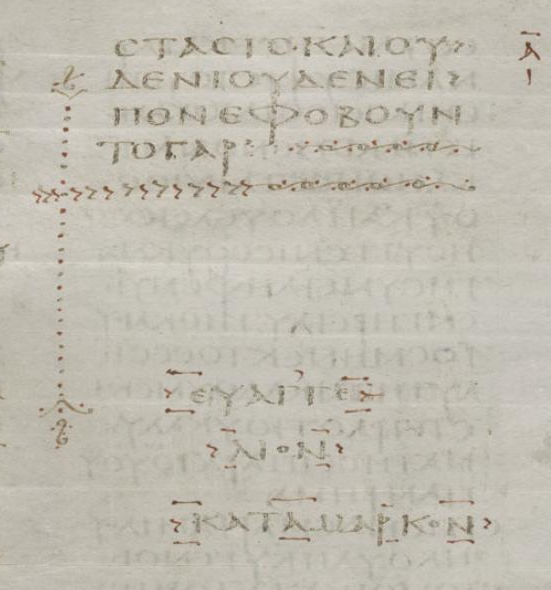
Obviously in the previous post, Kirsopp Lake wasn't impressed with the identification of "Scribe D" of Sinaiticus as the scribe of Vaticanus.   But before accepting that judgment, based on the style of the main text of the two MSS, we should note one other piece of evidence, which if nothing else, seems to tie the two MSS together at the scriptorium again.

We mean the colophons of both MSS.  These are essentially a kind of 'decorative signature' placed at the end of books by the scribe, although it is not as identifiable or as unique as a modern signature or fingerprint.  The following few samples are borrowed from W. Willker's page on the colophons of Vaticanus, which we can contrast with a good photo of the ending of Mark (placed below):

colophon of 1st John

colophon of 1st Peter

colophon of 2nd Peter

Enhanced colophon of Deuteronomy (Willker)

Colophon of Colossans
All are apparently by the same scribe, the scribe of Vaticanus.  (Willker has colored in the colophon of Deuteronomy to make it easier to see.)

Note that the scribe doesn't stick to the exact same pattern, but varies his doodle artistically, sometimes with dots, other times with scrolls, longer/shorter etc.  However, all these examples have some unique features in common, such as the chosen swirl shapes and use of dots etc. which should be carefully compared with the colophon for Mark written by "scribe D" below:
Contrast Enhanced

Codex Sinaiticus: Mark Colophon


Most textual critics are convinced these may be by the same hand, or at least represent a practice by the same group of scribes in the same scriptorium.
This extra evidence indicates the question of the identification of the "scribe D" of Sinaiticus with that of the scribe of Vaticanus may not be entirely without foundation.

peace
nazaroo

Wednesday, January 26, 2011

Sinaiticus & Mark's Ending (Pt 2): Burgon & Hort

When Tischendorf noted that Scribe D may have also been the scribe of Codex Vaticanus, this wasn't lost on Dean John Burgon.  Hort had previously argued for the independence of Sinaiticus and Vaticanus, insisting that their agreement always went back to an even earlier archetype or common ancestor.  The omission of Mark's Ending (Mark 16:9-20) was supposed to be again independent testimony by א and B to an earlier text.
Burgon called Hort out on the supposed "unique criterion supplied by the concord of the independent attestations of א and B" (so Hort).   Burgon remarked:
"...'independent attestations'?! But when two copies of the Gospel are confessedly derived from one and the same original, how can their attestations be called independent?  This is however greatly to understate the case:
 The non-independence of א and B in respect of St. Mark 16:9-20 is absolutely unique; for, strange to relate, it so happens that the very leaf from which the end of St. Mark's Gospel and the beginning of St. Luke's is written (Mk 16:2 - Lk. 1:56), is one of the 6 leaves of א which are held to have been written by the scribe of codex B.  Scrivener remarks 'The inference is simple and direct, that at least in these leaves  א and B make but one witness, not two.' (cf. F.H.A. Scrivener, Intro. vol. 2 p 337-8)
 - Burgon, Traditional Text, (London, 1871,1892) p. 233

However, the identity of the second scribe, Scribe D, need not be confirmed as the scribe of Codex Vaticanus for the essential problem to remain.   Its not that the 'cancel-sheets' or replaced pages of Sinaiticus were written by the scribe of Codex B that really matters.  Its the fact that the pages were taken out and replaced at all.   This puts collusion of some kind back on the table.


The supposed independence of the two MSS remains badly eroded, if not destroyed, by the fact that these MSS rested at the same scriptorium in Caesarea at about the same time during their manufacture, that is, before they ever left the scriptorium where they were made.  At that time, pages were removed and replaced by someone (scribe D) so that  א now conforms to B,   in omitting Mark's Ending.

The two manuscripts do not necessarily witness to an ancient text per se, but rather the two MSS actually witness to a single policy in a common scriptorium in the 4th century.   This policy may indeed have been based on an old manuscript omitting the verses or missing a page, but in the 4th century it may also have been based on political problems or religious controversy caused by the teaching found in the verses (e.g. Mk. 16:18 etc.).

Next, we'll look at Kirsopp Lake's examination of the pages.

peace
Nazaroo

Tuesday, January 25, 2011

Sinaiticus & Mark's Ending (Pt I): Scrivener

Since our mr.scrivener is a bit slow getting out of the starting gate, I'm going to plunge ahead here on Codex Sinaiticus and Mark's Ending (Mk. 16:9-20).

The first question is about the supposed "replacement-pages" at this very spot.  We get the first clue about them from F.H.A. Scrivener's popularization of Tischendorf's work, in his Collation of Sinaiticus (1867):
"In the deliberate judgment of Tischendorf, who has of course the best right to be heard on such a point, no less than four different hands were employed on the Codex Sinaiticus. He believes that:

The scribe A wrote the fragment of Chronicles, 1 Maccabees, the last 4 1/2 leaves of 4 Maccabees, Barnabas, and the whole NT excepting about six leaves.
To scribe В he ascribes the Prophetical Books and Hermas' Shepherd:
To scribe С the Poetical Books of the Old Testament, written in στιχοι or verses clause by clause, according to the sense, with two columns per page, just as in the great Codex Vaticanus, which in all other parts has three columns, but in the Poetical Books only two.
To scribe D he gives Tobit, Judith, the first 3 1/2 leaves of 4 Maccabees, and in the NT: 
leaf 10 (Matt. 16:9—18:12),
leaf 15 (Matt. 24:36—26:6),
leaf 28, 29 (Mark 14:64—Luke 1:56), [Quire 77 folio 4,5]
leaf 88 (1 Thess. 2:14—5:28),
leaf 91 (Heb.4:16—8:1),
and possibly the first 32 lines of Rev. (1:1-5 up to ιυ χυ,  fol. 126*), the last mainly upon grounds expressly assigned, which we shall speak of hereafter.
He further states that A and В much resemble each other, as also do С and D. On the other hand Tregelles, who by Tischendorf's permission examined the MS for three whole days in 1862, has observed no such diversity in the writing as would necessarily lead us to refer the several portions to different scribes;
Yet we know that Woide has suspected the same change of hands in the portion of the Codex Alexandrinus which he edited, and others too, with still greater show of probability, in the case of Codex Augiensis; though there is little doubt that each of these is the work of but one penman, whose hand would naturally vary a little with the quality of his materials, and as he became familiar with or weary of his task. 
Those who have not inspected the manuscript for themselves are scarcely entitled to express an opinion on a matter like this. We may venture, however, to say, that the published Facsimile plates (for the moveable type of the larger edition can hardly be relied upon in a question so delicate) show no such diversity as would have suggested to us Tischendorf's conclusions. 
Notice, however, the peculiar shape of omega, with its tall central stroke, represented in our Facsimile (7). This form occurs in none of Tischendorf's plates, by him assigned to С or D, or in those portions of the NT in moveable type which are imputed to D, but eight times in the two he ascribes to В (II. XVII.), six times in one of A's (V), only once in A's other nine, always towards the end of lines, mostly reduced in size, and except on Plate V. mixed up with the more familiar ω *  
We must add too, that the few leaves of the NT ascribed by Tischendorf to D are much freer from itacisms, or instances of false spelling, than those on either side of them: the transition is quite remarkable from leaf 9 of A to leaf 10 (Matt. 16:9 - 18:12) of D, and then back again to leaf 11 of A, as the reader may see for himself by consulting our collation. 
These remarks, so far as they extend, would seem to suggest two scribes, A being identical with B, and possibly С = D ; the members of which pairs Tischendorf declares to be much alike; but whether the actual penmen be one, or two, or four, is of the less importance, as (in the N. T. certainly, and most probably in the Old) the whole work was clearly executed at the same time, and transcribed from the same older copy. " (- F.H.A. Scrivener, Sinaiticus )
 From the above, it seems plausible that scribe D at least is a different hand than scribe A, and that scribe D is a much better speller, something that should be detectable in the subsequent examination of other pages, to shortly follow.

peace
Nazaroo

Friday, December 24, 2010

New Stories of Byzantine 'Recensions' from Bible.Org

An anonymous poster (identified as "Admin", i.e., 'administrator') who authoritatively answers questions at Bible.Org has begun propounding a whole new set of theories about the Byzantine Text.  In answer to a recent question about the problematic existence of thousands of discrepancies between the 'Alexandrian' manuscripts (Aleph, B,  C etc.).   Those who push the modern critical text, reconstructed mainly from Aleph/B are of course constrained to explain them.

The latest fantasy story from these parties is that there were two more definitive 'recensions' of the Byzantine text, one in the 9th and one in the 11th century!  To quote our anonymous 'expert':

"... Ironically, it is the Byzantine witnesses that, as time goes on, agree more and more. Two great periods of close agreement show strong evidence of a recension, one in the ninth century and one in the eleventh. By the time we get to the fifteenth century, the manuscripts are 98% in agreement with the printed Majority Text. The most likely explanation of this is that there was collusion—an intentional recension. It is in fact the only explanation that is based on evidence (Timothy Ralston’s doctoral dissertation at Dallas Seminary demonstrated this rather ably)." 

What evidence are we talking about?  Apparently "Timothy Ralston's doctoral dissertation", whatever that is.

Who is this anonymous 'expert'?

Well, elsewhere in the same post,  he says something else quite remarkable:
"when Aleph and B agree, their combined testimony must go back quite far. Westcott and Hort estimated that their agreement went back ten generations and must be located near the beginning of the second century."
Again in another 'expert answer':

"I would concur with Westcott and Hort that the common ancestor between these two MSS must be at least ten generations back. I hope this point is clear."
 Since Daniel Wallace personally responds to many of these inquiries with authored articles, we strongly suspect that "Admin" is simply Wallace incognito. 


Wallace himself doesn't apparently attach his name to such exact figures, for a good reason.  When his moniker is on the line, we find a much more subdued text, as in the recent book co-authored by Wallace,
"Many scholars believe that since both manuscripts belong to the same text-type yet have so many differences, their common ancestor must have been copied several generations before. ... Aleph and B are distant cousins from long after their common ancestor, which itself must go back several generations. Indeed, when they agree, their common reading usually is from the early 2nd century." (Wallace, Komoszewski, Sawyer, Reinventing Jesus (Kregel, 2006) p. 78.
Now to get to the early 2nd century, we only need an unspecified  "several generations". 

This kind of grandstanding is however extremely suspect.  TEN generations implies that someone has actually found evidence for TEN generations.  That is, they have found at least TEN identifiable layers among the differences collated between Aleph and B.  Of course if this were actually true, not only would it be published, but it would be front page textual-critical news.

The obvious elephant in the room is that this work has never been done, nobody has discovered "ten layers" or any other number of layers, in the conjectured and reconstructed line of ancestors between Aleph/B and their ancient common archetype.

Its another case of anonymous propaganda mascarading as  scientific and historical "fact". 

What about the "strong evidence of recension" claimed in the first post?  Don't hold your breath waiting for a demonstration of such an important, but so far unsubstantiated claim by the Hortian puppet-masters.

peace
Nazaroo

Sunday, December 19, 2010

Gerd Mink on Commentary MSS

In his article on textual stemmas for the NT - "Problems of a Highly Contaminated Tradition", found in the recent volume, Studies in stemmatology II , By Pieter Th. van Reenen, A. A. den Hollander, Margot van Mulken (2004, p.49) Gerd Mink makes the following concise and accurate statement on "commentary manuscripts", useful for a clear understanding of these special copies:
"Commentary manuscripts contain, apart from the commentaries, the continuous NT text. It is unlikely that these commentary manuscripts served as exemplars for manuscripts containing the continuous text. But it is very plausible that that text form was chosen as the basis for a commentary which was the most highly esteemed at that particular time and place. Accordingly, [that text-type] would also have been used as an exemplar in the scriptoria."

That is, the text chosen for the commentary would be the one popular for regular copies in that scriptorium where the commentary was made, at the time it was made. It would not normally be an "ancient text", but rather an 'approved text'.

This is an important observation regarding the conventions for such commentaries, because the discussion in the commentary itself would often be incongruous with the text presented alongside it. This is because the commentary would often have been composed some 5 or 10 centuries earlier than the commentary manuscript, and the author's text would differ from the one popular many centuries later. The commentaries would not be rewritten to correct this, and in fact it would probably not be noticed, as the two tasks were done separately in sections, even when written by the same scribe.

To take a specific case, 'Codex X' is not an ancient Uncial manuscript, in spite of its conventional letter ('X'). It is actually a late 12th century commentary, with gospel text included. The commentary and text is alternately placed in sections in the manuscript body.

Only parts of text which will be relevant to the commentary will be copied alongside the commentary. Because of this, there is a perfectly obvious explanation as to why this manuscript does not contain the Pericope de Adultera (John 7:53-8:11). The ancient commentary doesn't discuss it, because this passage of John was not read publicly during Pentecost services. The commentary follows the sections of John as they are read in public worship, so the commentary doesn't comment on a passage which is left out of the services.

The scribe who copied the sections from a continuous manuscript into the commentary did not bother to copy Jn. 7:53-8:11, since it was not relevant to the commentary. So even though this commentary manuscript generally gives a faithful copy of the continuous manuscript used to make it, the commentary manuscript itself (Codex X) cannot tell us what the original continuous copy had or did not have in its own text.

It is wrong to call this commentary a "continuous text manuscript". It is not. It is a commentary which contains text from a continuous text manuscript. But it cannot tell us more about that lost exemplar than it has bothered to record. As it is, the passage up to John 7:52 is copied for one section, and the passage beginning at 8:12 is copied a page or two later for the next section of the commentary. We can never know from this what the original continous-text manuscript looked like at the critical junction, 7:52/8:12. It may or may not have contained John 7:53-8:11. If it did, the copyist of Codex X did not record this fact for us, as it was of no concern to him when constructing the commentary with text.

In view of this, it is pointless to cite "Codex X" as if it were a witness for or against the text of the Pericope de Adultera (John 7:53-8:11). It is not a 'continuous-text' manuscript, except in the sense that it contains text from a real 'continuous-text' manuscript. It is not even a NT manuscript at all; it is a commentary, which happens to contain text from all four gospels, but not entirely complete.

Much confusion regarding the 'witness' of Codex X would be eliminated if it were simply dropped from the apparatus, as it has nothing to say about the authenticity or position of the Pericope de Adultera.

peace
Nazaroo


Saturday, November 27, 2010

Mark 1:2 - was it homoioteleuton?

Some key components of a thorough examination here have been inadvertantly skipped.

Lets see if we can work them in:

(1) It is important to determine the probability as to whether it is an accidental variation, or a deliberate change. The reason is that certain “canons” (rules) of NT TC only apply to one type of Variation Unit (VU) or another. Without intelligent guidance, rules and “cases” can lead us astray. Thus we need “meta-rules” for the rules. One such “meta-rule” is to try to determine the basic category (Accident/Deliberate). On the one hand, accidents often leave naive evidence behind as to what happened, aiding in evaluating readings. On the other, deliberate changes can sometimes be explained, as you have above, treating this variant as a deliberate editing job.

In the above example, the problem is why or what occasioned the boldness of a copyist, or even an editor to dare to make the change? More is needed than just “perceived benefit”. A copyist must feel so compelled as to go against all his training and habit of accurate reproduction. Even an editor must feel a mandate or convincing authority to make a decision, like the choice between variants. The variants usually already have to be present. That one corrector chose one reading and another the opposite tells us nothing about how this likely scenario actually arose. It is perhaps less difficult for an editor to make a “conjectural emendation” but still very very difficult, when even a self-appointed mandate would normally be preservation of the original text.

The possible answer is ironically found in an ACCIDENTAL origin. suppose the original text was as you suggest:

(1) “γέγραπται ἐν τῷ Ἠσαΐᾳ τῷ προφήτῃ”

Sans the later breathings, accents, and punctuation, it would have actually looked more like this:

ΓΕΓΡΑΠΤΑΙ ΕΝ ΤΩ ΗΣΑΙΑ ΤΩ ΠΡΟΦΗΤΗ…

A clear homoioteleuton drop out waiting to happen. After sleepy copyist A, the text looks like this:

ΓΕΓΡΑΠΤΑΙ ΕΝ ΤΩ ΠΡΟΦΗΤΗ…

Now copyist B reads it and thinks: “The case is definitely wrong. It doesn’t even match!” He adjusts what looks like an illiterate scribe’s gaffe, and voila:

ΓΕΓΡΑΠΤΑΙ ΕΝ ΤΟΙΣ ΠΡΟΦΗΤΑΙΣ…

γέγραπται ἐν τοῖς προφήταις“

The initial mistake gave occasion for the editors to jump into action. Now both readings become entrenched, because they are both possible and credible.

Other missing considerations could be discussed also.

For more on the controversial issues of NT TC, try our site here:
http://pa-john.freehostia.com/TEXT/Articles.html

peace
nazaroo

Tuesday, November 16, 2010

Matt. 12:46-48 - Classic Homoioteleuton


Click to Enlarge


In a lot of ways, Matthew 12:46-48 is a textbook case of homoioteleuton (accidental line skip from similar endings). The picture gives an example of how the text may have been laid out in the master-copy where the opportunity arose for error while copying this copy.

In this case, we have duplicated part of a column in the format typical of 4th century uncials such as Codex Vaticanus (B), with about 18-22 letters per line, and justified on both sides of the column.

Its easy to see how such errors can arise: The copyist finishes the first line ending in red; he is still looking at his own copy. He has in memory the line he has just copied, and now glances back to the master-copy (pictured here). He hunts for the line, by scanning down the right side for the last word he has just copied. He thinks he finds the line, but it is a similar line further down. Now his eye moves to the next line after the second instance, and he continues copying.

If the text still makes sense after the loss of the intervening text, this error will may not get corrected on a first pass. The corrector has the same problem as the copyist, that is, keeping track of lines in the master-copy as he glances back and forth to the copy during the check.

Typically, scribes skip text about 4 to 10 times as often as they accidentally duplicate text (copying it twice). But doubled lines are also easier to spot, and correct. One need only draw a line through the extra text. It will be immediately apparent to the next reader what happened.

Repairing an omission is much more difficult, as one may have to erase several columns and re-write them smaller to fit in the text, if not noticed early enough in the copying process.
There are several factors then that cause omissions to be perpetuated, while additions usually never make it past one generation of copies.

Often, there are several ways the text could have been laid out to create an easy opportunity for
homoioteleuton. In the following picture, the same error could have been made copying a 'wide margin' master-copy in the style of Codex W:


Essentially, any width of column where the intervening text forms some exact multiple of line numbers will cause the similar text to align. It doesn't even have to be at the end of the lines. The same error can arise (although perhaps less often from homoioarcton (skips from similar beginnings of lines).

Even a style like Codex Bezae, where the line endings are not right-justified, could still cause the same copying error:


Include Verse: א(corr.a) Θ Π 0112 0250
family 1, family 13, 28 33 565 700 892 1010 1071 1079 1195 1216 1230
1242 1253 1344 1365 1546 1646 2148 2174 Byz Maj (Majority of continuous MSS) lect.-333 it-a/aur/c/d/f/ff2/g1/h/l/q Vg Syr-P/H Cop-Bo Goth Arm Eth Geo
Diatessaron Origen Chrysostom


Omit: א* B L
1009 l12 it-ff1 Cop-Sa


For more textual information on this Variation Unit, click below:

Matthew 12:46-48 < - - Click here.

peace
Nazaroo

Tuesday, January 2, 2007

Egerton 'Gospel' - Earliest Evidence for Jn 8:1-11?


After nearly a century of intense study of the Egerton 'Gospel'fragments, the dust has pretty much settled about the actual nature ofthe document. It is probably not an unknown '5th gospel', but rather an interesting piece of creative writing, a 'harmony' of sorts of at least three canonical gospels (possibly by a student, or practicing writer/preacher).

It is now virtually admitted that the 'author' used canonical John among other documents (and not vice versa for instance), based upon the nature of the internal evidence in the document.This has made the Egerton papyrus perhaps one of the earliest significant textual witnesses to the existance and circulation of theGospel of John.

However, the use of John being reasonably settled, little thought has apparently been spent upon its possible importance as a witness to the early existance (and location in John) of the Pericope de Adultera. Admittedly, the evidence is very slender and tentative.

But it is a remarkable coincidence, that two phrases are placed in close proximity, in the correct order (the same as in the Pericope), namely,

"rulers...the crowd..."

"Teacher! (didaskale)" ...

"Go...and sin no more!"

In particular, the combination of "Teacher"...(cf. Jn 8:4) and "Sin no more" (Jn 8:11) are eerily reminiscent of the Pericope de Adultera.


But if we admit that the Egerton author had John in front of him already, the next question might be, not whether he himself connected the conversation of Nicodemus ("Rabbi" Jn 3:2) with that of the cripple in Judea ("Sin no more" Jn 5:14), but rather,

"Did the Egerton author use the Pericope de Adultera as an enclosing template for his Leper story?"

Note especially that in John's Gospel Nicodemus uses 'Rabbi', not 'Didaskale', and so Jn 3:2 is less plausible as the source for the 1st statement in the Egerton fragment.

This 2nd century 'harmonizer' uses 'Didaskale' elsewhere as well, making it a kind of trademark for the Egerton work, so this is perhaps not so unusual in itself. Yet...Whatever may be said of the 'softness' of the connection, it must be admitted that the only place in the Entire New Testament, and even among the hundreds of non-canonical 'gospels', where these two phrases come together in this order in close proximity, is the Pericope de Adultera, John 8:1-11.

The Egerton Papyrus and related articles are online here:

Egerton Papyrus Homepage <-- Click Here.