Showing posts with label Codex Sinaiticus. Show all posts
Wednesday, March 11, 2015
Homoioteleuton Errors in Modern NT Translations
Every single one of these translations uses a critical Greek text
which mutilates the New Testament by deleting some 200 whole and half-verses.
They did this on the flimsy basis that these were added to the text by
editors and copyists, in part by accident but mostly by intent,
for explanatory purposes or to reinforce or invent favorite doctrines.
However, modern scientific scholarship has shown that these are almost
all simply scribal errors, and accidental omissions mainly by homoioteleuton,
that is, lines were dropped due to similar endings or beginnings.
For the real statistical knowledge about scribal errors, these articles
should be consulted, which show that the general tendency was to omit,
not add text to the New Testament.
General Articles on Errors:
J. Wetstein (1751): Older MSS - Older not = Better!
J. Burgon (1882): Haplography - mechanics of error
B. Weiss (1887): Omissions - & most common errors
F.W. Shipley (1904): Dittography - & omissions
H. Gamble (1977): Interpolation - Identifying Marks
L. Haines (2008): Scribal Habits - 'Shorter Reading'?
J.Royse (2008) Shorter Reading? - & Griesbach
W. Pickering (2009) Oldest = Best MSS? - early errors
T. Holland (2009) "Oldest & Best MSS" - & Byzantine
Errors in Specific MSS:
B.B. Warfield (1887): Haplography - examples from א
S. F. Kenyon (1901): Haplography - more ex. from א/B
H. von Soden (1911): Omissions - in Codex א/B
H.A. Sanders (1912): Haplography - in Codex W
E.C. Colwell (1969): Haplography - & P45, P66, P75
D.A. Carson (1979) & homoeoteleuton - Lk 14:26
Jongkind (2005): א - tests Singular Readings Method!
J. Hernandez (2006): Errors of א in Rev - singular OMs
J. Royse (2008): Scribal Habits - P45,46,47,66,72,75
J. Royse (2008) homoeoteleuton - singular omissions
J. Krans (2010) GA-3 - famous insertion: 2 Cor 8:4
Scrivener (2010) homoeoteleuton - P-Oxy-1780 new!
For specific information on the actual verses that modern (per)versions
leave out, or place in the margin or footnotes, or bracket as if they were
unreliable or in doubt, or possible additions, look at these examples:
Saturday, April 19, 2014
Text Variants influenced by & affecting Doctrine: (1) Mark 7:19 (a)
The Problem with Mark 7:19
The Problem with this scripture is complicated by two layers of confusion.
The first concerns the Greek text.
While the Traditional (Majority/Received) Greek text of Mark reads as follows:
We can see the significant impact of the alteration of a single letter in one word in the resulting translation:
The Traditional text reads:
The UBS text reads:
But this not only rests on shakey textual ground, but it rests also on a super-imposed meaning based on Roman Catholic popular teaching.
When we look at the context, the correct reading is even clearer.
(1) Jesus lived as a law-abiding Jew during His public ministry.
(2) Had Jesus and His disciples been actually breaking the Jewish Food Laws, the Pharisees would hardly have quibbled about hand-washing, but would have accused Him (as they later did) of breaking with Jewish Law (Torah).
But the worst the Pharisees can observe is that some of Jesus' disciples forgot to wash their hands.
(3) Had Jesus taught that "all foods were clean" during His public ministry, all the Apostles would have long known of it, and Peter would have no need of any "vision" in Acts to clarify things.
(4) Nor would the Apostles in council have needed to review the matter and issue a simplified set of food-laws for Gentiles, if Jesus had taught that JEWS did not need to keep the Food Laws.
This is just another case of 19th century textual critics running after and idolizing a handful of 4th century manuscripts over and against the traditional text of the New Testament used by Christians for a thousand years.
Mark 7:19 is a good example of what happens when Protestants goof off, and let Roman Catholics write their bibles for them. The UBS Greek text was overseen by Cardinal Martin.
The Problem with this scripture is complicated by two layers of confusion.
The first concerns the Greek text.
While the Traditional (Majority/Received) Greek text of Mark reads as follows:
"...παν το εχωθεν εισπορευμενον εις τον ανθρωπονThe Hort/Nestle/UBS text however, reads καθαριζων, ('[he was] purifying'), thus ending the quotation after εκπορευεται, and setting off the last phrase as Mark's explanation in the narrative (rather than a continuation of Jesus' speech). This reading is only supported by three manuscripts, Codex Sinaiticus (Aleph), Vaticanus (B), and Alexandrinus (A), against the entire corpus of thousands of other MSS.
ου δυναται αυτον κοινωσαι.
οτι ουκ εισπορευεται αυτου την καρδιαν
αλλ' εις την κοιλιαν,
και εις τον αφεδρωμα εκπορευεται,
καθαριζον παντα τα βρωματα."
"...παν το εχωθεν εισπορευμενον εις τον ανθρωπονWhat is the significance of the change? It represents a stage in the Romanization (Gentilizing) of the New Testament, in which early editors tried to remove the embarrassing "Jewish" elements and downplay the Jewish origins and teachings of Jesus and the Apostles, in the process of making Christianity the state religion of the Roman Empire.
ου δυναται αυτον κοινωσαι.
οτι ουκ εισπορευεται αυτου την καρδιαν
αλλ' εις την κοιλιαν,
και εις τον αφεδρωμα εκπορευεται."
- καθαριζων παντα τα βρωματα.
We can see the significant impact of the alteration of a single letter in one word in the resulting translation:
The Traditional text reads:
"...everything from outside entering into the manThe Traditional text is straightforward, and simply states the obvious, that even if food temporarily enters a man, it also leaves again, restoring a man's purity (e.g. through fasting). There is no "magical" meaning attached to Jesus' words, nor is it needed, in order to make sense of the teaching.
is not able to make him 'common';
because it doesn't enter into his heart,
but into the intestine,
and into the toilet passes,
purifying [the man] of all the foods..."
The UBS text reads:
"...everything from outside entering into the manNaturally, all 'modern' versions, based on these 4th century Roman heavily edited ecclesiastical texts make Mark say in the narrative that Jesus had "declared all foods clean".
is not able to make him 'common';
because it doesn't enter into his heart,
but into the intestine,
and into the toilet passes."
- [he was ] purifying all foods...
But this not only rests on shakey textual ground, but it rests also on a super-imposed meaning based on Roman Catholic popular teaching.
When we look at the context, the correct reading is even clearer.
(1) Jesus lived as a law-abiding Jew during His public ministry.
(2) Had Jesus and His disciples been actually breaking the Jewish Food Laws, the Pharisees would hardly have quibbled about hand-washing, but would have accused Him (as they later did) of breaking with Jewish Law (Torah).
But the worst the Pharisees can observe is that some of Jesus' disciples forgot to wash their hands.
(3) Had Jesus taught that "all foods were clean" during His public ministry, all the Apostles would have long known of it, and Peter would have no need of any "vision" in Acts to clarify things.
(4) Nor would the Apostles in council have needed to review the matter and issue a simplified set of food-laws for Gentiles, if Jesus had taught that JEWS did not need to keep the Food Laws.
This is just another case of 19th century textual critics running after and idolizing a handful of 4th century manuscripts over and against the traditional text of the New Testament used by Christians for a thousand years.
Mark 7:19 is a good example of what happens when Protestants goof off, and let Roman Catholics write their bibles for them. The UBS Greek text was overseen by Cardinal Martin.
peace
Nazaroo
Tuesday, January 10, 2012
Thursday, August 18, 2011
The Question of the Theft of Codex Aleph
“Codex Sinaiticus, most of it taken by Dr von Tischendorf in 1859 from St. Catherine’s monastery beside Mt Sinai in Egypt– the monks say stolen –”
http://www.theologicaleditions.com/Features/religioustexts.htm
“J. Rendel Harris (who had visited St. Catherine’s) had no illusions: in his review of Gregory’s “Text and Canon” in the February 1908 issue of The Expositor, Harris expressed extreme skepticism (bordering on outright ridicule) of Tischendorf’s version of events pertaining to the “rescue” of Codex Sinaiticus.” – James Snapp Jr.
http://evangelicaltextualcriticism.blogspot.com/2009/07/codex-sinaiticus-highlights-ii.html
“While staying at St. Catherine’s monastery on Mount Sinai, he made the momentous discovery of the Codex Sinaiticus–a text dated to be from the fourth century C.E. He brought back the text with him. (According to the Mt Sinai monks, though there were bad feelings, and claims that Tischendorf had “stolen” the manuscript.)”
http://www.entheology.org/library/winters/NEWTEST2.TXT
“See for example D.A. Waite, Defending the King James Bible (The Bible For Today: 1993), p. 61, “They just about worship that manuscript.” This was just after alleging, inaccurately, that a was about to be burned (one will note that the steward at St. Catherine’s kept the manuscript in his cell, wrapped in a red cloth, hardly the way in which one treats trash). ”
http://www.aomin.org/aoblog/index.php?itemid=1290
“Under a complicated arrangement, Tischendorf was allowed to transcribe the manuscript, but did not have the time to examine it in full detail. Tischendorf wanted to take the manuscript to the west, where it could be examined more carefully.
It is at this point that the record becomes unclear. The monks, understandably, had no great desire to give up the greatest treasure of their monastery. Tischendorf, understandably, wanted to make the manuscript more accessible (though not necessarily safer; unlike Saint Petersburg and London, Mount Sinai has not suffered a revolution or been bombed since the discovery of Aleph). In hindsight, it seems quite clear that the monks were promised better terms than they actually received (though this may be the fault of the Tsarist government rather than Tischendorf). Still, by whatever means, the manuscript wound up in Saint Petersburg, and later was sold to the British Museum. ”
http://www.skypoint.com/members/waltzmn/ManuscriptsUncials.html
“A story of high adventure swirls around the Codex Sinaiticus. Tischendorf was granted an audience with the pope. The czar of Russia showered him with money and financed his final mission. Despite his fame, though, a shadow hangs over the man, who some insist was a thief.
Scattered Book, Checkered Reputation
…
However, opinion on Tischendorf is as diffuse and puzzling as the ancient pages themselves. Christfried Böttrich, an expert on the New Testament at Germany’s University of Greifswald, claims that “Tischendorf was a man without blemish and above reproach.”
But the monks at St. Catherine’s have a less flattering view. They think he stole the manuscript. “The Codex Sinaiticus Was Stolen,” was the headline of a 2000 article in the Sunday Times about a conference a British parliamentary committee held on stolen artifacts. Prince Charles, who is chairman of the St. Catherine’s Foundation, has reportedly demanded the return of the manuscripts to Egypt.”
http://www.spiegel.de/international/world/0,1518,479791,00.html
peace
Nazaroo
Labels:
Codex Sinaiticus,
monks,
Nazaroo,
theft,
Tischendorf
Friday, March 11, 2011
Sinaiticus & Mark's Ending (Pt 13): Burgon's Vindication on Dating
We may appropriately close this series of articles on Sinaiticus and Mark's Ending with the original Appendix by Dean John Burgon (1871) in his classic defense of the ME,
The special feature we discussed in the previous article, Dean Burgon had not noted, but in point (4) he fully notices the general frequency of "outdenting" the first letter of every paragraph so prevalent in Sinaiticus but almost nonexistent in Vaticanus, itself suggesting a significant difference in style and age.
Peace
Nazaroo
On the Relative Antiquity of B & Aleph
I. “Vix differt aetate a Codice Sinaitico,”, says Tischendorf, (ed. 8va, 1869, p. ix,) speaking of the Codex Vaticanus (B). Yet does he perpetually designate his own Sinaitic Codex (א) as “omnium antiquissimus.” Now, א Lacks Ancient Features
(1) The (all but unique) sectional division of the Text of Codex B, — confessedly the oldest scheme of chapters extant, is in itself a striking note of primitiveness. The author of the Codex knew nothing, apparently, of the Eusebian method. But I venture further to suggest that the following peculiarities in Codex unmistakably indicate for it a later date than Codex B.
(2) Cod. א , (like C, and other later MSS.,) is broken up into short paragraphs throughout. The Vatican Codex, on the contrary, has very few breaks indeed: e.g. it is without break of any sort from S. Matth. xvii. 24 to xx. 17: whereas, within the same limits, there are in Cod. א as many as thirty interruptions of the context. From S. Mark xiii. 1 to the end of the Gospel the text is absolutely continuous in Codex B, except in one place: but in Cod. א it is interrupted upwards of fifty times. Again: from S. Luke xvii. 11, to the end of the Gospel there is but one break in Codex B. But it is broken into well nigh an hundred and fifty short paragraphs in Cod. א . There can be no doubt that the unbroken text of Codex B, (resembling the style of the papyrus of Hyperides published by Mr. Babington,) is the more ancient. The only places where it approximates to the method of Cod. א , is where the Command- ments are briefly recited (S. Matth. xix. 18, &c.), and where our LORD proclaims the eight Beatitudes (S. Matth. v.)
(3) Again; Cod. א is prone to exhibit, on extraordinary occasions, a single word in a line, as at —
S. MATTH. XV. 30.
ΧΩΛΟΥΣ
ΤΥΦΛΟΥΣ
ΚΥΛΛΟΥΣ
ΚΩΦΟΥΣ
S. MARK X. 29.
Η ΑΔΕΛΦΑΣ
Η ΠΑΤΕΡΑ
Η ΜΗΤΕΡΑ
Η ΤΕΚΝΑ
Η ΑΓΡΟΥΣ
S. LUKE XIV. 13
ΠΤΩΧΟΥΣ
ΑΝΑ ΗΡΟΥΣ
ΧΩΛΟΥΣ
ΤΥΦΛΟΥΣ
This became a prevailing fashion in the 6th century; e.g. when the Cod. Laudianus of the Acts (E) was written. The only trace of anything of the kind in Cod. B is at the Genealogy of our LORD.
(4) At the commencement of every fresh paragraph, the initial letter in Cod. slightly projects into the margin, — beyond the left hand edge of the column; as usual in all later MSS. This characteristic is only not undiscoverable in Cod. B. Instances of it there are in the earlier Codex; but they are of exceedingly rare occurrence.
(5) Further; Cod. א abounds in such contractions as ΑΝΟΣ, ΟΥΝΟΣ (with all their cases), for ΑΝΘΡΩΠΟΣ, ΟΥΡΑΝΟΣ, &c. Not only ΠΝΑ, ΠΗΡ, ΠΕΡ, ΠΡΑ, ΜΡΑ (for πνευμα, πατηρ-τερ,-τερα, μητερα ), but also ΣΤΡΘΗ, ΙΗΛ, ΙΗΛΗΜ, for Σταυρωθη, Ισραηλ, Ιερουσαλεμ.
But Cod. B, though familiar with ΙΣ (Ιησους), and a few other of the most ordinary abbreviations, knows nothing of these compendia: which certainly cannot have existed in the earliest copies of all. Once more, it seems reasonable to suppose that their constant occurrence in Cod א indicates for that Codex a date subsequent to Cod. B.
(6) The very discrepancy observable between these two Codices in their method of dealing with “the last twelve verses of S. Mark's Gospel,” (already adverted to at p. 88,) is a further indication, and as it seems to the present writer a very striking one, that Cod. B is the older of the two. Cod. א is evidently familiar with the phenomenon which astonishes Cod. B by its novelty and strangeness.
(7) But the most striking feature of difference, after all, is only to be recognised by one who surveys the Codices themselves with attention. It is that general air of primitiveness in Cod. B which makes itself at once felt. The even symmetry of the unbroken columns; — the work of the prima manus everywhere vanishing through sheer antiquity; — the small, even, square writing, which partly recalls the style of the Herculanean rolls; partly, the papyrus fragments of the Oration against Demosthenes (published by Harris in 1848): — all these notes of superior antiquity infallibly set Cod. B before Cod.א; though it may be impossible to determine whether by 50, by 75, or by 100 years."
The special feature we discussed in the previous article, Dean Burgon had not noted, but in point (4) he fully notices the general frequency of "outdenting" the first letter of every paragraph so prevalent in Sinaiticus but almost nonexistent in Vaticanus, itself suggesting a significant difference in style and age.
Peace
Nazaroo
Labels:
Codex Sinaiticus,
Mark's Ending,
MS Evidence,
Nazaroo,
Variation Units
Friday, February 25, 2011
Sinaiticus & Mark's Ending (Pt 12): The Dating Bombshell
Earlier we posted a chart showing the Quire structure of Sinaiticus, but left some portions of the chart unexplained. Now we turn to this problem, specifically the following blip on the radar screen:
Now these pages are certainly also written by Scribe A, and identified as such by the British Museum Official Website. In fact, the second half of page 76-7 verso could hardly have been written by anyone else, given that the first half was clearly done the previous day by him:
Just as Mr. Scrivener has described Alexandrinus on his blog, we see the first letters of paragraphs fully 'outdented' into the margin, and enlarged! What is Scribe A doing? He finishes this page and also the whole last folio of the Quire (76) in the same format (this shows by the way that the text was written Quire by Quire: the next Quire begins again with the expected 'regular' style).
The answer is obvious, but not welcome. Scribe A has slipped into his own habitual way of copying MSS. He's forgotten what he's doing. He completes the Quire without even noticing this major gaffe.
But this is the most important and stunning piece of information we have yet gathered about Scribe A, the scriptorium, and specifically, the date of the manuscript's manufacture.
As Mr. Scrivener has noted for us, Alexandrinus was made no earlier than about 380 A.D. (Dating Alexandrinus) This was the time that this style of calligraphy was popular and even standard, and not before. Scribe A has tipped his hand, and perhaps not accidentally at that, but even slyly. And Scribe D has not noticed this boner, but it is such a disfigurement of the style of the codex that surely Scribe D would have yanked out the bottom sheet of the Quire and replaced the 1st and 8th folios to fix it.
Why then were the Scribes trying carefully to copy the style of a manuscript written about 100 years earlier? The answer is obvious here too. They wanted to give it the look and feel, the prestige, perhaps even the authority of an earlier manuscript. Why? Because this is what the rich patron who was paying for this expensive copy wanted. Like an early Roman copy of Greek 'gods', this manuscript is actually a reproduction, not a real early 4th century manuscript.
Is it a forgery? No. Not exactly. In fact, as a comparison to Codex B shows, the scribes were indeed copying from a much older master-copy, presenting a very early text. Thus it is in some sense just what it purporting to be: the text of an early 4th century manuscript. This was probably a stylistic choice dictated by the artistic vogue of the later period. But the point is, its just an early reproduction.
Hort Knew Sinaiticus was Late:
This fact did not pass unnoticed, even by Hort himself. He did not dare openly suggest a date 80 years later than the one supposed by Tischendorf and accepted by most other critics on his authority. But Hort carefully and quite clearly indicated that he knew this codex was much later than Codex Vaticanus. As Mr. Scrivener noted in another context on his blog ( copy generations ) :
It makes perfect sense however, if Sinaiticus is actually a reproduction, made in the same or a similar scriptorium, but 80-100 years later. The original master used by Vaticanus was probably now long gone, but a copy several generations later was still available, reflecting essentially the same archetype as Vaticanus, but with subsequent layers of copying errors.
Thus Hort knew that Sinaiticus betrayed itself as a later text with a subsequent accumulation of further corruption, explaining well its differences from Vaticanus, and Hort's own preference for Vaticanus.
Other Examples:
What other manuscripts also exhibit this similar and quite unique style of "outdenting"?
Codex Φ (Beratinus, GA-043) from the 6th century also displays the same style, with marginal notes placed around the Outdented Letters in the very same way:
Although this manuscript Codex Φ (GA-043) is in very bad shape, you can see that it was once a beautiful piece of caligraphy in the same style as Alexandrinus (5th cent.) and these unusual pages of Sinaiticus from Quire 76.
peace
Nazaroo
![]() | ||
| Two and a Half Pages of Bizarre! |
First 2 columns normal: Last two in style of Alexandrinus!
![]() |
| 76-7 verso: Click to Enlarge, backbutton to return |
Just as Mr. Scrivener has described Alexandrinus on his blog, we see the first letters of paragraphs fully 'outdented' into the margin, and enlarged! What is Scribe A doing? He finishes this page and also the whole last folio of the Quire (76) in the same format (this shows by the way that the text was written Quire by Quire: the next Quire begins again with the expected 'regular' style).
The answer is obvious, but not welcome. Scribe A has slipped into his own habitual way of copying MSS. He's forgotten what he's doing. He completes the Quire without even noticing this major gaffe.
But this is the most important and stunning piece of information we have yet gathered about Scribe A, the scriptorium, and specifically, the date of the manuscript's manufacture.
As Mr. Scrivener has noted for us, Alexandrinus was made no earlier than about 380 A.D. (Dating Alexandrinus) This was the time that this style of calligraphy was popular and even standard, and not before. Scribe A has tipped his hand, and perhaps not accidentally at that, but even slyly. And Scribe D has not noticed this boner, but it is such a disfigurement of the style of the codex that surely Scribe D would have yanked out the bottom sheet of the Quire and replaced the 1st and 8th folios to fix it.
Why then were the Scribes trying carefully to copy the style of a manuscript written about 100 years earlier? The answer is obvious here too. They wanted to give it the look and feel, the prestige, perhaps even the authority of an earlier manuscript. Why? Because this is what the rich patron who was paying for this expensive copy wanted. Like an early Roman copy of Greek 'gods', this manuscript is actually a reproduction, not a real early 4th century manuscript.
Is it a forgery? No. Not exactly. In fact, as a comparison to Codex B shows, the scribes were indeed copying from a much older master-copy, presenting a very early text. Thus it is in some sense just what it purporting to be: the text of an early 4th century manuscript. This was probably a stylistic choice dictated by the artistic vogue of the later period. But the point is, its just an early reproduction.
Hort Knew Sinaiticus was Late:
This fact did not pass unnoticed, even by Hort himself. He did not dare openly suggest a date 80 years later than the one supposed by Tischendorf and accepted by most other critics on his authority. But Hort carefully and quite clearly indicated that he knew this codex was much later than Codex Vaticanus. As Mr. Scrivener noted in another context on his blog ( copy generations ) :
[Hort] does say a few things [re: Aleph/B]:Hort here clearly indicates that the subsequent history (post common-ancestor) of Codex Vaticanus is relatively short and direct. This is in contradistinction to Codex Sinaiticus, for which he posits a longer and more complex history for the text it contains. But this would make little sense if they are really closely contemporary and from the same scriptorium.
a) B and Aleph are entirely different in regard to their subsequent history, i.e., 'post-nearest common ancestor'. For Vaticanus he makes incredible claims of purity and FEWNESS of generations:
"The ancestry of B posterior to the common archetype was probably a chain of very few links indeed;..." (Hort, Introduction, ¶ 328. pg 248-9, ).
Again, speaking primarily of B's unique/subsingular readings, he says,
"the sources of corruption in B are for the most part of a sporadic and indeterminate character (cf. ¶ 204)." (Hort, Intro, ¶ 328, p.250)
It makes perfect sense however, if Sinaiticus is actually a reproduction, made in the same or a similar scriptorium, but 80-100 years later. The original master used by Vaticanus was probably now long gone, but a copy several generations later was still available, reflecting essentially the same archetype as Vaticanus, but with subsequent layers of copying errors.
Thus Hort knew that Sinaiticus betrayed itself as a later text with a subsequent accumulation of further corruption, explaining well its differences from Vaticanus, and Hort's own preference for Vaticanus.
Other Examples:
What other manuscripts also exhibit this similar and quite unique style of "outdenting"?
Codex Φ (Beratinus, GA-043) from the 6th century also displays the same style, with marginal notes placed around the Outdented Letters in the very same way:
Although this manuscript Codex Φ (GA-043) is in very bad shape, you can see that it was once a beautiful piece of caligraphy in the same style as Alexandrinus (5th cent.) and these unusual pages of Sinaiticus from Quire 76.
peace
Nazaroo
Labels:
Codex Sinaiticus,
dating,
Mark's Ending,
Nazaroo
Saturday, February 19, 2011
Sinaiticus & Mark's Ending (Pt 11): Quire Structure - Synoptics
It has taken some time, but now we are approaching the more interesting aspects of the making of Sinaiticus:
An examination of the Quires by others has revealed the basic quire structure, and groupings of the folios. This is important, for it gives us important clues as to how the task of writing and compiling the NT was carried off.
The text was written quire by quire (in folded 8 folio sections). However, the planning was carried out on a larger scale, to calculate and provide just enough vellum (a very expensive material) for the task.
John was done separately, on two quires, beginning at the top of a new quire, and the second quire consisted of only three sheets (quire 81 has only 6 folios). The Collection of Paul's letters was begun also on a new quire (82-1), so we know that quire 81 probably never had 8 folios. (Paul follows John in Aleph. 1st Cor. begins immediately after Romans on folio 82-7verso, column 3, showing that the letters were treated as a group and copied continuously in quires of 8).
This information, combined with the layout of the Synoptics shows that the Synoptics were done together, and laid out on six quires, with the scribe periodically checking the page-by-page progress, and compressing or expanding the material by columns as required to keep pace and arrive at the correct place at various points in each quire.
This process makes it important to note that although Quire 79 only has 7 folios, it must have started with 8, because the quires would be assembled in a standard way before the text was planned and written. The reason for this step is to prevent the mixing up of pages, while breaking the job down into reasonably sized tasks. When the quire was complete, the 8th blank folio would have been trimmed off.
We can now consider the replacement-sheets.
We already know that the reason for replacement-sheet 1 (folios 75-2, 75-7) was a severe and problematic omission of large size (see previous post). This was done long after the entire Synoptics section at least was complete, because the Eusebian marks are missing.
But this is not so for replacement-sheet 2 (folios 77-4, 77-5): This on the contrary, appears to indeed have been done certainly before the manuscript ever left the scriptorium, and even before the Eusebian marks were added, since they are present on this sheet.
Why was this sheet replaced? (77-4/5)
Since there has not been any real addition of unusual material here (not even the Short Ending of Mark was inserted), some have conjectured that there must have been an unknown omission in the first six columns of Luke, for this would leave the format of the critical page the same, but also explain the extra letters here squeezed in by Scribe D on the last two columns of 77-5 recto and also 77-5 verso (about 315 extra letters in Luke 1:1-56.).
This is an attractive explanation, even though we have only indirect evidence in the compressed text on the replacement sheet (there seems to be no surviving omission this size). If this is ultimately plausible here, then it is equally plausible in regard to replacement-sheet 1 (folio 75-2), where there is also a discrepancy in the quantity of text and that suggested by the surrounding pages, of between 120 - 300 letters.
Mark's Ending Revisited (& 77-4/5)
The only drawback with this, is that it doesn't explain the behavior of Scribe D in regard to the last nine columns of Mark.
There (Part 7) we saw that again we have extra material on the first page of the cancel-sheet (101 letters on 77-4 recto, 78 of them crammed into the last column). Why did Scribe D do this? He should have easily estimated that he had plenty of space, including the now nearly blank 2nd column on 77-5 recto.
In fact, after having stuffed 77-4 recto, he had room for 853 more letters at normal pacing. But when its obvious that you are starting with room for at least 750 letters in page 2, why cram 100 of them onto page 1? It makes no sense, especially when the scribe has the old page he is replacing in his hand, and he's still in the scriptorium.
But the long ending of Mark (LE) is only 982 letters. It does make sense to squeeze 100 letters into the 4 columns of page 1, leaving space for 850, if you're going to insert the LE. You now only need to squeeze an extra 132 letters into page 2 and 3 (over 6 more columns). The real question then is why did he change his mind, and leave it out?
Questions of Authority and Cost:
The answer must be in the real background circumstances of the Codex's manufacture. As we replied to James Snapp Jr. in the comments for Part 6 of this series, it is a mistake to think that the Corrector/Overseer was the "order-giver", in the sense that he could make autonomous and independent decisions to leave out or put in something like the Ending of Mark. He may have had authority over the scribes under his watch, but not over the New Testament text!
If we are to look anywhere for this kind of authority, it must be either much higher, such as the Abbot of the monastery, or even higher than that, such as the regional bishop. But we could also look to the wealthy and powerful patron who was paying for the manuscript. This person might be a bishop or even a king or emperor, or their representative. Mr. Scrivener has given an excellent quotation of an expert estimate of the cost of making such a precious item ( Scrivener's Blog ):
In this scenario then, we would expect that someone else may have been consulted, and the word was given to leave the ending of Mark out, as perhaps it was originally penned by Scribe A.
The Full Explanation:
But if Scribe A had left out Mark's Ending in the first place, what prompted Scribe D (the corrector) to replace this folio? Part of the story is hinted at in the fact that this is a very early repair, probably done even before the quires were assembled.
Suppose now, that Scribe A had correctly laid out his quires, as the quantity of material had indicated in his master-copy, which was a special older manuscript, highly prized for its antiquity in the 4th century. In these circumstances (the careful duplication of a venerable ancient copy for a wealthy patron), the Scribe would modify his procedure and carefully measure according to the actual text to be copied, not necessarily the standard layout for a well-known and fuller text.
But it was probably not until Scribe A got reasonably close to the ending of Mark that he noticed the ending was actually missing in his master-copy. His natural instinct was to begin compressing his text to make room for the ending. For proof of this, we can examine the pages of Scribe A just prior to the cancel-sheet. (see folios 77-3 recto and verso, particularly the extra material in 77-3 recto column 2 ). He was probably quite pleased with himself, having been able to squeeze in Mark's Ending.
Unfortunately, Scribe D must have become aware of the situation after some discussion, and saw that Scribe A's action violated the directive to copy the ancient exemplar's text accurately without variation. To make matters worse, Scribe A seems also to have omitted a significant portion of Luke's chapter 1. The double-jeopardy of flawed ending and beginning called for the drastic measure of a cancel-sheet. Scribe D took over the job himself, as this would require his special skill in laying out the material so that it did not alter the look and style of the book-borders and yet stayed true to the master-text. A scenario like this would account for all the unusual features found.
Alternately, Scribe A may have indeed finished Mark without the ending, but nonetheless brought it to the attention of the Corrector (Scribe D). In this scenario, Scribe D at first attempted to make room for Mark's Ending, but after some other consultation with a superior or the patron reversed his decision and now stretched the rest of Mark to fill the space. However, in this case, Scribe D, while allowing the Ending to be dropped, could not pass over the extensive omission in Luke he now noticed, which had no precedent or approval as a 'reading'. So he replaced the lost text in Luke, but had probably already planned that repair before struggling with Mark's ending.
Each alternate scenario faces the problem of accounting for the second omission of material in Luke, which will require a separate investigation. Yet both alternatives also suggest that the scribes were well aware of the Long Ending of Mark.
In the meantime, we have accounted for all the basic features of the cancel-sheet, surrounding text, and the probable circumstances, much more thoroughly and adequately than previous proposals.
peace
Nazaroo
An examination of the Quires by others has revealed the basic quire structure, and groupings of the folios. This is important, for it gives us important clues as to how the task of writing and compiling the NT was carried off.
The text was written quire by quire (in folded 8 folio sections). However, the planning was carried out on a larger scale, to calculate and provide just enough vellum (a very expensive material) for the task.
John was done separately, on two quires, beginning at the top of a new quire, and the second quire consisted of only three sheets (quire 81 has only 6 folios). The Collection of Paul's letters was begun also on a new quire (82-1), so we know that quire 81 probably never had 8 folios. (Paul follows John in Aleph. 1st Cor. begins immediately after Romans on folio 82-7verso, column 3, showing that the letters were treated as a group and copied continuously in quires of 8).
This information, combined with the layout of the Synoptics shows that the Synoptics were done together, and laid out on six quires, with the scribe periodically checking the page-by-page progress, and compressing or expanding the material by columns as required to keep pace and arrive at the correct place at various points in each quire.
This process makes it important to note that although Quire 79 only has 7 folios, it must have started with 8, because the quires would be assembled in a standard way before the text was planned and written. The reason for this step is to prevent the mixing up of pages, while breaking the job down into reasonably sized tasks. When the quire was complete, the 8th blank folio would have been trimmed off.
We can now consider the replacement-sheets.
We already know that the reason for replacement-sheet 1 (folios 75-2, 75-7) was a severe and problematic omission of large size (see previous post). This was done long after the entire Synoptics section at least was complete, because the Eusebian marks are missing.
But this is not so for replacement-sheet 2 (folios 77-4, 77-5): This on the contrary, appears to indeed have been done certainly before the manuscript ever left the scriptorium, and even before the Eusebian marks were added, since they are present on this sheet.
Why was this sheet replaced? (77-4/5)
Since there has not been any real addition of unusual material here (not even the Short Ending of Mark was inserted), some have conjectured that there must have been an unknown omission in the first six columns of Luke, for this would leave the format of the critical page the same, but also explain the extra letters here squeezed in by Scribe D on the last two columns of 77-5 recto and also 77-5 verso (about 315 extra letters in Luke 1:1-56.).
This is an attractive explanation, even though we have only indirect evidence in the compressed text on the replacement sheet (there seems to be no surviving omission this size). If this is ultimately plausible here, then it is equally plausible in regard to replacement-sheet 1 (folio 75-2), where there is also a discrepancy in the quantity of text and that suggested by the surrounding pages, of between 120 - 300 letters.
Mark's Ending Revisited (& 77-4/5)
The only drawback with this, is that it doesn't explain the behavior of Scribe D in regard to the last nine columns of Mark.
There (Part 7) we saw that again we have extra material on the first page of the cancel-sheet (101 letters on 77-4 recto, 78 of them crammed into the last column). Why did Scribe D do this? He should have easily estimated that he had plenty of space, including the now nearly blank 2nd column on 77-5 recto.
In fact, after having stuffed 77-4 recto, he had room for 853 more letters at normal pacing. But when its obvious that you are starting with room for at least 750 letters in page 2, why cram 100 of them onto page 1? It makes no sense, especially when the scribe has the old page he is replacing in his hand, and he's still in the scriptorium.
But the long ending of Mark (LE) is only 982 letters. It does make sense to squeeze 100 letters into the 4 columns of page 1, leaving space for 850, if you're going to insert the LE. You now only need to squeeze an extra 132 letters into page 2 and 3 (over 6 more columns). The real question then is why did he change his mind, and leave it out?
Questions of Authority and Cost:
The answer must be in the real background circumstances of the Codex's manufacture. As we replied to James Snapp Jr. in the comments for Part 6 of this series, it is a mistake to think that the Corrector/Overseer was the "order-giver", in the sense that he could make autonomous and independent decisions to leave out or put in something like the Ending of Mark. He may have had authority over the scribes under his watch, but not over the New Testament text!
If we are to look anywhere for this kind of authority, it must be either much higher, such as the Abbot of the monastery, or even higher than that, such as the regional bishop. But we could also look to the wealthy and powerful patron who was paying for the manuscript. This person might be a bishop or even a king or emperor, or their representative. Mr. Scrivener has given an excellent quotation of an expert estimate of the cost of making such a precious item ( Scrivener's Blog ):
"Bagnall insists that the prices of books were expensive enough that copies of the Scriptures would have been possessed, in most cases, only by churches and monasteries. Churches were concerned with charity and financial support for their clergy—thus making clergymen the most likely owners of Christian books. Listen to this quote from Bagnall:Further, it is most likely that we must look to the high clergy (e.g., the office of bishop) for those who may have been able to purchase books in ancient Egypt.""At the lower end, let us imagine a reader who received 10 solidi per year. A complete Bible would cost him half a year’s income. Such a purchase would have been entirely out of reach. Even an unbound short book, a single gospel on papyrus of the sort that cost a third of a solidus in the ostraka cited by Anne Boud’hors, would amount to one-thirtieth of a year’s income—in proportionate terms (although not in purchasing power) the equivalent of $1,000 today, let us say, for someone earning $35,000. People at that sort of income level do not buy books at that price. Even the best-paid of academics do not buy books at that price (62)."
- Rex Howe, Review: Bagnall’s Early Christian Books In Egypt (2009) blogged on Level Paths.
In this scenario then, we would expect that someone else may have been consulted, and the word was given to leave the ending of Mark out, as perhaps it was originally penned by Scribe A.
The Full Explanation:
But if Scribe A had left out Mark's Ending in the first place, what prompted Scribe D (the corrector) to replace this folio? Part of the story is hinted at in the fact that this is a very early repair, probably done even before the quires were assembled.
Suppose now, that Scribe A had correctly laid out his quires, as the quantity of material had indicated in his master-copy, which was a special older manuscript, highly prized for its antiquity in the 4th century. In these circumstances (the careful duplication of a venerable ancient copy for a wealthy patron), the Scribe would modify his procedure and carefully measure according to the actual text to be copied, not necessarily the standard layout for a well-known and fuller text.
But it was probably not until Scribe A got reasonably close to the ending of Mark that he noticed the ending was actually missing in his master-copy. His natural instinct was to begin compressing his text to make room for the ending. For proof of this, we can examine the pages of Scribe A just prior to the cancel-sheet. (see folios 77-3 recto and verso, particularly the extra material in 77-3 recto column 2 ). He was probably quite pleased with himself, having been able to squeeze in Mark's Ending.
Unfortunately, Scribe D must have become aware of the situation after some discussion, and saw that Scribe A's action violated the directive to copy the ancient exemplar's text accurately without variation. To make matters worse, Scribe A seems also to have omitted a significant portion of Luke's chapter 1. The double-jeopardy of flawed ending and beginning called for the drastic measure of a cancel-sheet. Scribe D took over the job himself, as this would require his special skill in laying out the material so that it did not alter the look and style of the book-borders and yet stayed true to the master-text. A scenario like this would account for all the unusual features found.
Alternately, Scribe A may have indeed finished Mark without the ending, but nonetheless brought it to the attention of the Corrector (Scribe D). In this scenario, Scribe D at first attempted to make room for Mark's Ending, but after some other consultation with a superior or the patron reversed his decision and now stretched the rest of Mark to fill the space. However, in this case, Scribe D, while allowing the Ending to be dropped, could not pass over the extensive omission in Luke he now noticed, which had no precedent or approval as a 'reading'. So he replaced the lost text in Luke, but had probably already planned that repair before struggling with Mark's ending.
Each alternate scenario faces the problem of accounting for the second omission of material in Luke, which will require a separate investigation. Yet both alternatives also suggest that the scribes were well aware of the Long Ending of Mark.
In the meantime, we have accounted for all the basic features of the cancel-sheet, surrounding text, and the probable circumstances, much more thoroughly and adequately than previous proposals.
peace
Nazaroo
Labels:
Codex Sinaiticus,
Mark's Ending,
Nazaroo
Thursday, February 17, 2011
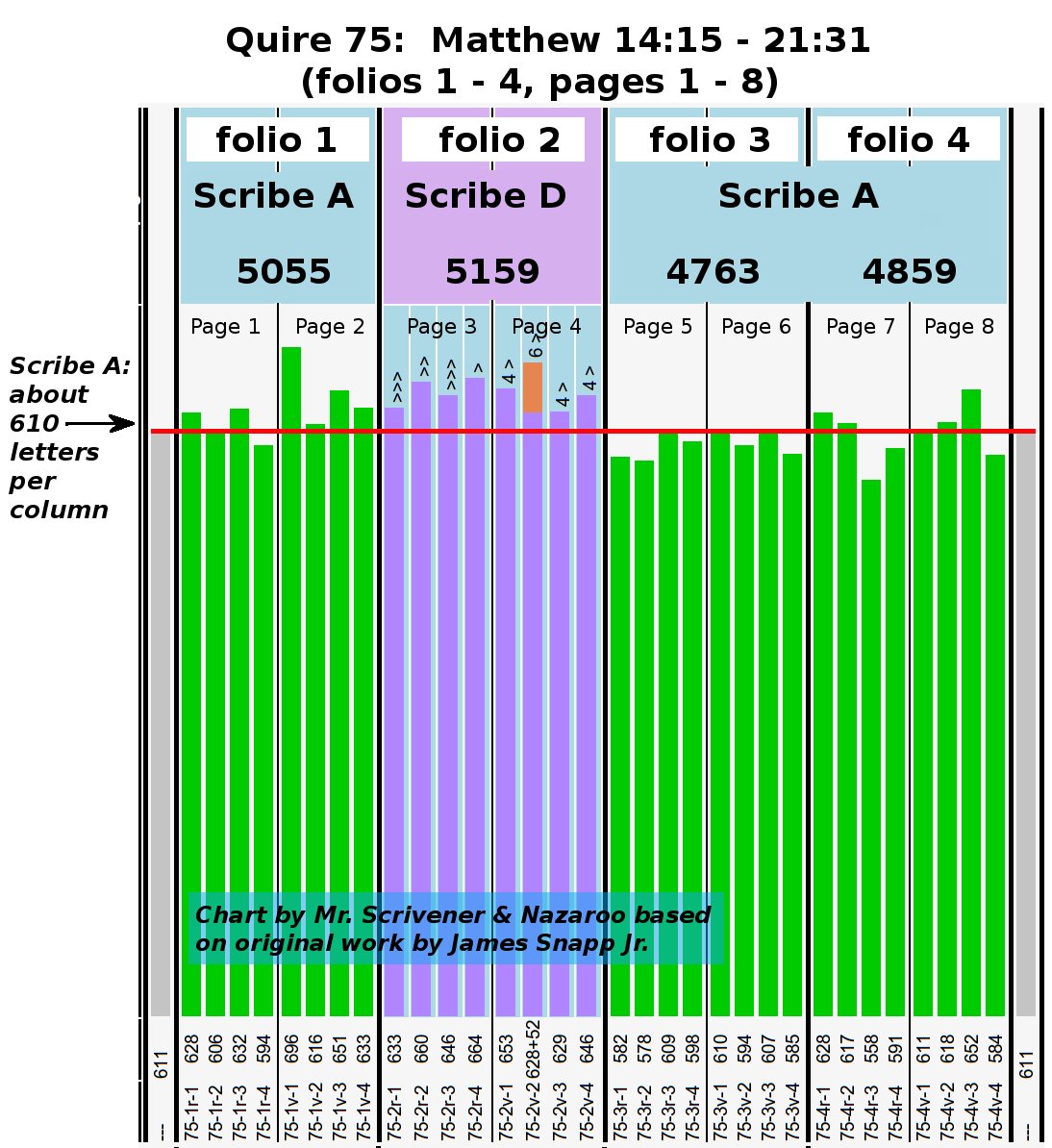
Sinaiticus & Mark's Ending (Pt 10): replacement sheet 1
We will be better equipped to discern the borders and purpose of the "cancel sheets" in Aleph if we examine first the more obvious of the two. I refer here to the sheet making up folios 2 and 7 in Quire 75, replaced by Scribe D and covering pages 3 & 4 (Matthew 16:9-18:12) and pages 13 & 14 (Matt. 24:35-26:6) of the Quire. Recall again the layout of a quire below:
In our case for Quire 75, the replacement sheet replaces folios #2 and #7 (second sheet from bottom: these were misnumbered by Myshrall as 74-2, 74-7, but are in fact 75-2 and 75-7).
Since the replacement sheet was apparently done in the scriptorium by the original scribes, there is nothing obvious about the vellum itself to distinguish it from the vellum used elsewhere. However, the borders between scribes are well-defined in this case, by several signs:
(1) The red Eusebian marginal numberings are missing completely from all four pages. This indicates the sheet was replaced after they had already been added to the manuscript, and after this quire was completed by Scribe A.
This does not necessarily prove either they or the replacement sheet were done before the MS left the scriptorium. On the contrary, all it shows is that the Eusebian numberings are contemporary with and prior to the replacement sheet. Although it is near-certain that Scribe D (who wrote other sections) wrote the sheet, this doesn't mean the MS never left the scriptorium. It is quite possible that it went out, a complaint was made, and it was sent back for repair, at which time the sheet was replaced. But it seems clear that both the Eusebian marks and the replacement sheet were done very close to the time of manufacture.
(2) The replacement pages have Scribe D's trademark 'fill-characters' (">") at the ends of lines in every column of the replacement pages. And with only one exception (a single ">" on page 9, column 4), these appear only on the replacement pages.
This flourish is not merely decorative (giving the right-margin sharper definition), but also appears to make the replacement pages easy to find and indicate the completion of the the repair beyond any doubt. As this was a very expensive and time-consuming operation, this was probably done for billing purposes, or to provide proof the repair-work was done as ordered.
There was no attempt to hide the replacement job in any sinister sense. Instead, it appears that the repair was done essentially to restore the text, but also carefully preserve the look and style of the manuscript throughout. This is why the Scribes are careful to write so similarly.
(3) The problem-area was on Folio 2. This becomes obvious when we compare the material originally done by Scribe A on the surrounding pages. Scribe D crams an extra 120 - 350 letters on his replacement pages 3 and 4. This is a large discrepancy, amounting to from 2 - 12 verses! The material on the other end of the sheet, pages 13-14, although slightly higher than average, is about the same as that on the surrounding pages in the last half of the Quire.
(4) Scribe A had omitted a large portion of text, requiring the extreme solution of replacing the pages. In other places Scribe D (the overseer/corrector) is content to insert up to 72 characters in the margin of the manuscript, without replacing pages.
More to follow...
Nazaroo
In our case for Quire 75, the replacement sheet replaces folios #2 and #7 (second sheet from bottom: these were misnumbered by Myshrall as 74-2, 74-7, but are in fact 75-2 and 75-7).
Since the replacement sheet was apparently done in the scriptorium by the original scribes, there is nothing obvious about the vellum itself to distinguish it from the vellum used elsewhere. However, the borders between scribes are well-defined in this case, by several signs:
![]() |
| Click to Enlarge: backbutton to return |
(1) The red Eusebian marginal numberings are missing completely from all four pages. This indicates the sheet was replaced after they had already been added to the manuscript, and after this quire was completed by Scribe A.
This does not necessarily prove either they or the replacement sheet were done before the MS left the scriptorium. On the contrary, all it shows is that the Eusebian numberings are contemporary with and prior to the replacement sheet. Although it is near-certain that Scribe D (who wrote other sections) wrote the sheet, this doesn't mean the MS never left the scriptorium. It is quite possible that it went out, a complaint was made, and it was sent back for repair, at which time the sheet was replaced. But it seems clear that both the Eusebian marks and the replacement sheet were done very close to the time of manufacture.
(2) The replacement pages have Scribe D's trademark 'fill-characters' (">") at the ends of lines in every column of the replacement pages. And with only one exception (a single ">" on page 9, column 4), these appear only on the replacement pages.
This flourish is not merely decorative (giving the right-margin sharper definition), but also appears to make the replacement pages easy to find and indicate the completion of the the repair beyond any doubt. As this was a very expensive and time-consuming operation, this was probably done for billing purposes, or to provide proof the repair-work was done as ordered.
There was no attempt to hide the replacement job in any sinister sense. Instead, it appears that the repair was done essentially to restore the text, but also carefully preserve the look and style of the manuscript throughout. This is why the Scribes are careful to write so similarly.
(3) The problem-area was on Folio 2. This becomes obvious when we compare the material originally done by Scribe A on the surrounding pages. Scribe D crams an extra 120 - 350 letters on his replacement pages 3 and 4. This is a large discrepancy, amounting to from 2 - 12 verses! The material on the other end of the sheet, pages 13-14, although slightly higher than average, is about the same as that on the surrounding pages in the last half of the Quire.
![]() |
| Click to Enlarge |
(4) Scribe A had omitted a large portion of text, requiring the extreme solution of replacing the pages. In other places Scribe D (the overseer/corrector) is content to insert up to 72 characters in the margin of the manuscript, without replacing pages.
More to follow...
Nazaroo
Labels:
Codex Sinaiticus,
Mark's Ending,
MS Evidence,
Nazaroo
Saturday, February 12, 2011
Sinaiticus & Mark's Ending (Pt 9): Myshrall on Scribe D
Well, we may never get much help from the Official Sinaiticus Site (they will be too busy no doubt to respond). But we need a definitive answer on exactly what Scribe D was responsible for (last week we noted that they listed the rest of the entire Quire 77 as the work of Scribe D!).
Before we set off, we will give the up-to-date discussion of Scribe D by Myshrall, an excellent and thorough piece by the way. Here we will find more useful keys for sorting which scribe is which:
We are now I think ready to try an analysis of the surrounding pages, to determine the actual extent of the work of Scribe D involving Mark's Ending and the modified Quire 77.
peace
Nazaroo
Before we set off, we will give the up-to-date discussion of Scribe D by Myshrall, an excellent and thorough piece by the way. Here we will find more useful keys for sorting which scribe is which:
"Scribe D was an excellent speller, A was poor, and B was appalling! One must be aware of the circularity of some of this reasoning though. If one assumes that a scribe is a poor speller, then one will try to assign all the texts with spelling mistakes to that scribe, which many not be so. Not every scribe was entirely consistent, so ther must be more concrete palaeographical reasons for identifying a hand.Several individual characteristics distinguish the three scribes of Sinaiticus, although the general appearance of the hands is very similar... The superline of the final nu (i.e., a nu found at the end of a line) by Scribe A partly covers the preceding vowel, whereas with Scribe B it is placed more to the right and goes further into the margin (M & S, Figure 6). The line endings themselves also help to identify the hands (M & S, Figure 7).
For Scribe A, compression begins a long way back into the line at the 6th or 7th letter(11th in poetical texts). The upright slopes become elongated and the rounded letters diminished to allow the writing to be compressed into a smaller space.
For Scribe B compression rarely affects more than three letters, and those evenly.
Scribe D resembles Scribe A in the final letters but there is no elongation of the vertical strokes. IN addition, he seldom diminishes more than three letters at a time.
Click to Enlarge: Backbutton to return
KAI Forms & Diples (">")
The KAI compendium by Scribe A is in the form of an oblique stroke at an acute angle from the bottom of the K. With Scribe B, the angle of the stroke is flatter, and the stroke often shorter (M&S, Figure 6).
Scribe D has a curved stroke on his KAI compendium which is very distinctive.
Scribe A never uses the diple (">") to fill in the ends of empty lines. Scribe B uses it very rarely; no more than once every three pages in the prophetic books and less in Hermas (with the exception of one page in Jeremiah where he uses it 12 times). However, Scribe D uses it in abundance, sometimes doubled (">>") to cover erasures, which makes his NT cancel leaves stand out. The hand of Scribe D is smaller, with an undulating effect as the rounded letters are smaller. This has led M&S to say that Scribe D is a far superior scribe, due to his spelling and style. (M&S, p. 23).
The Cancel Leaves of Matthew
Within the Gospel of Matthew in Aleph, Scribe D has replaced one sheet of parchment (2 folios). This stands out because the rest of the text is by Scribe A. The sheet replaced is Quire 74-2 and 74-7 [@ 4 sheets or 8 folios /quire], this being folio pages 10/10b, and 15/15b [i.e., recto/verso of folios 10 & 15 = 4 page faces]. The text is Matt. 16:9-18:12 [f10] and Matt. 24:36- 26:6.[f15]
Although the letter shapes of Scribes A and D are very similar (so similar in fact that I could not tell a difference between the two scribes, apart from through the following features), there are certain signs that can be seen showing these pages are by a different hand:
(1) Scribe D uses diples ("<", ">") to fill in the ends of his lines. these number 8 on page 10, 17 on page 10b, 17 on page 15, and 31 on 15b. Scribe A rarely uses diples, so this sudden abundance indicates a different scribe. An example of Scribe A's diples is on 3b/4/24.
(2) Scribe D's KAI compendium is more curved than Scribe A's within the text. This can be seen on 10/3/1, 10/4/26, 10b/1/28, 15/1/16, 15/2/30, 15b/2/20, 15b/2/46, 15b/3/40. For an example of Scribe A's compendium see 3.5 (1b/4/30) and throughout the rest of Matthew.
(3) Scribe D's spelling is generally more precise. There are fewer itacisms on his pages, as well as basic spelling mistakes. Itacisms found, number 8 on pg 10, 7 on 10b, 7 on 15, 4 on 15b. This compares to Scribe A's 41 on p.11, 40 on 11b, 38 on 16, 34 on 16b. (pages chosen follow on from Scribe D. The same is true for any of Scribe A's leaves.)
(4) Scribe D tends to use fewer abbreviations in his text, these including Nomina Sacra and numerals. (I haven't counted these because the number of abbreviations varies depending on the number of Nomina sacra.)
The Cancel Leaves of Mark and Luke
There is only one cancel leaf in Mark/Luke, which contains the end of Mark (14:54-16:8), and Luke 1:1-56. As this cancel sheet (two folios) was in the center of the quire, both leaves are consecutive, 76-4 and 76-5, called folios 29 and 29b by Lake.
These pages were replaced by Scribe D, possibly because Scribe A made an unusually serious mistake. The same features of the change of hands can be seen as in the cancel leaves of Matthew. The number of diples used in Mark are 20 on folio 38, 20 on 28b, and 16 on 29. The number in Luke are 5 on the rest of 29, and 11 on 29b. This suggests that Scribe D was trying to stretch Mark out onto another column, but does not necessarily imply that the original problem was with the end of Mark, although this is always an option. Also indicative of Scribe D here is the spelling of Ιωανην for Ιωαννην in Luke 1:13.
However, on this cancel leaf we do have Eusebian notation unlike in Matthew, and we do have a fair few nomina sacra, 10 examples on folio 29, and 23 on folio 29b. THis includes the first occurrence of CPI for σωτηρι. There are also some itacisms here but they mainly involve propoer nouns such as Elizabeth Ελεισαβετ Ελισαβετ. There was a lot of variation in the spelling of proper names, so Scribe D can still be seen as an accurate speller.
The importance of the indentification of cancel leaves is that it shows how thoroughly the MS was revised in the scriptorium. It suggests that it was destined for somewhere quite important because of the care taken in producing it, with appearance being as important as text. Only when it reached the "C Correctors" did the text become of fundamental importance, hence the numerous corrections carried out at that time. This can be seen because the corrections were carried out in a more careless way than the earlier ones.
The other major complication of the cancel leaves is that they indicate the number of people working on one text at one time. This implies a scriptorium background for Aleph, as privately copied MSS would probably have been done by one person. Scribe D could be viewed as the senior scribe, who probably skim read the text looking for obvious errors before it went out. This would explain why his corrections would tend to be bunched, because if he noticed one error he would probably concentrate more in that area on finding problems, and then relax again when the text seemed to be going alright. It is even possible to hypothesize that in areas where many mistakes were made the scribe was tiring, and ready for a break, and then when the text suddenly rights itself he had stopped and had a rest.
The identification of Scribe D for these pages has repercussions for the running titles. Within these pages Scribe D spells Ιωανην for Scribe A and B's Ιωαννην. Byu demonstrating D's spelling of this proper noun, he can be ruled out for the running titles, superscription and subscription of the Gospel of John. The other major importance of this identification is that it proves that cancel leaves were written for Sinaiticus, showing that accuracy was of great importance for this MS. It also shows that it was not necessarily the original hand that completed the cancel leaf."A.C. Myshrall,Cod.Sinaiticus,Its Correctors & the Caesarean text of the Gospels,Dissertation, (Birmingham U., 2005)
We are now I think ready to try an analysis of the surrounding pages, to determine the actual extent of the work of Scribe D involving Mark's Ending and the modified Quire 77.
peace
Nazaroo
Labels:
Codex Sinaiticus,
handwriting style,
Mark's Ending,
MS Evidence,
Nazaroo
Sunday, January 30, 2011
Sinaiticus & Mark's Ending (Pt 8): Scribe Identification & Confusion
That multiple scribes were at work on Codex Sinaiticus seems to be completely certain. We have already noted some of the observations of Tischendorf and Scrivener in particular on the features that distinguish Scribe D. We repeat F.H.A. Scrivener in full here:
Kirsopp Lake is also informative:
Has there been a mistake by earlier critics with less access to good photos, or has the British Museum, custodian of the actual MS, made some remarkable blunder, based on a confusion between the end of the Quire and the 'cancel-sheet' (77-4 recto to 77-5 verso)??
The only sure guide would seem to be the quality of the text on the disputed pages.
"It is quite worthy of notice, that although ">" is sometimes placed in the margin of the NT to point out quotations from the OT, and that too by the first hand, e.g. Acts 26:23; though more frequently by later scribes, as in Matt. 1:23; 2:6, etc. : this mark is never met with in the NT at the end of a line for the mere purpose of filling up a blank space (which is its usual purpose in the OT portion of Sinaiticus and some other MSS), except repeatedly in the leaves assigned to Scribe D, viz. 219 times in the other six leaves, four times in Rev.1:1—5 (see p. xvi). Elsewhere ">" is found in only four places which have suffered correction (Matt. 6:28 ; 22:9 ; Luke 11:36 ; 12:58), being used, like — in 1st Cor. 15:22, merely to cover erasures.
We must add too, that the few leaves of the NT ascribed by Tischendorf to Scribe D are much freer from itacisms, or instances of false spelling, than those on either side of them : the transition is quite remarkable from leaf 9 of A to leaf 10 (Matt. 16:9-18:12) of Scribe D, and then back again to leaf 11 of A, as the reader may see for himself by consulting our collation. These remarks, so far as they extend, would seem to suggest two scribes, A being identical with B, and possibly С with D ; the members of which pairs Tischendorf declares to be much alike; but whether the actual penmen be one, or two, or four, is of the less importance, as (in the N. T. certainly, and most probably in the Old) the whole work was clearly executed at the same time, and transcribed from the same older copy.
Moreover, the apostrophe ('), though frequently employed in the OT to divide syllables in the middle of a word, is never so used throughout the NT itself; while in the Shepherd of Hermas, at the end, assigned by Tischendorf to scribe B, we read: αγ'γελια, αγ'γελον, αλ'λα (3x), μελ'λοντες, πολ'λους, ελατ'τονι, εχ'μαλωτισμον , etc, and ">" several times at the end of lines. These minute points, insignificant as they may seem, go far to support Tischendorf's notion that the MS is the work of several distinct hands. (See also p. xxxii, note 7.)" (Scrivener, Sinaiticus Intro.)
Kirsopp Lake is also informative:
From all this, it would seem that the work of Scribe D was hardly in dispute, and well understood. It is naturally with some alarm then, that upon visiting the official Codex Sinaiticus Website, we find all the pages from 77-4 recto to 77-8 verso identified as "Scribe D" in the apparatus and titling above the photos."The discrimination of Scribe D from Scribes A/B is easier and admits of no reasonable doubt. There is a distinct difference in the script, though it is more easily perceived than described; possibly the letters are somewhat squarer in Scribe D than in A - the height being less in proportion to the breadth - and Scribe D is altogether prettier than A. But the decisive point is that Scribe D constantly fills out the end of a line with the sign >, which is rarely or never used by Scribes A/B."
Has there been a mistake by earlier critics with less access to good photos, or has the British Museum, custodian of the actual MS, made some remarkable blunder, based on a confusion between the end of the Quire and the 'cancel-sheet' (77-4 recto to 77-5 verso)??
The only sure guide would seem to be the quality of the text on the disputed pages.
Labels:
Codex Sinaiticus,
Mark's Ending,
Nazaroo
Saturday, January 29, 2011
Sinaiticus & Mark's Ending (Pt 7): James Snapp (cont.)
Continuing our discussion of Codex Sinaiticus, we turn our attention again to the numbers of letters in each column of the 'cancel sheet(s)' (Scribe D), and the counts in the surrounding area by the original Scribe A.
Here is a wonderful chart composed by Mr. Scrivener diagramming the details of the current picture. The letter-counts are based on the text as transcribed on the Codex Sinaiticus Homepage (British Museum), but we have subtracted all marginal notes (which were added independently later), and also the peculiar symbols of Scribe D (the ">" arrow used to fill rows to make the page look fuller.). Still counted as a character was the "dots" indicating verse and paragraph divisions, because these are assumed to have been copied from the original master-copy, and are not the invention of either scribe.
Now lets turn to the chart:
The behavior of Scribe D (the person who substituted the pages) is fairly straightforward. For the first three columns, he simply copies the pages he has removed, rightly noting that the previous Scribe A (author of the rest of the NT minus a couple of pages) has already done some of the work of compressing the text for the purpose of creating nearly a whole blank column of space.
He has already carefully calculated that the best course for handling Luke's verses will be to squeeze them into SIX of the last columns on the 'cancel-sheet' (folio 77-5 recto last 2 columns, and the 4 columns of the other side, 77-5 verso). This will gain him about a half a column.
Now he calculates the remaining approximately SIX columns of Mark, and to leave the last column nearly empty (but avoiding leaving a whole column), he crams about 60 letters into the last column of folio 77-4 recto. He has actually been too extreme here, and now must write the final FIVE columns of Mark rather sparsely to make sure he spills over a little into the last blank column before Luke.
A glance at the column heights explains why he chose this route. He did not have enough material to stretch Luke to fill an entire SEVENTH column, and even if he had done this by some real spreading, He would have only had just enough space for Mark, filling all the previous columns, without the Long Ending (Mark 16:9-20). This may indeed have been exactly what Scribe A had originally done.
However, Scribe D, likely the Overseer and Corrector of the scriptorium, knew this would be highly unsatisfactory, and wished to at least leave a nearly blank column to tip off future users and enable them to copy in the Ending if they chose to. Scribe D then, was aware of the Long Ending. Even though he did not allow sufficient space for it, due to his desire to keep the look of the manuscript professional and standardize the book-seams, he did feel compelled to make sure that at least the option was available and the problem highlighted.
In this strategy, Scribe D mimicks almost exactly the behavior of the scribe of Codex Vaticanus, who also leaves just enough space to allow for Mark's Ending, but in that case he also left a rather awkward completely blank column between Mark and Luke. It seems clear that our Scribe D had seen that solution before and wanted to improve it by extending Mark into the blank column, and give the appearance of a normal manuscript.
We only need try to reconstruct what the original Scribe A had done on the pages now lost, which ought to explain how the 'need' for a substitution arose.
Here is a wonderful chart composed by Mr. Scrivener diagramming the details of the current picture. The letter-counts are based on the text as transcribed on the Codex Sinaiticus Homepage (British Museum), but we have subtracted all marginal notes (which were added independently later), and also the peculiar symbols of Scribe D (the ">" arrow used to fill rows to make the page look fuller.). Still counted as a character was the "dots" indicating verse and paragraph divisions, because these are assumed to have been copied from the original master-copy, and are not the invention of either scribe.
Now lets turn to the chart:
![]() |
| Click to Enlarge: Backbutton to return |
He has already carefully calculated that the best course for handling Luke's verses will be to squeeze them into SIX of the last columns on the 'cancel-sheet' (folio 77-5 recto last 2 columns, and the 4 columns of the other side, 77-5 verso). This will gain him about a half a column.
Now he calculates the remaining approximately SIX columns of Mark, and to leave the last column nearly empty (but avoiding leaving a whole column), he crams about 60 letters into the last column of folio 77-4 recto. He has actually been too extreme here, and now must write the final FIVE columns of Mark rather sparsely to make sure he spills over a little into the last blank column before Luke.
A glance at the column heights explains why he chose this route. He did not have enough material to stretch Luke to fill an entire SEVENTH column, and even if he had done this by some real spreading, He would have only had just enough space for Mark, filling all the previous columns, without the Long Ending (Mark 16:9-20). This may indeed have been exactly what Scribe A had originally done.
However, Scribe D, likely the Overseer and Corrector of the scriptorium, knew this would be highly unsatisfactory, and wished to at least leave a nearly blank column to tip off future users and enable them to copy in the Ending if they chose to. Scribe D then, was aware of the Long Ending. Even though he did not allow sufficient space for it, due to his desire to keep the look of the manuscript professional and standardize the book-seams, he did feel compelled to make sure that at least the option was available and the problem highlighted.
In this strategy, Scribe D mimicks almost exactly the behavior of the scribe of Codex Vaticanus, who also leaves just enough space to allow for Mark's Ending, but in that case he also left a rather awkward completely blank column between Mark and Luke. It seems clear that our Scribe D had seen that solution before and wanted to improve it by extending Mark into the blank column, and give the appearance of a normal manuscript.
We only need try to reconstruct what the original Scribe A had done on the pages now lost, which ought to explain how the 'need' for a substitution arose.
Labels:
Codex Sinaiticus,
James Snapp Jr.,
Mark's Ending,
MS Evidence,
Nazaroo
Thursday, January 27, 2011
Sinaiticus & Mark's Ending (Pt 6): James Snapp (cont.)
Now lets continue again with more of James Snapp Jr.'s article, in which he gets into some more detail about these pages and in particular the compression and expansion of text in the columns. Again we give the diagram to help readers locate the columns under discussion:
James goes on:
James now jumps back to discuss the previous two pages, namely folio 77 -4 (recto/verso):
Our first observation is this: James writes in brackets above,
One fact that is simply not taken into account in various of James' options is this: Elsewhere, scribe D always inserts single cancel-leaves, not double-sheets of four pages (i.e., folio 10, 15, 88, 91). Why recopy four whole pages here? The small amount of text in the Lukan variant (proposed originally by Tischendorf, for which there is no textual support at all) cannot justify a four-page replacement, nor can such a small factor explain why the original scribe A would have needed to turn to scribe D for help.
Given this most remarkable extra feature, the replacement of four whole pages, with obvious attempts at adjusting all the columns preceding Mark's ending, it seems far more plausible that the problem was Mark's ending; Scribe A appealed to Scribe D, and Scribe A's work was taken over, removed and replaced by Scribe D.
James' "Theory 1" above is inadequate, because it mixes up the roles of the two scribes. It was in fact Scribe A who was copying from an exemplar having Mark's ending (as suggested by all other MSS everywhere, except B). He was the one who noticed the problem (the inadequate space of the pre-allocated pages), and therefore the 2nd Scribe D's subsequent waffling attempts at adjusting the pace were done with the problem already perceived. This is evident because at this time the pages were already being replaced.
The fact that Scribe D may have changed his mind, or received new (but ultimately unrealistic) orders on how to proceed while in the middle of the task, is hardly surprising, nor is the fact that the pages were not replaced yet again, given the cost of vellum.
James goes on:
The Last Two Columns of Mark in Codex Sinaiticus
"[James' diagram] shows the arrangement of the text in columns 9 and 10 of the four-page (16-column) cancel-sheet at the end of Mark in Sinaiticus. [here we have inserted below a good photo of this page with columns 9 - 12:]
![]() |
| Folio 77 - 5 (recto): Mark ends & Luke begins |
James now jumps back to discuss the previous two pages, namely folio 77 -4 (recto/verso):
![]() | ![]() |
| 77-4 recto: columns 1-4 | 77-4 verso: columns 5-8 |
The text of Mark from 15:19 (which appears earlier in the cancel-sheet, at column 5, line 11) onward has been stretched so as to fill more space than it normally would. However, from column 4, line 1 to column 5, line 10, the text was written in a compressed script, with the result that column 4 contains 707 letters. If the copyist had continued to write compactly, the cancel-sheet would have had plenty of room for the Long Ending. (However, if the copyist had continued to write so as to average 635 letters per column, if he had tried to write the Long Ending he would have reached the end of column 10 with 206 letters to go. Thus it is practically certain that the original pages of the end of Mark in Sinaiticus did not contain the Long Ending.)
As you can see, column 9 [folio 77-5 recto at top] contains only 552 letters (significantly less than the typical amount of about 635). Columns 11-16 [including folio 77-5 verso below] (containing Luke 1:1-56) are all written in compressed script; in those six columns the average column contains 691 letters. This suggests that the cancel-sheet was made because the original pages featured an accidental omission of text in Luke 1.
![]() |
| Folio 77-5 verso (back): columns 13-16 |
That still does not explain why the text is compacted in column 4 and in the first 10 lines of column 5.
One theory is that the person who made the cancel-sheet began by using an exemplar which contained the Long Ending, and as he was writing column 4, he sensed that something was amiss, so he began to compact the text so that the Long Ending would fit, but then (at the beginning of Mark 15:19) he consulted the exemplar used by the original copyist, and realized that it did not contain the Long Ending. He had to stretch the text of Mark from that point on, in order to avoid leaving a blank column between Mark and Luke.
Another theory is that the cancel-sheet's maker initially planned to begin the text of Luke in column 10, and compressed the text of Mark for that reason (i.e., so as to end Mark's text in column 9). Then he changed his mind, preferring to compress Luke's text within six columns rather than to stretch it for seven columns, with the result that he had to stretch the text of Mark from 15:19 onward (especially in column 9) to avoid leaving a blank column between Mark and Luke. However, this does not explain why, if the cancel-sheet's maker initially planned to begin the text of Luke in column 10, he did not start the text-compression immediately in columns 1-3."
Our first observation is this: James writes in brackets above,
(However, if the [original scribe A] had continued [at] 635 letters per column, he would have [had] 206 letters to go [for the Long Ending]. Thus it is practically certain that the original pages ... did not contain the Long Ending.)This statement, while technically true, is however misleading. All it amounts to is that the original scribe A didn't have room to fit it in, and stopped his work, which begs the question.
One fact that is simply not taken into account in various of James' options is this: Elsewhere, scribe D always inserts single cancel-leaves, not double-sheets of four pages (i.e., folio 10, 15, 88, 91). Why recopy four whole pages here? The small amount of text in the Lukan variant (proposed originally by Tischendorf, for which there is no textual support at all) cannot justify a four-page replacement, nor can such a small factor explain why the original scribe A would have needed to turn to scribe D for help.
James' "Theory 1" above is inadequate, because it mixes up the roles of the two scribes. It was in fact Scribe A who was copying from an exemplar having Mark's ending (as suggested by all other MSS everywhere, except B). He was the one who noticed the problem (the inadequate space of the pre-allocated pages), and therefore the 2nd Scribe D's subsequent waffling attempts at adjusting the pace were done with the problem already perceived. This is evident because at this time the pages were already being replaced.
The fact that Scribe D may have changed his mind, or received new (but ultimately unrealistic) orders on how to proceed while in the middle of the task, is hardly surprising, nor is the fact that the pages were not replaced yet again, given the cost of vellum.
Peace
Nazaroo
Labels:
Codex Sinaiticus,
James Snapp Jr.,
Mark's Ending,
MS Evidence,
Nazaroo
Sinaiticus & Mark's Ending (Pt 5): James Snapp Jr.
Since we need to get into the details, a quick orientation involving some terminology won't hurt here. In this discussion, a "Quire" means a grouping of sheets, usually folded like a booklet, and meant to be stitched together, then attached to other such groups, to make a large book of many pages. Quires are a sensible approach to large books, and prevent problems when too many pages are folded together in a single clump.
According to the Official website, Codex Sinaiticus was originally stitched together in Quires of four double-sheets. A double-sheet makes up two "Folios", or single sheets, each having two sides or page-surfaces. Typically it is folios that are numbered in this context, and the sides of a folio are called "recto" (front or right-side), and "verso" (back or left-side). Thus the pages are not numbered like a modern book.
Here is an illustration of what we are talking about:
In the illustration, the Quire is open to the innermost double-sheet, showing us folio #4 and folio #5, which would have originally been attached, being made from a single large double-sheet. In the discussion which follows, James Snapp Jr. will be referring to the columns, starting with the columns (not shown) on folio #4 (columns 1 - 4), then as we have numbered them above (5 - 12), and finally, finishing with columns 13 - 16 (other side of folio # 5).
The folios themselves were numbered by an unknown hand as 227 and 228, but are referred to by Tischendorf and Scrivener in the previous posts as folios #28 and #29, or #29 and #30 by Kirsopp Lake (of the New Testament portion).
The official website for Codex Sinaiticus (British Museum) numbers these relatively in relation to the Quires, so they are respectively now Quire 77 - 4 and Quire 77 - 5. All clear? Not to worry. For now all we need pay attention to are the columns.
James Snapp Jr. tells us on his webpage the following:
To help us better picture the discussion, here are the two relevant pages, from folio 77-4 (recto and verso) containing columns 1 - 8 inclusive. The Ending of Mark is on the following page, but we will examine that later:
One can see that column 4 is compressed, while 1 to 3 are expanded, with plenty of white-space too.
Similarly, the top of column 5 is compressed, while the remaining columns are expanded.
One thing must be noted. The concept of compressing text to fit is no stranger to Scribe D, nor is it merely a theoretical possibility. It is clearly used by him for some purpose as yet undetermined with certainty.
peace
Nazaroo
According to the Official website, Codex Sinaiticus was originally stitched together in Quires of four double-sheets. A double-sheet makes up two "Folios", or single sheets, each having two sides or page-surfaces. Typically it is folios that are numbered in this context, and the sides of a folio are called "recto" (front or right-side), and "verso" (back or left-side). Thus the pages are not numbered like a modern book.
Here is an illustration of what we are talking about:
![]() |
| Click to Enlarge, backbutton to return |
The folios themselves were numbered by an unknown hand as 227 and 228, but are referred to by Tischendorf and Scrivener in the previous posts as folios #28 and #29, or #29 and #30 by Kirsopp Lake (of the New Testament portion).
The official website for Codex Sinaiticus (British Museum) numbers these relatively in relation to the Quires, so they are respectively now Quire 77 - 4 and Quire 77 - 5. All clear? Not to worry. For now all we need pay attention to are the columns.
James Snapp Jr. tells us on his webpage the following:
"In Codex Sinaiticus, the four pages on which the last part of Mark (14:54-16:8) and the first part of Luke (1:1-56) are written constitute a cancel-leaf (to picture this, think of a four-page church bulletin, folded in the middle). That is, they are not the pages written by the copyist who wrote the surrounding text of Mark and Luke. Someone (probably the scriptorium-supervisor who oversaw the production of the codex) removed the original pages, re-wrote the text they contained, and then inserted the new, re-written pages.
Why? It was NOT to remove Mark 16:9-20. A statistical analysis of the capacity of the 16 columns on these pages shows that they did not have room for the contents of Mark 16:9-20 (unless the copyist "compacted" the text).
Possibly the main copyist accidentally skipped from the end of Luke 1:4 to the beginning of Luke 1:8, omitting Luke 1:5-7, and the supervisor decided that the best way to fix this mistake was to replace the entire four-page sheet. But whatever the reason was, the relevant implication is that when we look at Sinaiticus we are probably not looking at the text that was in the main copyist's exemplar; we are probably looking at the text that was in an exemplar used by the supervisor.
Everyone seems to be in agreement that the two folios containing Mark 14:64 - Luke 1:56 (by whatever number) are 'cancel-leaves' or 'replacement-folios' written by Scribe D. It is also apparent by Mr. Snapp's description, that the text is alternately compressed and stretched, in the process of fitting it into the required space. This is certainly odd, and even Mr. Snapp's explanation is not entirely satisfactory, although its a reasonable account of the phenomena.Furthermore, the text in the 4th column of the replacement-page (and the first 10 lines of the 5th column) is "compacted," which may suggest that the supervisor accessed -- but abandoned at 15:19 -- an exemplar which contained Mark 16:9-20. If the supervisor had continued to write the cancel-leaf the way he wrote column 4, [i.e., compressed] the full text of Mark 14:54-16:20 could fit on the replacement-page with room to spare, along with the text from Luke 1:1-56. "
To help us better picture the discussion, here are the two relevant pages, from folio 77-4 (recto and verso) containing columns 1 - 8 inclusive. The Ending of Mark is on the following page, but we will examine that later:
![]() |
| Folio 4 (recto): columns 1-4: click to enlarge |
![]() |
| Folio 4 (verso) columns 5 - 8: Click to Enlarge |
One thing must be noted. The concept of compressing text to fit is no stranger to Scribe D, nor is it merely a theoretical possibility. It is clearly used by him for some purpose as yet undetermined with certainty.
peace
Nazaroo
Labels:
Codex Sinaiticus,
James Snapp Jr.,
Mark's Ending,
Nazaroo
Subscribe to:
Posts (Atom)