Saturday, January 8, 2011
Gary S. Dykes on Script Mensuration
Mr. Dykes notes in his paper that precision measurement of scripts and styles of copyists and scribes is not in a very advanced state. He makes careful investigations and offers conclusions and recommendations for how to put the science of handwriting measurement on a sure footing, regarding Greek MSS.
Its a virtual tour-de-force, and an excellent introduction to the problems researchers face in trying to measure and identify scribes and copyists who may or may not have authored more than one extant MS.
Mr. Dykes offers two useful files with discussions and examples in .pdf format at his site. Although these go back to 2006, they are still great reads:
http://www.biblical-data.org/TC_stuf/script_mensuration.pdf
http://www.biblical-data.org/TC_stuf/metrics_365_1319.pdf
Both are essential reading for those trying to sort out copyists and date manuscripts, and many of his ideas have an applicability which extends far beyond his own area of interest, minuscules (mr.scrivener, take note of spelling).
It appears novel that Mr. Dykes uses angles between key lines in a ligature structure, or ratios/areas in a square block of space, as these appear for his purposes to be independent of other types of measurement which turn out to be problematic, such as line width, and pen-angle.
Perhaps others can offer further leads and advances in this fascinating, but rather new area of investigation.
Nazaroo
Friday, December 24, 2010
New Stories of Byzantine 'Recensions' from Bible.Org
The latest fantasy story from these parties is that there were two more definitive 'recensions' of the Byzantine text, one in the 9th and one in the 11th century! To quote our anonymous 'expert':
"... Ironically, it is the Byzantine witnesses that, as time goes on, agree more and more. Two great periods of close agreement show strong evidence of a recension, one in the ninth century and one in the eleventh. By the time we get to the fifteenth century, the manuscripts are 98% in agreement with the printed Majority Text. The most likely explanation of this is that there was collusion—an intentional recension. It is in fact the only explanation that is based on evidence (Timothy Ralston’s doctoral dissertation at Dallas Seminary demonstrated this rather ably)."
What evidence are we talking about? Apparently "Timothy Ralston's doctoral dissertation", whatever that is.
Who is this anonymous 'expert'?
Well, elsewhere in the same post, he says something else quite remarkable:
"when Aleph and B agree, their combined testimony must go back quite far. Westcott and Hort estimated that their agreement went back ten generations and must be located near the beginning of the second century."Again in another 'expert answer':
"I would concur with Westcott and Hort that the common ancestor between these two MSS must be at least ten generations back. I hope this point is clear."Since Daniel Wallace personally responds to many of these inquiries with authored articles, we strongly suspect that "Admin" is simply Wallace incognito.
Wallace himself doesn't apparently attach his name to such exact figures, for a good reason. When his moniker is on the line, we find a much more subdued text, as in the recent book co-authored by Wallace,
"Many scholars believe that since both manuscripts belong to the same text-type yet have so many differences, their common ancestor must have been copied several generations before. ... Aleph and B are distant cousins from long after their common ancestor, which itself must go back several generations. Indeed, when they agree, their common reading usually is from the early 2nd century." (Wallace, Komoszewski, Sawyer, Reinventing Jesus (Kregel, 2006) p. 78.Now to get to the early 2nd century, we only need an unspecified "several generations".
This kind of grandstanding is however extremely suspect. TEN generations implies that someone has actually found evidence for TEN generations. That is, they have found at least TEN identifiable layers among the differences collated between Aleph and B. Of course if this were actually true, not only would it be published, but it would be front page textual-critical news.
The obvious elephant in the room is that this work has never been done, nobody has discovered "ten layers" or any other number of layers, in the conjectured and reconstructed line of ancestors between Aleph/B and their ancient common archetype.
Its another case of anonymous propaganda mascarading as scientific and historical "fact".
What about the "strong evidence of recension" claimed in the first post? Don't hold your breath waiting for a demonstration of such an important, but so far unsubstantiated claim by the Hortian puppet-masters.
peace
Nazaroo
Tuesday, December 21, 2010
Hort on the New Papyri Evidence
Hort also would have wholeheartedly approved of using the data gathered in these modern analyses of actual MSS:
Hort had full confidence in the overwhelming abundance and weight of such data: Regarding the character of individual MSS, Hort continues,
"Readings authenticated by the coincidence of strong Intrinsic and strong Transcriptional Probability, or it may be by one alone of these Probabilities in exceptional strength and clearness and uncontradicted by the other, are almost always to be found sufficiently numerous to supply a solid basis for inference." (ibid. p. 32)
Hort acknowledged that genealogical evidence could only take us back so far. From that point Internal Evidence in the form of Transcriptional and Intrinsic Probability had to take over:
"Where the two ultimate witnesses [i.e., the reconstructed alternate texts] differ, the genealogical method ceases to be applicable, and a comparison of the intrinsic general character of the two texts becomes the only resource." (p. 42)
In such cases, Hort expected to reconstruct the text based on understanding why early copyists chose one reading over another:
"The rational use of Transcriptional Probability as textual evidence depends on the power of distinguishing the grounds of preference implied in an ancient scribe's substitution of one reading for another, from those felt as cogent now after close and deliberate [textual] criticism." (p. 28)
Thus Hort felt that very often for Transcriptional Probability (knowledge of scribal habits) to be valuable, we have to understand the conscious and unconscious mechanisms of copyist mistakes and editor/correctors' choices.
However, even Hort put plain limits on the need and even value of our own understanding in many accidental cases of Transcriptional Probability.
On the one hand, Hort expects the masterful textual critic should be able to "explain" why ANY reading is probably the 'original', putting ourselves inside the mind of those copyists and editors who were making such conscious decisions.
Hort himself was singularly good at arguing in favour of the "worst" readings:
"...I mean [Hort's] extreme cleverness as an advocate; for I have felt as if there were no reading so improbable that he could not give good reasons for thinking it to be the only genuine..." (Dr. Salmon, 'Some Thoughts..." p.33-4)
On the other hand, Hort fully acknowledges that in the case of plain blunders (i.e., Haplography), we don't need to "understand", and there are some in fact that we simply can't:
"What we should naturally expect, ...is that each reading should shew some excellence of its own, apparent or real, provided that we on our part are qualified to recognise it. If any reading fails to do so, clerical errors being of course excepted, the fault must lie in our knowledge, or our perception..." (p. 29)
Hort himself fully approved of the comparison and combination of Intrinsic (what the author intended) and Transcriptional (what the copyist did) Probabilities.
This was Hort's own special category of strong evidence:
"Internal Evidence of Readings attains the highest degree of certainty which its nature admits, this relative trustworthiness being due to the coincidence of the two independant Probabilities, Intrinsic and Transcriptional. Readings thus certified are of the utmost value." (p. 29)
Thus Hort would have approved of the careful and judicious use of both categories of Internal Evidence, for the determination of difficult cases like that of 1st Cor. 10:28 above.
Sunday, December 19, 2010
Gerd Mink on Commentary MSS
"Commentary manuscripts contain, apart from the commentaries, the continuous NT text. It is unlikely that these commentary manuscripts served as exemplars for manuscripts containing the continuous text. But it is very plausible that that text form was chosen as the basis for a commentary which was the most highly esteemed at that particular time and place. Accordingly, [that text-type] would also have been used as an exemplar in the scriptoria."
That is, the text chosen for the commentary would be the one popular for regular copies in that scriptorium where the commentary was made, at the time it was made. It would not normally be an "ancient text", but rather an 'approved text'.
This is an important observation regarding the conventions for such commentaries, because the discussion in the commentary itself would often be incongruous with the text presented alongside it. This is because the commentary would often have been composed some 5 or 10 centuries earlier than the commentary manuscript, and the author's text would differ from the one popular many centuries later. The commentaries would not be rewritten to correct this, and in fact it would probably not be noticed, as the two tasks were done separately in sections, even when written by the same scribe.
To take a specific case, 'Codex X' is not an ancient Uncial manuscript, in spite of its conventional letter ('X'). It is actually a late 12th century commentary, with gospel text included. The commentary and text is alternately placed in sections in the manuscript body.
Only parts of text which will be relevant to the commentary will be copied alongside the commentary. Because of this, there is a perfectly obvious explanation as to why this manuscript does not contain the Pericope de Adultera (John 7:53-8:11). The ancient commentary doesn't discuss it, because this passage of John was not read publicly during Pentecost services. The commentary follows the sections of John as they are read in public worship, so the commentary doesn't comment on a passage which is left out of the services.
The scribe who copied the sections from a continuous manuscript into the commentary did not bother to copy Jn. 7:53-8:11, since it was not relevant to the commentary. So even though this commentary manuscript generally gives a faithful copy of the continuous manuscript used to make it, the commentary manuscript itself (Codex X) cannot tell us what the original continuous copy had or did not have in its own text.
It is wrong to call this commentary a "continuous text manuscript". It is not. It is a commentary which contains text from a continuous text manuscript. But it cannot tell us more about that lost exemplar than it has bothered to record. As it is, the passage up to John 7:52 is copied for one section, and the passage beginning at 8:12 is copied a page or two later for the next section of the commentary. We can never know from this what the original continous-text manuscript looked like at the critical junction, 7:52/8:12. It may or may not have contained John 7:53-8:11. If it did, the copyist of Codex X did not record this fact for us, as it was of no concern to him when constructing the commentary with text.
In view of this, it is pointless to cite "Codex X" as if it were a witness for or against the text of the Pericope de Adultera (John 7:53-8:11). It is not a 'continuous-text' manuscript, except in the sense that it contains text from a real 'continuous-text' manuscript. It is not even a NT manuscript at all; it is a commentary, which happens to contain text from all four gospels, but not entirely complete.
Much confusion regarding the 'witness' of Codex X would be eliminated if it were simply dropped from the apparatus, as it has nothing to say about the authenticity or position of the Pericope de Adultera.
peace
Nazaroo
Wednesday, December 15, 2010
Azazel (Lev16): Finally a Plausible Explanation
Its from the July 25 post on Doug's blog, Biblia Hebraica et Graeca:
The Scapegoat Ritual in Leviticus 16
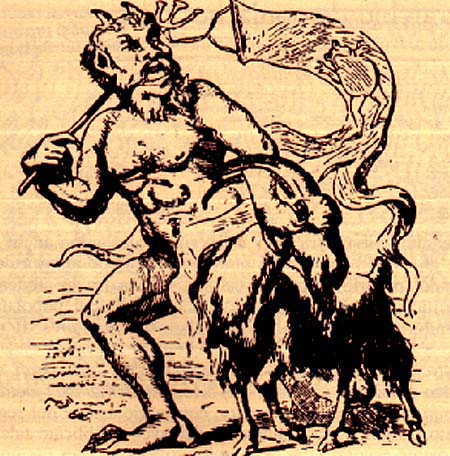
| Azazel from Collin de Plancy's Dictionnaire Infernal(Paris,1825). |
6 “Aaron shall offer the bull as a sin offering for himself and shall make atonement for himself and for his house. 7 Then he shall take the two goats and set them before the LORD at the entrance of the tent of meeting. 8 And Aaron shall cast lots over the two goats, one lot for the LORD and the other lot for Azazel. 9 And Aaron shall present the goat on which the lot fell for the LORD and use it as a sin offering, 10 but the goat on which the lot fell for Azazel shall be presented alive before the LORD to make atonement over it, that it may be sent away into the wilderness to Azazel.There has been much speculation about who or what “Azazel” was: the main interpretations have been a local deity, a wilderness goat-demon, or a desert mountain. Later Jewish literature, notably the Book of Enoch, understood Azazel as a demon, one of the fallen angels and brings him into its complex mythology of supernatural angels and demons.
Rabbinic interpretation understood Azazel to be a cliff off which the goat was driven to its death.
The Rabbis, interpreting "Azazel" as "Azaz" (rugged), and "el" (strong), refer it to the rugged and rough mountain cliff from which the goat was cast down (Yoma 67b; Sifra, Ahare, ii. 2; Targ. Yer. Lev. xiv. 10, and most medieval commentators). Most modern scholars, after having for some time indorsed the old view, have accepted the opinion mysteriously hinted at by Ibn Ezra and expressly stated by Nahmanides to Lev. xvi. 8, that Azazel belongs to the class of "se'irim," goat-like demons, jinn haunting the desert, to which the Israelites were wont to offer sacrifice (Lev. xvii. 7 [A. V. "devils"] (from the Jewish Encyclopedia).Of course, all of that may be for naught if this Hittite parallel is correct and the term is connected with a type of offering.
“In the Leviticus 16 ritual a crux has always been the term laʿazāʾzēl rendered in the Septuagint and Vulgate by “as a scapegoat” (followed by the English AV), but replaced in more recent English translations by “for Azazel,” sometimes thought to denote a wilderness demon. Appealing to scapegoat rites in the Hurrian language from the Hittite archives, Janowski and Wilhelm would derive the biblical term from a Hurrian offering term, azazḫiya. This is particularly appealing to me. There were two goats used in the Leviticus 16 ritual. One is designated for Yahweh as a “sin offering” (Heb. ḥaṭṭāʾṭ, LXX peri hamartias) (16:9), and the other is “for Azazel,” but is presented alive before Yahweh to make atonement, and is sent away into the wilderness “to/for Azazel.” The contrast is twofold: (1) Yahweh versus Azazel, and (2) sin offering versus Azazel. If one adopts the first, Azazel seems to be a divine being or demon, who must be appeased. But if one adopts the second as primary, the word ʿazāʾzēl represents the goal of the action. In the system of Hurrian offering terms to which Wilhelm’s azazḫiya belongs, the terms represent either a benefit that is sought by the offering (e.g., keldiya “for wellbeing,” cf. Heb. šelāmîm), or the central element offered (e.g., zurgiya “blood”). If Janowski and Wilhelm’s theory is correct, the Hebrew term would not denote a demon as recipient of the goat, but some benefit desired (e.g., removal of the sins and impurities) or the primary method of the offering (e.g. the banishment of the goat).”[1]Similar rituals are widely attested in the ancient Near East with examples from Ebla and elsewhere. I'm sure much more could be said about the practice and its ancient parallels. Leviticus 16 and the term Azazel provide a fascinating example of how misunderstandings and speculation sometimes spin off into elaborate traditions that fall far from the likely original meaning of the biblical text.
Harry A. Hoffner, Jr., “Hittite-Israelite Cultural Parallels” in Hallo, W. W., & Younger, K. L. (2003). Context of Scripture, vol. 3 (xxxii). Leiden; Boston: Brill.
Tuesday, December 14, 2010
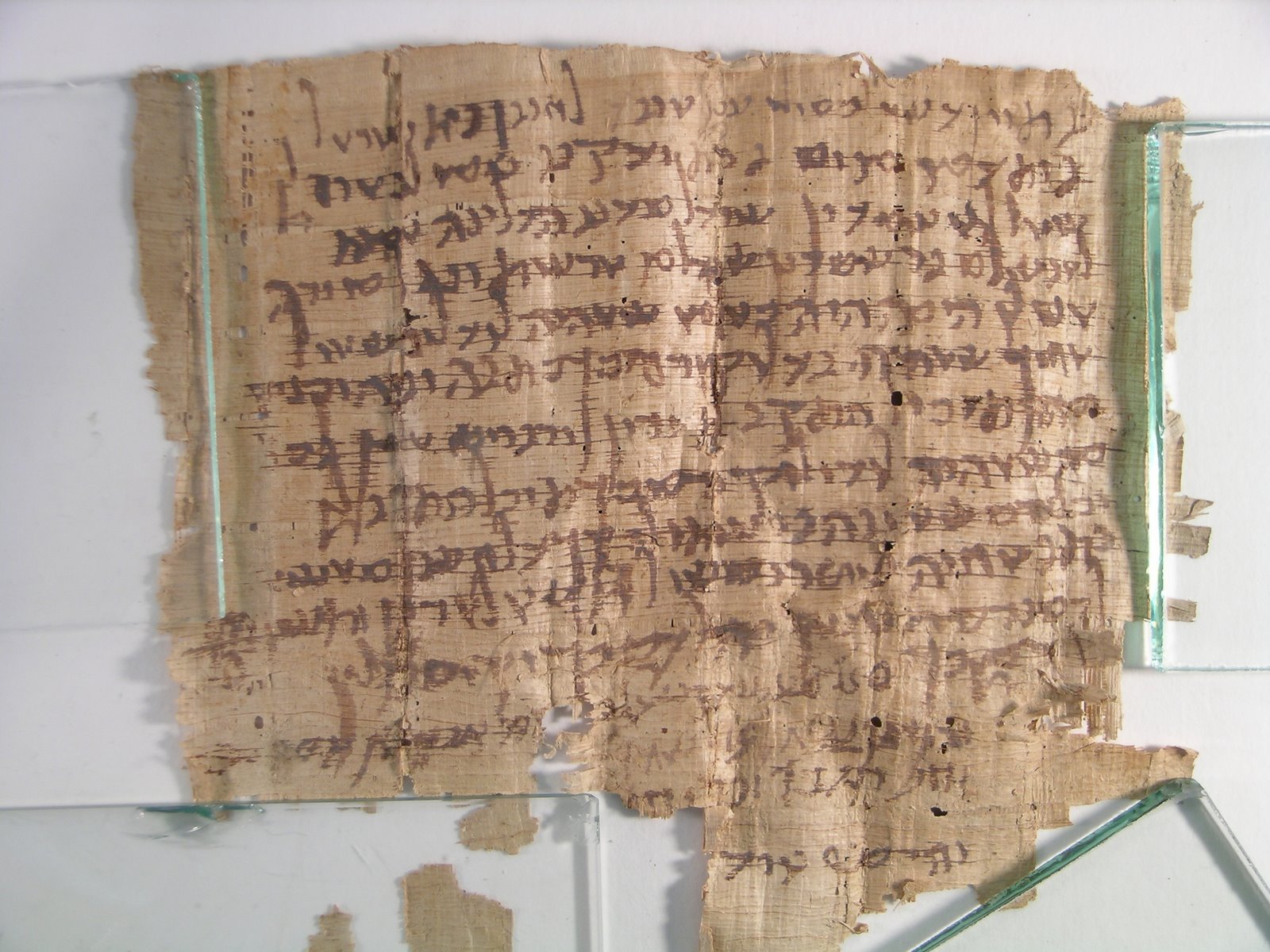
2009 Hebrew Scroll Find:
Possibly dated within four years of Temple's destruction (c. 74 A.D.):
The IAA press release:
Fifteen lines of Hebrew text, written from right to left and one below the other, can be discerned in the document. In the upper line of the text one can clearly read the sentence “Year 4 to the destruction of Israel”. This is likely to be the year 74 CE – in the event the author of the document is referring to the year when the Second Temple was destroyed during the Great Revolt. Another possibility is the year 139 CE – in the event the author is referring to the time when the rural settlement in Judah was devastated at the end of the Bar Kokhba Revolt.The name of a woman, “Miriam Barat Ya‘aqov”, is also legible in the document followed by a name that is likely to be that of the settlement where she resided: Misalev. This is probably the settlement Salabim. The name Miriam Bat Ya‘aqov is a common name in the Second Temple period. Also mentioned in the document are the names of other people and families, the names of a number of ancient settlements from the Second Temple period and legal wording which deals with the property of a widow and her relinquishment of it."
The Bibliahebraica.blogspot comments:
"Since the find is unprovenanced, the authenticity of the scroll is officially yet to be determined. After viewing the photo, I strongly suspect it will turn out to be genuine. Finds like this of legal or business documents in Hebrew provide important data for exploring the issues of literacy and the use of Hebrew in Palestine in the 1st-2nd centuries CE. Gone are the days of simplistic models of how Hebrew all but died out, supplanted by Aramaic and Greek. Why use a nearly dead classical language to record a legal transaction? It's intended to be read and the terms understood."peace
Nazaroo
Saturday, December 11, 2010
Emerging Technology for MS Analysis
I reproduce below a recent post on a new technology for detecting the difference between "grassroots" dissemination of information, and "orchestrated campaigns". It should be obvious that if this can be detected on the internet, the same techniques should be able to establish whether for instance the Byzantine text-type is a real "grassroots" type, or an "artificial" (formal) recension.
Truthy: Visualizing the Diffusion of Information on Twitter

"Truthy [indiana.edu] is a recently developed online system to analyze and visualize the diffusion of information on Twitter. It evaluates 1,000s of tweets an hour to identify new bursts of activity around specific topics and memes, to reveal when, where and how they emerged .For instance, Truthy claims it can distinguish organically emerging grass-roots viral campaigns from those that [are] forged (i.e. 'astroturfing', which denotes political, advertising, or public relations campaigns that are formally planned by an organization, but are disguised as spontaneous, popular 'grassroots' behavior). It therefore uses a combination of text and data mining, social network analysis, and complex networks models, together with a training algorithm based on input from users who are invited to flag dubious injections.
Next to a network diagram that shows the relationships between Twitter members that retweet or mention a specific of meme, the interface also contains a meme activity timeline graph and various numerical statistics and mood-identifying semantic analysis results."
For more information, see also here. See also Tracking the Mood on Twitter.
peace,
Nazaroo