A few days ago I had the opportunity to peruse an 1891 printing of the David C. Cook Pictorial Family Bible. Family Bibles in this era often contained, either in parallel columns or as a supplement, that new scholarly translation of the Bible, the Revised Version. In this one, the RV NT was supplemental.
What interested me the most about this Bible, though, was a table of dates for the composition of the various books of the New Testament. Recall, this represented the same updated scholarship that had brought us the Revised Version. Most proponents of Marcan Priority have little idea how recently this idea came to the fore, and on how thin a layer of historical evidence it actually rests. According to the latest scholarly thinking of 1891, Matthew was the first Gospel written. The table is as follows, with dates given in years after the death of Christ in 33 AD:
Matthew 6
Mark 10
1 Peter 15
1 & 2 Thessalonians 19
Luke 23
Galatians 23
1 & 2 Corinthians, Romans 24
Ephesians - Colossians, Philemon, Hebrews 29
Acts 30
1 & 2 Timothy, Titus, 2 Peter 30
James and Jude, not so certain; supposed to be around 33
Revelation 63
John 64
1, 2, 3 John 65

Showing posts with label dating. Show all posts
Showing posts with label dating. Show all posts
Tuesday, June 12, 2012

Tuesday, September 6, 2011
Later dates for MSS: Codex W = 700 CE, P52 = II-III cent
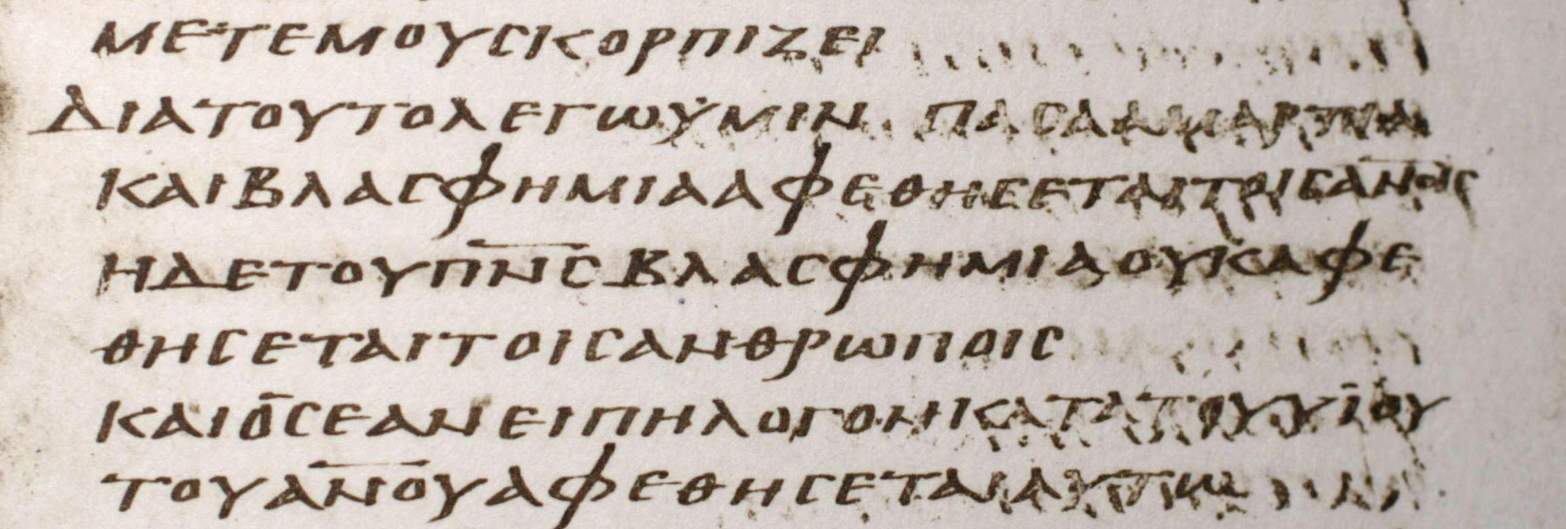
H. Houghton has reported in "Recent Developments in NT TC (2011, Early Christianity 2.2, p. 245-268:
"...There have also been developments in the dating of certain manuscripts. The Freer Gospels (032, W), famous for their unique text in the Longer Ending of Mark, were initially assigned to the fourth or fifth century. However, following the redating of the manuscripts used for the original comparison and the subsequent discovery of similar material, including the Cologne Mani Codex, Schmid has suggested that it may have been copied at least a century later. [29] Parker and Birdsall's consideration of the palaeography and catena of Codex Zacynthius (040, Ξ) prompt them to propose a date of around 700 for the majuscule underwriting, rather than Hatch's suggestion of the sixth century. [30] The date of the earliest surviving fragment of the New Testament, P52, has also been the subject of a recent review by Nongbri. [31] This cautions against the uncritical adoption of the earliest suggested date of 125 CE and demonstrates that a date in the late second or early third centuries remains palaeographically possible. As more and more comparative material becomes available online, it will not be surprising if the dating of other manuscripts is reassessed. ...
29. Ulrich Schmid, "Reassessing the Palaeography and Codicology of the Freer Gospel Manuscript," in The Freer Biblical Manuscripts: Fresh Studies of an American Treasure Trove ed. Larry W. Hurtado (SBLTCS 6. Atlanta GA: SBL, 2006), 227–49.
30. D.C. Parker and J. Neville Birdsall, "The Date of Codex Zacynthius (Ξ): A New Proposal," JTS 55.1 (2004): 117–31 (reprinted in Parker, Manuscripts, Texts, Theology, 113–20).
31. Brent Nongbri, "The Use and Abuse of P52: Papyrological Pitfalls in the Dating of the Fourth Gospel," HTR 98.1 (2005): 23–48.
It seems what has long been suspected by outsiders is turning out to have some substance and basis, namely that manuscripts generally have been dated too early, and more revisions are in the works, either by their over-enthusiastic discoverers, or else apologists.
Nazaroo
Saturday, March 5, 2011
Middleton (1892) on Vellum Production & Cost
Some interesting background on vellum for manuscripts is given in Middleton's volume:
Here is an exerpt:
One Pound Sterling (GBP) in 1892 had the purchasing power of about £72.41 today. 'Times four' that would give about £290, or $472.41 American for 150 sheets of ordinary parchment, = $3.00 per sheet in 1892, with quantities limited.
This seems quite low, and the real value should be measured instead against what an ordinary laborer could afford, or against the available resources for other community projects:
£4 (150 sheets of ordinary parchment) in 1892 converts to the following in modern money:
These numbers now give a more realistic range of values based on real conditions 100 years ago, such as expected earnings and availability of resources.
You can get estimates for purchasing power 100 years ago and today here:
Measuring Worth
You can convert to American dollars here:
Currency Conversion
peace
Nazaroo
Here is an exerpt:
Illuminated Manuscripts in Classical
and Mediaeval Times: And Their Art and ...By J. Henry MiddletonOriginally published in 1892 (reprinted. Cambridge 2010)
Chapter XIV. (p. 224-225)The Materials and Technical Processes of the Illuminator.
Vellum for scribes 1 The most remarkable skill is shown by the perfection to which the art of preparing vellum 2 for the scribe was brought. The exquisitely thin uterine vellum, which was specially used for the minutely written Anglo-Norman Vulgates of the 13th century, has been already described (see p. 113). For ivory-likebeauty of colour and texture nothing could surpass the best Italian vellum of the 15th century.One occasional use of the very thin uterine vellum should be noted.
For example in a German 12th century copy of the Vulgate, now in the corpus library in Cambridge, some fo the miniature pictures have been painted on separate pieces of uterine vellum, and then pasted into their place on the thicker vellum pages of the manuscript. This, however, is an exceptional thing.
On note 3, the cost of vellum:The vellum used for illuminated manuscripts appears to have been costly, partly on account of the skill and labour that were required for its production, and, in the case of uterine vellum on account of the great number of animals' skins that were required to provide enough material for the writing of a single manuscript such as a copy of the Vulgate.Even the commoner kind of parchment used for official documents was a rather costly thing. The roll with the Visitation expenses of Bishop Swinfield, Bishop of Hereford from 1282 to 1317, shows that 150 sheets of parchment cost 3s. 4d., about 4 lb in modern value 3.The vellum used for manuscripts has a different texture on its two sides. One side, that on which the hair grew, has a matt, unglossy surface; the other (interior) side of the skin is perfectly smooth and, in the case of the finest vellum, has a beautifully glossy texture like that of polished ivory.In writing a manuscript the scribe was careful to arrange his pages so that two glossy and two dull pages came opposite each other. 4The are of preparing vellum of the finest kind is now lost; the vellum made in England is usually spoilt first by rubbing down the surface to make it unnaturally even, and then by loading it with a sort of priming of plaster and white lead, very much like the paper of a cheap memorandum book.The best vellum is still made in Italy, especially in Rome. Good, stout, undoctored vellum of a fine, pure colour can be procured in Rome, though in limited quantities, and at a high price, 5 but nothing is now made which resembles either the finest ivory-textured vellum of 15th century Italian manuscripts, or the exquisitely thin uterine vellum of the Anglo-Norman Bibles.
1. See Peignot, Essai sur l'histoire du parchemin et du vellin, Paris, 1812.2. Strictly speaking, the word vellum should denote parchment made from calf-skin,
but the word is commonly used for any of the finer qualities of parchment which were
used for manuscripts.3. Quoted by Hook, Lives of Archbishops of Canterbury, Vol. III, p.353; the Rev. Canon G.F. Browne kindly called my attention to this passage. Other examples of the cost of vellum are given in the preceeding chapter.
4. The same arrangement is to be seen in books printed on vellum.5. For example, the mere vellum required to print a small thick folio, such as Caxton's Golden Legend, would now cost about 40 lbs.
One Pound Sterling (GBP) in 1892 had the purchasing power of about £72.41 today. 'Times four' that would give about £290, or $472.41 American for 150 sheets of ordinary parchment, = $3.00 per sheet in 1892, with quantities limited.
This seems quite low, and the real value should be measured instead against what an ordinary laborer could afford, or against the available resources for other community projects:
£4 (150 sheets of ordinary parchment) in 1892 converts to the following in modern money:
| £322.00 | using the retail price index | A Commodity. If your are asking about the "present worth" of buying a loaf of bread, or the amount of money spent today on such things? If so, use the price index |
| £430.00 | using the GDP deflator | If the question is how much it cost compared to the present cost of materials or labor, you would use the the GDP deflator value. |
| £1,930.00 | using the average earnings | how "affordable" this would be to the average person, the compensation of a production worker is given by the average earnings figure, |
| £2,450.00 | using the per capita GDP | another estimate of how "affordable" this would be to the average person, is the GDP per capita. |
| £3,970.00 | using the share of GDP | In the past there were less materials and labor available for all projects. So to measure how important this project was to the community (vs. other projects) use the share of GDP indicator. |
These numbers now give a more realistic range of values based on real conditions 100 years ago, such as expected earnings and availability of resources.
You can get estimates for purchasing power 100 years ago and today here:
Measuring Worth
You can convert to American dollars here:
Currency Conversion
peace
Nazaroo
Friday, February 25, 2011
Sinaiticus & Mark's Ending (Pt 12): The Dating Bombshell
Earlier we posted a chart showing the Quire structure of Sinaiticus, but left some portions of the chart unexplained. Now we turn to this problem, specifically the following blip on the radar screen:
Now these pages are certainly also written by Scribe A, and identified as such by the British Museum Official Website. In fact, the second half of page 76-7 verso could hardly have been written by anyone else, given that the first half was clearly done the previous day by him:

Just as Mr. Scrivener has described Alexandrinus on his blog, we see the first letters of paragraphs fully 'outdented' into the margin, and enlarged! What is Scribe A doing? He finishes this page and also the whole last folio of the Quire (76) in the same format (this shows by the way that the text was written Quire by Quire: the next Quire begins again with the expected 'regular' style).
The answer is obvious, but not welcome. Scribe A has slipped into his own habitual way of copying MSS. He's forgotten what he's doing. He completes the Quire without even noticing this major gaffe.
But this is the most important and stunning piece of information we have yet gathered about Scribe A, the scriptorium, and specifically, the date of the manuscript's manufacture.
As Mr. Scrivener has noted for us, Alexandrinus was made no earlier than about 380 A.D. (Dating Alexandrinus) This was the time that this style of calligraphy was popular and even standard, and not before. Scribe A has tipped his hand, and perhaps not accidentally at that, but even slyly. And Scribe D has not noticed this boner, but it is such a disfigurement of the style of the codex that surely Scribe D would have yanked out the bottom sheet of the Quire and replaced the 1st and 8th folios to fix it.
Why then were the Scribes trying carefully to copy the style of a manuscript written about 100 years earlier? The answer is obvious here too. They wanted to give it the look and feel, the prestige, perhaps even the authority of an earlier manuscript. Why? Because this is what the rich patron who was paying for this expensive copy wanted. Like an early Roman copy of Greek 'gods', this manuscript is actually a reproduction, not a real early 4th century manuscript.
Is it a forgery? No. Not exactly. In fact, as a comparison to Codex B shows, the scribes were indeed copying from a much older master-copy, presenting a very early text. Thus it is in some sense just what it purporting to be: the text of an early 4th century manuscript. This was probably a stylistic choice dictated by the artistic vogue of the later period. But the point is, its just an early reproduction.
Hort Knew Sinaiticus was Late:
This fact did not pass unnoticed, even by Hort himself. He did not dare openly suggest a date 80 years later than the one supposed by Tischendorf and accepted by most other critics on his authority. But Hort carefully and quite clearly indicated that he knew this codex was much later than Codex Vaticanus. As Mr. Scrivener noted in another context on his blog ( copy generations ) :
It makes perfect sense however, if Sinaiticus is actually a reproduction, made in the same or a similar scriptorium, but 80-100 years later. The original master used by Vaticanus was probably now long gone, but a copy several generations later was still available, reflecting essentially the same archetype as Vaticanus, but with subsequent layers of copying errors.
Thus Hort knew that Sinaiticus betrayed itself as a later text with a subsequent accumulation of further corruption, explaining well its differences from Vaticanus, and Hort's own preference for Vaticanus.
Other Examples:
What other manuscripts also exhibit this similar and quite unique style of "outdenting"?
Codex Φ (Beratinus, GA-043) from the 6th century also displays the same style, with marginal notes placed around the Outdented Letters in the very same way:


Although this manuscript Codex Φ (GA-043) is in very bad shape, you can see that it was once a beautiful piece of caligraphy in the same style as Alexandrinus (5th cent.) and these unusual pages of Sinaiticus from Quire 76.
peace
Nazaroo
 | ||
| Two and a Half Pages of Bizarre! |
First 2 columns normal: Last two in style of Alexandrinus!
 |
| 76-7 verso: Click to Enlarge, backbutton to return |

Just as Mr. Scrivener has described Alexandrinus on his blog, we see the first letters of paragraphs fully 'outdented' into the margin, and enlarged! What is Scribe A doing? He finishes this page and also the whole last folio of the Quire (76) in the same format (this shows by the way that the text was written Quire by Quire: the next Quire begins again with the expected 'regular' style).
The answer is obvious, but not welcome. Scribe A has slipped into his own habitual way of copying MSS. He's forgotten what he's doing. He completes the Quire without even noticing this major gaffe.
But this is the most important and stunning piece of information we have yet gathered about Scribe A, the scriptorium, and specifically, the date of the manuscript's manufacture.
As Mr. Scrivener has noted for us, Alexandrinus was made no earlier than about 380 A.D. (Dating Alexandrinus) This was the time that this style of calligraphy was popular and even standard, and not before. Scribe A has tipped his hand, and perhaps not accidentally at that, but even slyly. And Scribe D has not noticed this boner, but it is such a disfigurement of the style of the codex that surely Scribe D would have yanked out the bottom sheet of the Quire and replaced the 1st and 8th folios to fix it.
Why then were the Scribes trying carefully to copy the style of a manuscript written about 100 years earlier? The answer is obvious here too. They wanted to give it the look and feel, the prestige, perhaps even the authority of an earlier manuscript. Why? Because this is what the rich patron who was paying for this expensive copy wanted. Like an early Roman copy of Greek 'gods', this manuscript is actually a reproduction, not a real early 4th century manuscript.
Is it a forgery? No. Not exactly. In fact, as a comparison to Codex B shows, the scribes were indeed copying from a much older master-copy, presenting a very early text. Thus it is in some sense just what it purporting to be: the text of an early 4th century manuscript. This was probably a stylistic choice dictated by the artistic vogue of the later period. But the point is, its just an early reproduction.
Hort Knew Sinaiticus was Late:
This fact did not pass unnoticed, even by Hort himself. He did not dare openly suggest a date 80 years later than the one supposed by Tischendorf and accepted by most other critics on his authority. But Hort carefully and quite clearly indicated that he knew this codex was much later than Codex Vaticanus. As Mr. Scrivener noted in another context on his blog ( copy generations ) :
[Hort] does say a few things [re: Aleph/B]:Hort here clearly indicates that the subsequent history (post common-ancestor) of Codex Vaticanus is relatively short and direct. This is in contradistinction to Codex Sinaiticus, for which he posits a longer and more complex history for the text it contains. But this would make little sense if they are really closely contemporary and from the same scriptorium.
a) B and Aleph are entirely different in regard to their subsequent history, i.e., 'post-nearest common ancestor'. For Vaticanus he makes incredible claims of purity and FEWNESS of generations:
"The ancestry of B posterior to the common archetype was probably a chain of very few links indeed;..." (Hort, Introduction, ¶ 328. pg 248-9, ).
Again, speaking primarily of B's unique/subsingular readings, he says,
"the sources of corruption in B are for the most part of a sporadic and indeterminate character (cf. ¶ 204)." (Hort, Intro, ¶ 328, p.250)
It makes perfect sense however, if Sinaiticus is actually a reproduction, made in the same or a similar scriptorium, but 80-100 years later. The original master used by Vaticanus was probably now long gone, but a copy several generations later was still available, reflecting essentially the same archetype as Vaticanus, but with subsequent layers of copying errors.
Thus Hort knew that Sinaiticus betrayed itself as a later text with a subsequent accumulation of further corruption, explaining well its differences from Vaticanus, and Hort's own preference for Vaticanus.
Other Examples:
What other manuscripts also exhibit this similar and quite unique style of "outdenting"?
Codex Φ (Beratinus, GA-043) from the 6th century also displays the same style, with marginal notes placed around the Outdented Letters in the very same way:


Although this manuscript Codex Φ (GA-043) is in very bad shape, you can see that it was once a beautiful piece of caligraphy in the same style as Alexandrinus (5th cent.) and these unusual pages of Sinaiticus from Quire 76.
peace
Nazaroo
Saturday, January 8, 2011
Gary S. Dykes on Script Mensuration

Mr. Dykes notes in his paper that precision measurement of scripts and styles of copyists and scribes is not in a very advanced state. He makes careful investigations and offers conclusions and recommendations for how to put the science of handwriting measurement on a sure footing, regarding Greek MSS.
Its a virtual tour-de-force, and an excellent introduction to the problems researchers face in trying to measure and identify scribes and copyists who may or may not have authored more than one extant MS.
Mr. Dykes offers two useful files with discussions and examples in .pdf format at his site. Although these go back to 2006, they are still great reads:
http://www.biblical-data.org/TC_stuf/script_mensuration.pdf
http://www.biblical-data.org/TC_stuf/metrics_365_1319.pdf
Both are essential reading for those trying to sort out copyists and date manuscripts, and many of his ideas have an applicability which extends far beyond his own area of interest, minuscules (mr.scrivener, take note of spelling).
It appears novel that Mr. Dykes uses angles between key lines in a ligature structure, or ratios/areas in a square block of space, as these appear for his purposes to be independent of other types of measurement which turn out to be problematic, such as line width, and pen-angle.
Perhaps others can offer further leads and advances in this fascinating, but rather new area of investigation.
Nazaroo
Subscribe to:
Posts (Atom)
